





Bringing home a new puppy is exciting. You want them to feel loved, comfortable and part of the family from the moment they walk through your door. Naturally, you want to give them the freedom to explore their new home, follow you from room to room and settle wherever they please.
With over 30 years of experience providing professional dog training in Hamilton and surrounding communities, we’ve seen how giving puppies too much freedom too early can lead to unnecessary behavioural problems.
But what if that freedom is actually creating some of the very problems you’re trying to avoid?
At K9 Principles Dog Training, one of the most common mistakes we see new puppy owners make is giving their puppy too much freedom before they’ve learned how to handle it.
The result? Chewed furniture, accidents around the house, excessive puppy biting, unwanted barking, difficulty settling and an owner who feels like they’re constantly chasing their puppy around.
Here’s something every new puppy owner needs to understand: Your puppy doesn’t need the freedom of a fully trained adult dog. They need the structure and guidance that will eventually earn them that freedom.
That’s where proper puppy management, supervision, boundaries and crate training become incredibly valuable.
Too Much Freedom Is One of the Biggest Mistakes Puppy Owners Make
Imagine bringing an eight-week-old puppy into your home and immediately giving them access to your living room, kitchen, bedrooms and hallways.
What could possibly go wrong?
Quite a lot, actually!
Your puppy hasn’t learned which objects are appropriate to chew, where they’re supposed to go to the toilet, how to settle independently or what behaviour is expected inside your home.
Instead, they’re exploring their environment and discovering what works for them.
That expensive shoe makes a fantastic chew toy. The corner behind the sofa seems like a perfectly acceptable toilet. Jumping at your legs gets your attention, and running away with the television remote starts a wonderful game of chase.
From your puppy’s perspective, they’re simply having fun and learning about their surroundings.
Unfortunately, they’re also developing habits that can become increasingly difficult to change.
Many owners believe that allowing their puppy to roam freely will help them become independent.
However, independence without guidance isn’t the same as teaching appropriate behaviour.
Good puppy training starts by controlling the environment so your puppy has more opportunities to make the right choices and fewer opportunities to practise the wrong ones.
Your Puppy Hasn’t Earned the Same Freedom as Your Adult Dog
Think about the freedoms you give a well-trained adult dog.
They might sleep on the living room floor, relax while you prepare dinner, wander into another room or remain home alone without destroying anything.
Why can they do these things?
Because they’ve learned how to behave in those situations.
Now consider an eight-week-old puppy who has only just left their mother and littermates. They’re still learning about the world, have limited bladder control and haven’t developed the self-control needed to make consistently appropriate decisions.
Expecting that puppy to manage an entire house is simply unrealistic.
It’s similar to allowing a toddler to explore a home completely unsupervised and then being surprised when they get into trouble.
We don’t give young children unlimited freedom because we understand they’re still learning about safety, boundaries and expectations.
Your puppy deserves that same guidance.
The solution isn’t to restrict their freedom permanently. It’s to introduce freedom gradually as their training, maturity and reliability improve.
At K9 Principles, we encourage owners to think of freedom as something their puppy learns to manage successfully.
Freedom should increase as your puppy demonstrates they’re ready for it, not simply because they’re getting older.
Preventing Bad Habits Is Easier Than Fixing Them
One of the most important principles in dog training is understanding that behaviour develops through repetition and reinforcement.
Every time your puppy practises a behaviour, they have another opportunity to learn from the experience.
Let’s say your puppy grabs a sock from the laundry basket. You immediately chase them around the house, trying to get it back.
What did your puppy learn?
Stealing socks is exciting! It gets your attention and creates a fantastic game.
The next day, your puppy steals another sock. Before long, you’re wondering why they keep running away with your belongings.
Now imagine a different approach.
Your puppy is supervised in a puppy-proofed area, the laundry is inaccessible, and you’ve provided appropriate chew toys. When they choose an acceptable toy, you reward that choice.
Instead of repeatedly practising unwanted behaviour, your puppy is developing habits you actually want.
The same principle applies to toilet training, jumping, chewing furniture and attention-seeking behaviours.
This is why professional puppy training isn’t only about teaching commands such as sit, down and come. It’s also about preventing unwanted habits from developing in the first place.
At K9 Principles, our approach to Hamilton dog training focuses on more than teaching basic commands. We help owners understand how structure, supervision and consistency prevent unwanted behaviours before they become established habits.
Management prevents mistakes. Training teaches the behaviour you want instead.
Successful puppy owners understand that both are necessary.
Crate Training: A Valuable Tool, Not a Punishment
Few puppy training topics create as much discussion as crate training.
Some owners love using crates. Others worry that putting their puppy in a crate is unfair or that they’re somehow being unkind.
The reality is that a properly introduced crate can be an extremely useful training and management tool.
A crate shouldn’t be somewhere your puppy is sent because they’ve done something wrong. It should become a familiar, comfortable resting space where they feel safe and relaxed.
Think of it as your puppy’s own bedroom.
When introduced gradually using positive experiences, a crate can help your puppy develop healthy routines, rest without constant interruption and remain safely contained when you cannot supervise them.
Crate training can also support house training by helping you establish a predictable routine of rest, supervised activity and regular toilet opportunities. However, puppies still need frequent breaks, and confinement should never be used to force a puppy to hold their bladder longer than they’re physically able.
Crates can also be valuable later in life.
Your dog may need to be confined following surgery, during veterinary care, while travelling or when staying at a boarding facility. A dog that has already learned to relax comfortably in a crate may find these situations much easier to manage.
At K9 Principles, our Board & Train dogs live inside a real home rather than an outdoor kennel building. We incorporate appropriate crate routines into their daily lives because we recognise the long-term value of dogs being comfortable with safe confinement.
However, it’s important to understand that a crate is not a substitute for exercise, social interaction, enrichment, companionship or training.
The purpose of crate training isn’t to keep your puppy confined. It’s to teach them how to be comfortable with periods of rest and confinement when necessary.
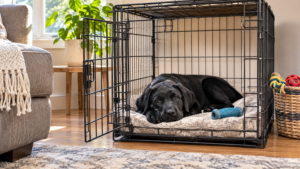
Puppies Need to Learn How to Do Absolutely Nothing
This might surprise you, but one of the most valuable skills you can teach your puppy has nothing to do with obedience commands.
It’s teaching them how to relax.
Many new puppy owners feel that their puppy needs constant entertainment. They provide endless toys, games, activities, training sessions and exercise because they believe a tired puppy must be a happy puppy.
But puppies also need plenty of sleep and quiet time.
An overtired or overstimulated puppy may become increasingly mouthy, jumpy, restless and difficult to settle. Owners sometimes respond by introducing even more activity, unintentionally making the situation worse.
Sound familiar?
Your puppy has been playing for an hour, suddenly starts biting your hands and clothing, races around the living room and seems incapable of listening to anything.
Sometimes the solution isn’t another game of fetch. It’s a toilet break followed by an opportunity to rest.
Establishing predictable routines that include appropriate activity and quiet time can make a tremendous difference.
A comfortable crate or puppy pen can be useful for teaching relaxation, provided your puppy has been introduced to that space positively and is able to settle without significant distress.
We also encourage owners to reward calm behaviour outside the crate. When your puppy lies quietly on a mat or relaxes beside you, acknowledge and reinforce that behaviour.
After all, you probably don’t want an adult dog who needs constant entertainment every waking moment.
You want a dog who can enjoy activities with you but also understands how to relax when nothing exciting is happening.
A dog that knows how to settle is often much easier to live with than one that only knows how to stay busy.
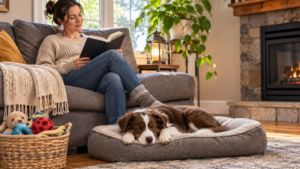
Teaching Independence Without Creating Separation Problems
Another common mistake is allowing a puppy to have constant access to their owner throughout the day.
Your puppy follows you into the kitchen, bathroom, bedroom and everywhere else you go.
Whenever you sit down, they’re beside you. Whenever you stand up, they’re immediately following.
It’s adorable, especially during those first few weeks.
However, puppies also benefit from gradually learning that they can be comfortable when you’re not directly beside them.
This doesn’t mean ignoring your puppy or forcing them to cope with frightening situations.
It means carefully introducing short, positive experiences where your puppy rests or enjoys an appropriate activity independently.
For example, you might provide a safe chew in a puppy pen while you move around the same room.
As your puppy becomes comfortable, you can gradually practise brief periods where you’re out of sight.
The key is working at a pace your puppy can handle.
It’s also important to understand that crate training does not automatically prevent separation anxiety.
Some puppies and dogs experience genuine distress when separated from their owners. Others may be frightened by confinement itself. These situations require careful assessment and an individualised training approach rather than simply leaving the puppy to cry.
If your puppy becomes panicked, attempts to escape, injures themselves or shows persistent distress, don’t assume they just need to get used to it.
At K9 Principles, we believe effective dog training means understanding the individual dog and adjusting the approach accordingly.
The goal is to build confidence and independence, not force a puppy to tolerate fear.
How to Introduce Crate Training the Right Way
Successful crate training begins with making the crate a positive part of your puppy’s everyday environment.
Start by choosing an appropriately sized crate. Your puppy should have enough room to stand comfortably, turn around and lie down naturally.
Place the crate somewhere suitable in your home and allow your puppy to investigate it without pressure.
You can encourage exploration by placing treats inside, feeding meals near or inside the crate and rewarding your puppy for entering voluntarily.
Once your puppy is comfortable going inside, begin introducing very brief periods with the door closed. Stay nearby, reward calm behaviour and gradually increase the duration as your puppy becomes more relaxed.
Don’t rush the process.
Some puppies take to crates quickly, while others need considerably more time. A puppy who is relaxed with the door open may not yet be comfortable with the door closed.
The crate should never be used as punishment, and you should avoid leaving a puppy inside for extended periods simply because it’s convenient.
Young puppies require regular opportunities to toilet, exercise, explore, interact with their families and develop social skills.
When you cannot actively supervise your puppy, a properly introduced crate can be helpful.
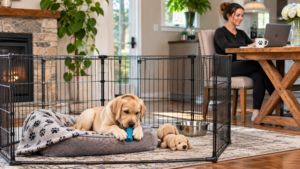
However, a secure puppy pen or puppy-proofed room may be more suitable when additional movement or longer periods of management are needed.
Baby gates can also allow your puppy to participate in family life without having unrestricted access to the entire house. Supervised tethering may be useful in certain situations, but a tethered puppy should never be left unattended.
And remember, not every puppy responds to confinement in the same way.
If your puppy becomes frightened or distressed, the answer is to reassess the training plan, not simply increase the length of confinement.
Good crate training is about creating comfort, predictability and trust.
How Much Freedom Should Your Puppy Actually Have?
There’s no magical age when every puppy suddenly becomes ready to roam freely around the house.
Some puppies develop reliable household habits relatively quickly. Others require more supervision and management, particularly during adolescence.
Rather than focusing on age alone, pay attention to your puppy’s behaviour.
Initially, your puppy should spend their active time in areas where you can supervise them and guide their choices. When you cannot supervise, provide an appropriate, safely managed space.
As toilet training improves and your puppy demonstrates appropriate chewing and settling habits, you can begin allowing access to one puppy-proofed room under supervision.
If things are going well, gradually introduce additional areas of the house.
Eventually, you can practise brief periods of independence in a safe area, increasing the duration as your puppy demonstrates reliability.
But what happens if your puppy begins having accidents, stealing items or chewing things they shouldn’t?
You’ve probably increased their freedom too quickly.
Reduce access, improve supervision and spend more time reinforcing the behaviours you want.
This isn’t a failure. It’s simply information telling you that your puppy needs more practice before moving forward.
Consider this important question: If your puppy disappears into another room for five minutes, are you confident they’ll make appropriate decisions?
If the answer is no, they’re probably not ready for that level of freedom.
One of the biggest differences we see between owners who struggle with puppy training and those who experience steady progress is consistency.
Successful owners don’t simply hope their puppy will make good choices. They create an environment where good choices are easier to make and then gradually build reliability through training.
Don’t measure your puppy’s progress by how much freedom they have. Measure it by how responsibly they use the freedom you’ve given them.
Building Better Puppy Habits With Professional Dog Training in Hamilton
Raising a well-behaved puppy involves much more than teaching a handful of obedience commands.
It requires understanding behaviour, establishing appropriate expectations, creating effective routines and knowing when to give your puppy more freedom.
For many families, the challenge isn’t a lack of effort. It’s knowing exactly what to do, when to do it and how to remain consistent while balancing work, children and everyday responsibilities.
That’s where experienced professional guidance makes a difference.
At K9 Principles Dog Training, we bring over 30 years of professional dog training experience to families throughout Hamilton, Burlington, Caledonia and the surrounding communities.
As trusted dog trainers for the Hamilton/Burlington SPCA and Hamilton Animal Services, we’ve worked with dogs of different breeds, ages, personalities and behavioural challenges.
We understand that no two puppies are exactly alike, which is why our training focuses on the individual dog rather than a one-size-fits-all approach.
Our Puppy Starter Program helps owners establish important foundations, including basic obedience, leash manners, appropriate greetings, puppy biting, jumping, household routines and the early skills that make living with a puppy more enjoyable.
For owners dealing with more specific challenges, our private dog training provides personalised, hands-on guidance in the environment where those problems are occurring.
We also offer Board & Train programs for families looking for more intensive professional training.
Unlike facilities where dogs spend their time in kennel buildings, our Board & Train dogs live inside a trainer’s home, allowing us to work on manners, structure and everyday household expectations in a real-life environment.
Of course, professional training doesn’t end when the lesson or program finishes.
We believe owners must understand how to maintain their dog’s training, which is why transferring those skills back to the family is such an important part of our approach.
Whether you’re struggling with crate training, house training, excessive biting, jumping or simply want to give your puppy the best possible start, we can help you develop a clear, practical training plan.
Don’t wait until those cute puppy habits become frustrating adult dog behaviours.
The sooner you establish appropriate boundaries, supervision and training, the easier it becomes to build a dog you can confidently enjoy throughout their life.
If you’re looking for professional puppy training in Hamilton or the surrounding area, contact K9 Principles Dog Training to discuss the program best suited to your puppy and your family.
Visit www.k9principles.ca to learn more about our puppy training, private lessons and Board & Train programs.

Every puppy owner dreams of having a dog they can trust around the house. A dog who relaxes while the family watches television, leaves household belongings alone, understands appropriate boundaries and can be comfortable without constant supervision.
But that freedom doesn’t happen automatically.
It’s developed through patience, consistency, appropriate management and training.
Crates, puppy pens, baby gates and supervised environments aren’t about preventing your puppy from enjoying life. They’re tools that help you teach your puppy how to live successfully in your home.
The goal isn’t to keep your puppy confined forever.
The goal is to raise a dog who no longer needs constant supervision because you’ve invested the time to teach them how to behave.
At K9 Principles, we believe great dog training starts long before unwanted behaviours become established habits. Whether you’re bringing home your first puppy or struggling with unwanted behaviours, K9 Principles provides professional dog training in Hamilton, Burlington, Caledonia and surrounding communities to help you build the foundation for a well-mannered dog.
Give your puppy the guidance they need today, and you’ll be working towards the freedom you both want tomorrow.
If you’re looking for professional dog training in Hamilton, Burlington, Caledonia, or the surrounding communities, we’re here to help.
Visit www.k9principles.ca to learn more about our private training programmes and take the first step towards a calmer, more confident dog.
Contact us for more information:
- Name: K9 Principles
- Address: Haldimand County, Greater Hamilton Area, Burlington, and Most of Norfolk County
- Phone: 289 880-3382
- Email: k9principlesinc@gmail.com
- Website: www.k9principles.ca
FAQs
-
A1. Crate training isn’t inherently cruel. When a crate is introduced gradually, associated with positive experiences and used appropriately, it can provide a comfortable resting space and valuable management tool. However, crates should never be used as punishment, for excessive confinement or as a substitute for meeting a puppy’s physical and emotional needs. If a puppy experiences significant distress in a crate, the training approach should be reassessed.
