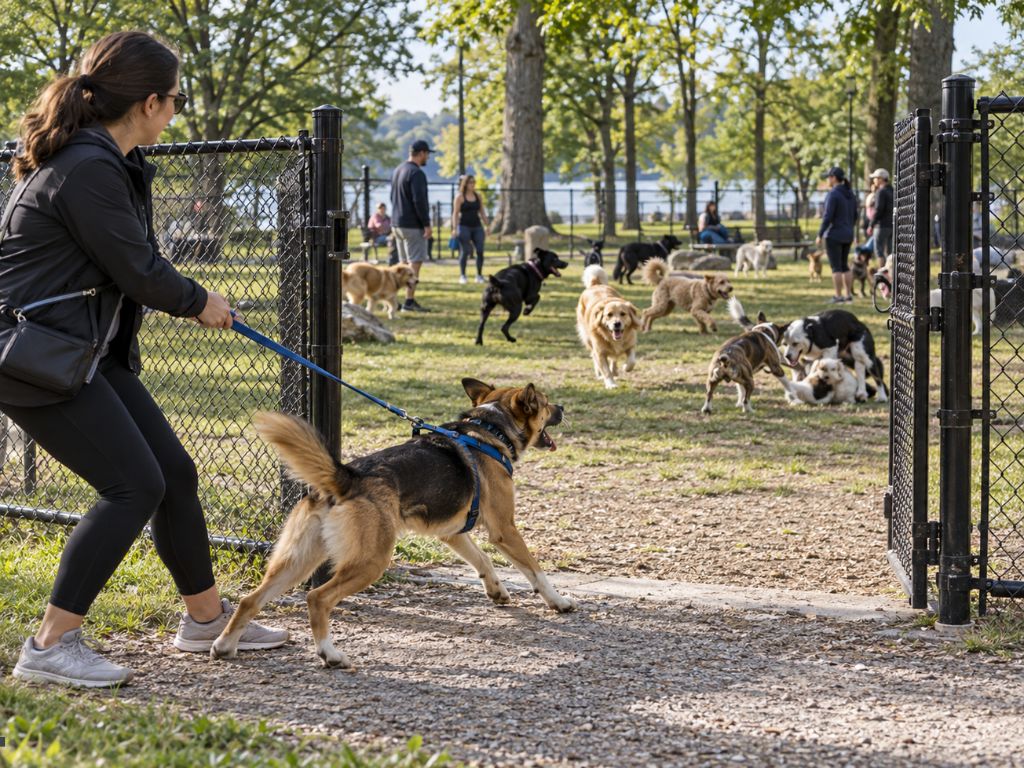





Dog parks are often presented as one of the best ways to exercise and socialise a dog. You open the gate, let your dog run, and assume the experience is helping them become more comfortable around other dogs.
Sometimes it does.
But what looks like healthy socialisation to us is not always what the dog is learning.
At K9 Principles, one of the biggest misunderstandings we see is the belief that a well-socialised dog should want to greet and play with every dog they meet. In reality, good dog training should help a dog remain calm, confident and responsive around other dogs without automatically expecting interaction.
That difference matters.
A dog who regularly races into a dog park may begin learning that the sight of another dog predicts excitement, access and play. Later, when that same dog sees another dog while walking on leash, frustration can develop because access is suddenly restricted.
The result may be pulling, whining, barking or lunging.
That does not necessarily mean the dog has suddenly become aggressive. In some cases, the dog has simply learned to expect interaction whenever another dog appears.
Dog parks can also expose dogs to poor play, bullying, excessive arousal, frightening interactions and dogs whose owners have limited control over them.
This does not mean every dog park visit is harmful. It does mean owners should look beyond the idea that more dog interaction automatically creates better socialisation.
As professional trainers providing dog training in Hamilton and the surrounding area, our goal is to help owners understand what their dogs are actually learning from these experiences and whether those lessons support the behaviour they want in everyday life.
Socialisation Is More Than Playing With Other Dogs
The word socialisation is often misunderstood.
Many owners picture puppies wrestling together or dogs running through a park. They assume the more dogs their puppy meets, the better socialised that puppy will become.
Socialisation is much broader than that.
It involves helping a dog become comfortable with the world around them, including people, dogs, traffic, different surfaces, noises, environments, handling and everyday situations.
One of the most useful social skills a dog can develop is neutrality.
A neutral dog can notice another dog without feeling compelled to greet it. They can continue walking, remain beside their owner or work in a training class while other dogs are nearby.
From a practical Hamilton dog training perspective, that skill is often far more valuable than teaching a dog that every unfamiliar dog is a potential playmate.
Adult dogs may also become more selective as they mature.
A puppy that played happily with almost every dog at five months old may prefer only a handful of familiar dogs later in life. Some dogs simply tolerate other dogs without wanting much interaction.
That is not necessarily a problem.
Trying to force social interaction onto a dog that clearly prefers distance can actually create stress.
Good socialisation should build confidence, not pressure a dog into situations they would rather avoid.
The Biggest Dog Park Problem Is Unpredictability
You may know your own dog extremely well, but you have no control over what comes through the dog park gate.
The next dog may be socially appropriate and easygoing. They may also be fearful, possessive, overexcited, pushy, poorly trained or aggressive.
You usually do not know their history, and sometimes their owner does not fully understand their behaviour either.
Dog parks also combine dogs with very different play styles.
One dog may enjoy chasing while another prefers wrestling. One may tolerate rough physical play while another quickly becomes uncomfortable.
Neither dog needs to be aggressive for a conflict to develop.
Problems become harder to manage when several dogs are interacting at once. Excitement spreads quickly, owners may be standing at a distance, and subtle changes in body language are easily missed.
Even if your dog has an excellent recall, another dog may not.
That lack of control is one of the main reasons public dog parks are very different from carefully planned social interactions.
Controlled environments allow owners or trainers to select appropriate dogs, monitor the interaction closely and stop it before problems escalate.
At a public dog park, much of that control disappears.
Overarousal Can Create Problems Outside the Dog Park
Many dog park issues begin with excitement.
Your dog recognises the route, starts whining in the vehicle, sees dogs through the fence and drags you towards the entrance. The leash comes off and the dog explodes into play.
The dog may be enjoying themselves, but their level of arousal is also climbing.
As arousal increases, impulse control often decreases.
A highly excited dog may struggle to recall, disengage from another dog, respond to cues or notice that another dog is uncomfortable.
If this pattern happens frequently, the dog becomes very practised at becoming intensely excited around other dogs.
That learning can carry into everyday life.
The dog sees another dog during a walk and immediately stares, pulls or stops listening.
This is an important principle in dog training: dogs are learning all the time, not only during formal training sessions.
Repeated behaviour becomes familiar behaviour.
If your dog repeatedly practises rushing towards dogs, ignoring you and becoming highly aroused, those patterns can become stronger.
Owners sometimes spend the week working on calm leash walking and engagement, then unintentionally reward the opposite behaviour at the dog park.
The goal is not to prevent excitement. Dogs should have fun.
The goal is to teach dogs that excitement does not mean they lose all ability to respond to their owner.
When Dog Play Stops Being Healthy Play
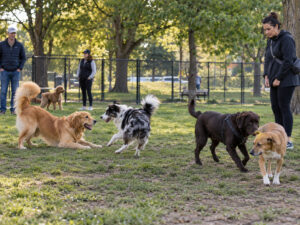
Healthy dog play can look rough.
Dogs chase, wrestle, growl, mouth one another and knock each other over. None of those behaviours automatically mean there is a problem.
The key is whether both dogs continue to participate willingly.
Appropriate play often includes loose body language, pauses, role changes and opportunities to disengage.
One dog may chase and then become the one being chased. Dogs may stop briefly before voluntarily returning to play.
Problems start when one dog is clearly trying to end the interaction and the other refuses to allow it.
For example, one dog may continually chase another around the perimeter of the park while the second dog tries to hide behind people or reach the gate.
Someone may say, “He just wants to play.”
That may be true, but the other dog does not.
Repeated mounting, body slamming, cornering, pinning or relentless chasing should not be dismissed simply because the dog initiating it is friendly.
Friendly dogs can still behave inappropriately.
This is where canine body language becomes important.
A wagging tail alone does not tell you whether a dog is comfortable. Look at the dog’s entire body.
Stiffness, freezing, avoidance, repeated attempts to leave, hiding or suddenly stopping participation are all signals worth paying attention to.
Owners who recognise these signs early can intervene before the interaction escalates.
That ability is valuable well beyond the dog park and forms an important part of responsible dog training in Hamilton.
Dog Parks Can Weaken Recall and Owner Engagement
Many owners discover that their dog listens beautifully at home but seems to forget everything around other dogs.
The environment has changed, and so has the value of the competing distractions.
Calling a dog away from another dog is much harder than calling them across the living room.
If the dog has also spent months learning that other dogs are the most rewarding thing in the environment, that challenge becomes even greater.
Recall problems can worsen when owners repeatedly call while the dog ignores them.
The cue begins to lose meaning.
Another common mistake happens when the dog finally returns and the owner immediately attaches the leash and leaves.
The dog may begin learning that coming back ends the fun.
Reliable recall needs to be built gradually.
We teach the behaviour first, then increase distractions as the dog becomes more capable.
Expecting a developing recall to suddenly work in the middle of a crowded dog park may be asking too much too soon.
The same is true of engagement.
Dogs should be allowed to explore, sniff and enjoy themselves, but they should also be capable of reconnecting with their owner when asked.
At K9 Principles, our Hamilton dog training approach focuses heavily on foundations because strong skills give dogs more freedom later.
A dog that can disengage and return when called is much easier to safely manage in real-world situations.
Dog Parks Can Contribute to Leash Reactivity
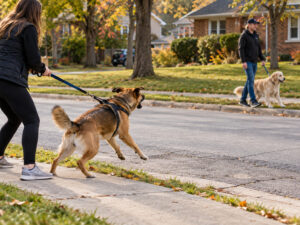
Not every dog that barks or lunges at another dog is trying to drive that dog away.
Some are frustrated because they want to reach it.
This can happen when dogs become accustomed to unrestricted access to other dogs.
If seeing another dog usually leads to greeting or play, the dog may begin expecting that outcome.
Then one day they see another dog while restrained by a leash.
They pull.
The owner holds them back.
They become more frustrated.
Pulling turns into whining, barking or lunging.
Over time, this can become a well-established pattern.
Dog parks are not responsible for every case of leash reactivity. Fear, genetics, negative experiences and other forms of frustration can all contribute.
But repeatedly teaching a dog that another dog predicts interaction can make calm neutrality harder.
This is why we do not recommend allowing dogs to greet every dog they encounter.
During dog training in Hamilton, we often work towards a much more practical skill: seeing another dog and continuing on.
That reduces pressure on both the dog and owner and makes neighbourhood walks much easier to manage.
For dogs already showing reactivity, the first step is understanding why the behaviour is occurring.
A frustrated social dog and a fearful dog may both bark and lunge, but they require different considerations within the training plan.
One Bad Experience Can Change Future Behaviour
Dogs can learn quickly from frightening experiences.
They do not need to suffer a serious injury for an incident to affect how they feel about other dogs.
Being chased, cornered, pinned or overwhelmed may be enough to change future behaviour.
A dog who previously approached other dogs comfortably may suddenly become hesitant after a bad interaction.
On the next walk, they may freeze, stare, bark or lunge when another dog approaches.
From the owner’s perspective, it can seem as though the behaviour appeared overnight.
From the dog’s perspective, the reaction may be an attempt to prevent another unpleasant experience.
If barking causes the other dog to move away, the behaviour can become even stronger because it worked.
This is particularly important with puppies and adolescent dogs.
Young dogs are still developing their view of the world. Positive experiences can build confidence, while overwhelming experiences can create lasting concerns.
Owners often bring puppies to dog parks because they have been told socialisation is essential.
The intention is good, but uncontrolled groups are not always the best environment for a developing puppy.
A carefully selected adult dog, structured puppy class or controlled social experience may provide far greater value.
When owners contact us for puppy dog training in Hamilton, we focus on quality rather than quantity.
The goal is not to expose the puppy to as many dogs as possible.
The goal is to create useful experiences that build confidence and appropriate behaviour.
The Human Side of Dog Park Problems
The dogs are only part of what determines whether a dog park experience goes well.
The people supervising them matter just as much.
Some owners recognise body language quickly and interrupt inappropriate play. Others may be distracted, standing far away or unaware that their dog is making another dog uncomfortable.
This is where problems can escalate.
You may remove your dog from an interaction, only to have the other dog continue following.
You may ask someone to call their dog and hear, “Don’t worry, he’s friendly.”
Friendly does not automatically mean appropriate.
Another common belief is that dogs should simply “work it out.”
Small misunderstandings can sometimes resolve naturally, but repeatedly allowing dogs to escalate until one finally reacts is risky.
Owners should advocate for their dogs before a conflict occurs.
If your dog looks uncomfortable, create distance.
If your dog is overwhelming another dog, interrupt them.
If excitement keeps increasing, give the dogs a break.
Food and toys can add another level of unpredictability because some dogs behave very differently when valuable resources are involved.
At K9 Principles, owner education is a major part of our dog training programs because better handling often prevents problems long before a correction or intervention becomes necessary.
Which Dogs Should Avoid Dog Parks?
Dog parks are not appropriate for every dog, and there is nothing wrong with that.
Dogs with a known history of aggression towards other dogs should not be placed into uncontrolled group settings in the hope that exposure will fix the problem.
Fearful dogs may also find dog parks overwhelming.
If a dog consistently hides, freezes, tries to leave or becomes defensive when unfamiliar dogs approach, more uncontrolled exposure is unlikely to create genuine confidence.
Dogs with significant resource guarding concerns, extremely high arousal or very poor recall may also be difficult to manage safely.
Age can matter as well.
Puppies can be overwhelmed by larger or more intense dogs, while senior dogs may have little patience for rough play or may struggle physically to escape it.
Dogs recovering from a negative social experience may need carefully planned exposure rather than another trip into a crowded park.
And some perfectly normal adult dogs simply do not enjoy playing with unfamiliar dogs.
That is okay.
Dog ownership should not be about forcing every dog into the same lifestyle.
Good dog training looks at the dog in front of us and develops the skills that allow that individual dog to live comfortably and safely with their owner.
Better Alternatives to Dog Parks
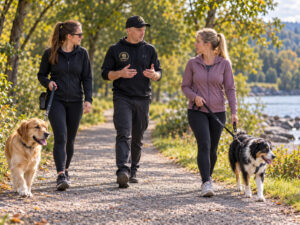
Skipping the dog park does not mean your dog has to miss out on exercise, enrichment or social experiences.
Structured walks with an appropriate dog can be extremely valuable.
Parallel walking allows dogs to move together without immediately creating the pressure of direct interaction.
Carefully selected play partners are another option.
Instead of hoping a group of unfamiliar dogs will all be compatible, owners can choose one dog whose temperament and play style suits their own.
Training classes also provide excellent social exposure.
Dogs learn to work around other dogs without interacting with them.
That teaches a useful lesson: another dog’s presence does not always mean play.
Dog sports can provide additional physical and mental stimulation.
Scent detection, rally obedience, agility and other activities allow dogs to use their brains and bodies while strengthening communication with their owners.
Even simple sniffing walks can provide a tremendous amount of enrichment.
Dogs do not need chaotic play to be fulfilled.
The best alternative will always be one that suits the individual dog.
For some, that may include carefully managed play.
For others, hiking, scent work or structured training may be far more enjoyable.
Neutrality Is a More Useful Goal Than Constant Interaction
A dog does not need to love every dog they meet.
They need to be able to function comfortably around them.
For most family dogs, that means walking past another dog without pulling, barking or becoming overwhelmed.
It means responding to their owner when distractions are present.
It means understanding that seeing another dog does not automatically mean they are going to interact.
This is one of the most practical goals we work towards through Hamilton dog training.
Imagine being able to walk along a trail while another dog passes without your dog losing focus.
Imagine sitting on a patio while another dog walks nearby and your dog simply remains relaxed.
Imagine calling your dog away from a social interaction and having them respond immediately.
Those skills create freedom.
Obedience is most useful when it improves everyday life.
Recall creates safety.
Loose leash walking makes outings easier.
Impulse control allows dogs to handle stimulating environments.
Neutrality around other dogs makes it possible to take your dog into more places without constantly worrying about what will happen when another dog appears.
The goal is not to prevent dogs from being social.
The goal is to teach them how to remain capable of making good choices while other dogs are present.
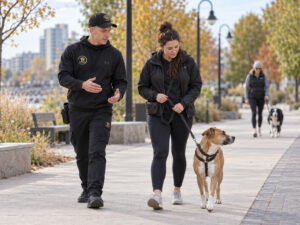
What To Do If Dog Parks Have Already Created Problems
If your dog has developed intense excitement, barking, lunging, fear or frustration around other dogs, stopping uncontrolled dog park visits may be a sensible first step.
The next step is identifying what is driving the behaviour.
Does the dog want to reach other dogs?
Are they afraid?
Are they frustrated by the leash?
Did a negative experience change their response?
Do they become so aroused that they can no longer think clearly?
Understanding the cause helps determine how training should proceed.
Dogs generally learn best when they are working at a level where they can still think and respond.
If another dog is so close that your dog is completely overwhelmed, increasing distance can make learning easier.
From there, training can focus on engagement, impulse control, appropriate responses and gradually increasing difficulty.
For owners seeking professional dog training in Hamilton, individualised training like our In-Home Private lessons can be especially useful because outwardly similar behaviours may have very different causes.
At K9 Principles, we have more than 30 years of professional dog training experience working with a wide range of behavioural concerns.
Our goal is not simply to stop the visible behaviour for the moment.
We want owners to understand why the behaviour is happening, what skills are missing and how to create better habits moving forward.
Success also should not be measured by whether your dog eventually returns to the dog park.
For many dogs, the far more valuable goal is being able to enjoy a calm walk while other dogs are nearby.
Conclusion: Your Dog Does Not Need the Dog Park to Be Well Socialised
Dog parks can be enjoyable for some dogs, but they are not an essential part of socialisation.
Simply putting dogs together does not automatically create good social skills.
What matters is what your dog is actually learning from the experience.
Are they becoming more confident and responsive, or more frustrated and overexcited?
Are they learning appropriate play, or repeatedly practising behaviour that other dogs find overwhelming?
Are they developing the ability to disengage, or learning that every dog is more important than their owner?
At K9 Principles, we believe effective dog training starts with strong foundations.
Dogs should first learn how to respond, control their impulses and work around distractions before we expect reliability in highly stimulating situations.
A well-socialised dog does not need to run towards every dog they see.
Often, the most valuable skill is being able to notice another dog and simply carry on.
If dog park experiences have contributed to reactivity, frustration, poor recall or overexcitement, professional dog training in Hamilton can help rebuild those foundations.
Your dog does not need to be everybody’s friend.
They need the confidence and training to comfortably share the world with them.
Contact us for more information:
- Name: K9 Principles
- Address: Haldimand County, Greater Hamilton Area, Burlington, and Most of Norfolk County
- Phone: 289 880-3382
- Email: k9principlesinc@gmail.com
- Website: www.k9principles.ca
FAQs
-
A1. Dog parks are not automatically bad for every dog, but they are unpredictable. Some dogs may enjoy them without difficulty, while others become overwhelmed, overexcited or frustrated. The better question is whether the environment is helping your individual dog develop useful behaviour.