







For many dog owners, getting into the car is simply part of everyday life. We drive our dogs to veterinary appointments, training classes, parks, trails, family visits, holidays and countless other places. Because travelling is so normal for us, it can be surprising when a dog finds the entire experience frightening or overwhelming.
Some dogs refuse to approach the vehicle. Others will get inside but immediately begin panting, trembling, drooling, whining or pacing. Some dogs bark continuously while the vehicle is moving, while others become physically sick. There are also dogs who look perfectly comfortable until the engine starts or the vehicle begins moving.
The important thing to understand is that calm car travel is not something every dog automatically knows how to do. For many dogs, it is a learned skill.
Just as we teach a dog to walk politely on a leash, remain on Place or stay calm around distractions, we can teach them how to behave and feel more comfortable inside a vehicle. The process usually works best when we stop thinking about “making the dog ride in the car” and instead break the experience into several smaller training exercises.
At K9 Principles, we often remind owners that strong behaviour comes from strong foundations. The same principle applies here. Before expecting a dog to calmly tolerate a long drive, we first need to make sure the dog can comfortably approach the vehicle, get inside, remain settled and handle movement without becoming overwhelmed.
Why Does My Dog Get So Stressed in the Car?
The first step is determining what part of the experience is actually causing the problem because not every dog struggling in a vehicle is struggling for the same reason.
Some dogs are frightened of the vehicle itself. They may hesitate as soon as they see the car door open, put on the brakes when walking towards it or attempt to back away. These dogs may have had limited exposure to vehicles as puppies, experienced an unpleasant event in the car or simply learned that getting into the vehicle predicts something they dislike.
Other dogs are comfortable entering the car but become anxious once the engine starts. The sound, vibration and movement can feel very unusual to a dog that has never learned how to process those sensations calmly.
Motion sickness can also play a significant role. A dog who repeatedly becomes nauseated during car trips may quickly develop a negative emotional association with the vehicle. Eventually, the dog may begin feeling anxious before the vehicle even moves because they have learned what usually happens next.
There are also dogs whose problem is not fear at all. Some become extremely over-aroused because the car predicts something exciting. Perhaps every car ride ends at the dog park, training field or favourite hiking trail. The dog begins barking, spinning, pacing or whining before the owner has even left the driveway.
Although fear and excitement look different emotionally, both can produce a dog who is unable to settle.
This is why effective Hamilton dog training should address the cause rather than simply trying to suppress the behaviour. If we misunderstand the emotional reason behind what the dog is doing, we can easily choose the wrong training approach.
Car Anxiety and Carsickness Are Not Always the Same Thing
Carsickness and car anxiety can occur independently, but they can also become closely connected.
Motion sickness can cause drooling, lip licking, swallowing, nausea, restlessness and vomiting. Younger dogs may be particularly susceptible, although dogs of any age can experience it.
Imagine that every time you entered a particular room, you became nauseated. It would not take very long before simply approaching that room made you uncomfortable. Dogs can develop the same type of association with vehicles.
A dog may initially have no emotional problem with the car at all. However, repeated experiences of feeling sick can teach the dog that the vehicle predicts discomfort. Soon the dog begins panting before the journey starts, refusing to approach the vehicle or trying to escape once inside.
At that point, there may be two separate problems to address: the physical component of motion sickness and the learned emotional response to the car.
Owners should speak with their veterinarian when a dog regularly vomits, produces excessive saliva, appears nauseated or shows significant physical distress during travel. Training can help address the behavioural association, but it should not replace appropriate veterinary care when a physical issue may be contributing.
Once the physical component has been addressed, gradual dog training can help rebuild the dog’s confidence around the vehicle.
Recognising the Early Signs of Car Stress
One of the biggest mistakes owners make is waiting until the dog’s behaviour becomes dramatic before recognising that the dog is struggling.
A dog does not need to be barking, scrambling through the vehicle or desperately trying to escape before stress is present.
Early signs can include hesitation when approaching the car, turning the head away from the open door, repeatedly licking the lips, yawning when the dog is not tired, refusing food they would normally enjoy, panting when the temperature does not justify it, holding the body unusually stiff, trembling, whining or constantly changing position.
Some dogs become unusually still. Owners sometimes interpret this as calm behaviour when the dog may actually be uncomfortable or shut down.
Pay attention to patterns.
Does the dog become worried when you pick up the car keys? Does the stress begin when the garage door opens? Does the dog happily enter but become uncomfortable when the engine starts? Does everything look fine until the vehicle begins moving?
Finding the exact point where the behaviour changes gives you a much clearer starting place for training.
If your dog is already highly distressed before the vehicle has moved, driving around for thirty minutes is unlikely to teach relaxation. Instead, begin training at the point just before the dog becomes uncomfortable.
This is a principle we use throughout dog training in Hamilton and with our private training clients: work at a level where the dog can still process information and succeed.
Build Confidence Before You Start Driving
One of the best things you can do for a dog who struggles with the car is temporarily stop making every interaction with the vehicle lead to a journey.
For many dogs, the sequence is incredibly predictable. The leash goes on, the car door opens, the dog gets inside, the door closes, the engine starts and the vehicle moves.
The dog learns that each step predicts the next.
Instead, we can break that chain.
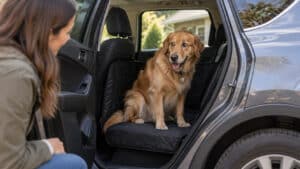
Start with something simple. Walk towards the vehicle, reward calm behaviour and then walk away again. You are not trying to get the dog inside. You are simply teaching the dog that approaching the car does not automatically mean something stressful is about to happen.
Once the dog can approach comfortably, open the door and do nothing else. Let the dog investigate. Reward calm engagement and then finish the session.
Another session might involve getting into the vehicle and immediately getting back out.
Later, the dog may sit inside the stationary vehicle for thirty seconds before leaving.
Then perhaps one minute.
Then you might close the door briefly and reopen it.
After that, you can introduce the engine while the vehicle remains parked.
This progression might sound unnecessarily slow, particularly for an owner who needs to transport their dog regularly. However, slowing the process down at the beginning often allows us to progress much more quickly later because the dog is actually learning instead of repeatedly rehearsing anxiety.
The purpose is to change the dog’s prediction.
Instead of thinking, “I am getting into the car, so now something uncomfortable is going to happen,” we want the dog to learn that being around the vehicle can be completely uneventful.
That is an important concept in Hamilton dog training generally. Calm behaviour is often created by making situations predictable and understandable rather than simply exposing the dog to more intensity.
Teach Calm Loading and Unloading
Getting into and out of the vehicle deserves to be treated as its own training exercise.
Many dogs rush into the car because they are excited. Others scramble backwards because they are worried. Some jump out the moment the door opens.
None of those behaviours create a particularly calm starting point.
Teach your dog that entering the vehicle happens on cue. Walk towards the vehicle calmly and pause before opening the door. The dog should not drag you towards the car or launch themselves inside simply because the door opens.
When you are ready, give the dog’s loading cue and encourage them into their travelling area.
Initially, reward the dog as soon as they enter. Then calmly release them back out.
Repeat the process until entering the vehicle begins to feel routine rather than emotionally significant.
The same principle applies when exiting.
Opening the door should not automatically release the dog. Ideally, the dog learns to wait until given permission to leave the vehicle.
This is helpful behaviourally, but it is also an important safety skill. A dog that immediately jumps out of a vehicle could enter a road, parking lot or other unsafe environment.
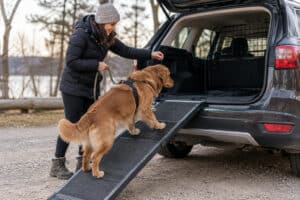
If your dog is frightened of jumping into the vehicle, consider whether the physical height is part of the problem. Large SUVs and trucks can be intimidating, particularly for smaller dogs, older dogs or dogs that have previously slipped while jumping.
A secure ramp or step can sometimes make the exercise significantly easier.
The goal is to make loading boring, predictable and controlled.
That might not sound exciting, but boring is exactly what we want.
Teach Your Dog That Their Job in the Car Is to Settle
Getting a dog into the vehicle is only half of the training.
Once inside, the dog needs to understand what they are supposed to do.
Many dogs are allowed to pace from window to window, climb between seats, bark at passing vehicles or constantly reposition themselves throughout the journey. The more they rehearse that behaviour, the more normal it becomes.
Instead, create a clearly defined travelling area.
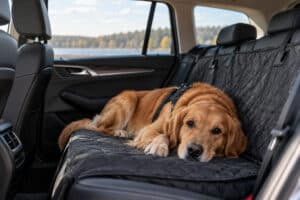
Depending on your vehicle and dog, this might be a properly secured crate or an appropriate restraint system in the back seat. The exact arrangement matters less from a training perspective than consistency and safety.
Once the dog is in position, begin teaching relaxation while the car is stationary.
This is where basic obedience becomes extremely useful.
Dogs that understand Down, Place, duration and impulse control already have a framework for remaining settled. You are simply transferring those skills into a different environment.
Start with short periods of calm behaviour in the parked vehicle. Reward the dog for lying down, relaxing and remaining in their designated space.
Avoid constantly exciting the dog with food or praise. The goal is not to create a party inside the vehicle. We want the emotional state to become quieter.
A calm “good” and occasional reward can be enough.
Once the dog can genuinely relax while parked, start the engine.
Do not immediately drive.
Allow the dog to experience the sound and vibration without anything else happening.
If the dog remains calm, turn the vehicle off and finish.
Over several sessions, the engine starting becomes another completely normal event.
This type of foundation work is why basic dog training is so valuable. Skills taught in a controlled environment eventually become tools you can use in real life.
Begin Driving With Trips That Feel Almost Too Short
When the dog can remain comfortable in the running vehicle, it is time to introduce movement.
This is where owners often progress too quickly.
The first journey does not need to be a trip around town.
Back out of the driveway and pull back in.
Drive to the end of the street and return home.
Go around the block.
The objective is not distance. The objective is maintaining the calm emotional state you created during the stationary exercises.
A three-minute journey during which the dog remains relaxed can be far more valuable than a thirty-minute journey where the dog spends the entire time panting, pacing and whining.
Watch your dog closely.
If the dog is relaxed for the first five minutes but begins showing stress after seven minutes, that tells you something important. Your current successful training window is shorter than seven minutes.
Work comfortably below that threshold and gradually extend it.
Perhaps you do several successful four-minute trips before increasing to six minutes.
Then eight.
Then ten.
Training does not have to increase every single session. Some days you may repeat an easier exercise simply to strengthen the behaviour.
We want the dog accumulating successful repetitions.
There is another useful strategy here: do not make every trip lead somewhere exciting or stressful.
Sometimes drive around the block and return home.
Sometimes visit a quiet park.
Sometimes go somewhere enjoyable.
If the only time your dog enters the vehicle is for a veterinary appointment, the vehicle can quickly become part of the prediction that something unpleasant is coming.
Likewise, if every trip ends at an extremely exciting destination, your dog may begin becoming over-aroused as soon as the car starts.
Variety helps make travelling more emotionally neutral.
Common Mistakes That Can Make Car Anxiety Worse
One of the most common approaches to car anxiety is simply taking the dog on more car rides and hoping they eventually get used to it.
That can work when a dog is only mildly inexperienced, but it can also make established anxiety significantly worse.
Exposure and desensitisation are not the same thing.
Desensitisation means introducing the dog to a difficult experience at an intensity they can successfully handle and gradually increasing that difficulty.
Repeatedly placing a terrified dog into a moving vehicle is simply repeated exposure to something frightening.
If every experience confirms the dog’s belief that the car is unpleasant, the behaviour can become stronger.
Another mistake is trying to lure a highly frightened dog into the vehicle with food.
Food can be extremely useful during training, but it should not be used to trick the dog into crossing a threshold they are not emotionally prepared to handle. If the dog follows food into the car and then suddenly realises they are trapped in the situation they fear, trust can actually decrease.
Owners may also accidentally reinforce frantic behaviour by creating a great deal of excitement around the vehicle. High-pitched encouragement, constant reassurance and repeated prompting can make the whole experience feel more significant.
Calm handling usually produces better results.
Another common mistake is waiting until the family is preparing for a long road trip before addressing the problem.
If your dog cannot calmly travel ten minutes, a six-hour holiday drive is unlikely to solve the issue.
Start training long before you actually need the skill.
This is true across dog training. We want to build behaviour before we urgently need it.
Puppies Should Learn How to Travel Before There Is a Problem
Car training is much easier when it begins before anxiety develops.
Puppies benefit enormously from early, positive exposure to vehicle travel, but the quality of those experiences matters more than simply how often the puppy rides in the car.
Start with the same foundation you would use with an older dog.
Allow the puppy to explore the stationary vehicle. Teach calm loading. Spend brief periods sitting in the vehicle without driving anywhere.
Then introduce very short journeys.
The puppy should experience different destinations so the car does not become associated with only one event.
A short drive followed by a relaxed walk can be helpful. Another journey might simply return home.
Some trips can lead to training or visiting family.
The objective is for car travel to become an ordinary part of life.
Puppies should also learn from the beginning that travelling means settling rather than climbing around the vehicle or barking through windows.
Owners sometimes allow chaotic behaviour when dogs are young because it seems harmless.
Unfortunately, those habits become much harder to change once the puppy grows into a sixty-pound adult.
Teaching the expected behaviour early is almost always easier than correcting an established habit later.
This is one reason foundational dog training matters so much. The obedience behaviours we teach are not simply exercises performed during a class. They become tools the dog can use throughout everyday life.
When Professional Dog Training Can Help With Car Anxiety

Many mild car problems can be improved through patient, structured training at home.
However, professional help can be valuable when the dog refuses to approach the vehicle, becomes highly distressed before the journey begins, cannot settle despite gradual exposure, becomes dangerous inside the car or continues getting worse despite the owner’s efforts.
The challenge is often identifying exactly where the problem begins.
An owner may think the dog hates driving when the first sign of stress actually occurs several steps earlier.
That is why working in the dog’s real environment can be particularly helpful.
With private dog training in Hamilton and the surrounding area, we can work with the owner’s actual vehicle and observe the entire sequence: approaching the car, loading, settling, starting the engine and eventually travelling.
That allows the training plan to address the dog’s individual behaviour rather than applying a generic solution.
At K9 Principles, our approach to Hamilton dog training is built around strong foundations, clear communication and helping owners understand why behaviour is happening. The goal is not simply to get the dog into the vehicle. The goal is to teach both dog and owner how to make travelling calmer, safer and more predictable.
Conclusion: Calm Car Travel Is a Skill Your Dog Can Learn
A dog who struggles in the vehicle does not necessarily need more car rides. They need better car experiences.
Start by identifying where the stress begins. Separate the process into small pieces and work on each one individually. Teach your dog to approach the vehicle calmly, enter on cue, remain in a designated area and settle before expecting them to cope with long journeys.
Once those foundations are solid, introduce movement gradually and increase the length of trips according to your dog’s emotional response rather than your desired destination.
Most importantly, avoid rushing the process.
Every calm, successful experience helps create a different association with the vehicle.
Car travel should eventually become ordinary. The dog gets in, settles, travels and gets out. There does not need to be excitement, fear or drama surrounding the experience.
If your dog is struggling with car anxiety and you would like professional help, K9 Principles offers private dog training in Hamilton, Burlington, Caledonia and surrounding areas. Working with your actual vehicle allows us to address the problem where it occurs and show you how to continue the training between lessons.
Contact us for more information:
- Name: K9 Principles
- Address: Haldimand County, Greater Hamilton Area, Burlington, and Most of Norfolk County
- Phone: 289 880-3382
- Email: k9principlesinc@gmail.com
- Website: www.k9principles.ca
FAQs
-
A1. A sudden change can happen for several reasons. Your dog may have experienced motion sickness, slipped while getting into the vehicle, been frightened by a sound, had an unpleasant experience during a previous journey or begun associating the car with a destination they dislike. Sometimes owners only notice the behaviour once it becomes obvious even though subtle signs of discomfort have been developing for some time. Try to think back to when the behaviour first appeared and identify whether anything changed around the same time.
