







You love your dog. But that does not mean living with them is always easy.
Maybe walks have become stressful. Guests arriving at the door feels like an event you need to prepare for. Your dog pulls you down the street, jumps on people, ignores you when distracted, struggles to settle, or seems to have no idea how to switch off.
You know training would help.
The problem is that life is already full.
Work, family, appointments, traffic, responsibilities, and everything else do not disappear because your dog needs more training.
That is exactly why many families begin looking into Board and Train.
But handing your dog over to someone for several weeks is a big decision. You should know what is happening while your dog is away, how they are living, what they are learning, and what happens when they come home.
At K9 Principles, Board and Train is not about taking your dog away, drilling commands for a few weeks, and handing back a completely different dog.
It is about creating better habits through structure, repetition, real-life experiences, and professional dog training that happens throughout the entire day.
Here is what really happens.
Your Dog Moves Into Our Home
One of the biggest differences between K9 Principles and many traditional Board and Train facilities is where your dog actually lives.
K9 Principles is a home-based Board and Train program located in Caledonia, Ontario, serving families throughout Hamilton, Haldimand County, the greater Toronto area, and surrounding communities.
Dogs stay inside our home.
They are not housed in outdoor kennel runs. They are not kept in a detached kennel building. They are not living in an outbuilding and brought inside only when it is time to train.
They become part of a structured household.
That matters because most owners are not looking for a dog who behaves beautifully in a kennel or training facility.
They want a dog who can live calmly inside their home.
They want a dog who understands how to settle while dinner is being made, remain on place while someone answers the door, walk politely through the neighbourhood, relax while the family watches television, and behave appropriately when life becomes busy.
The environment in which those habits are developed matters.
Training Begins With Understanding the Dog in Front of Us
Every dog arrives with a different history.
Some dogs have been through previous dog training. Others have very little formal training. Some understand commands but struggle when distractions are present. Others have learned that pulling, jumping, barking, ignoring commands, or constantly demanding attention works very well.
Before meaningful training can happen, we need to understand the dog.
We look at how the dog learns, what motivates them, where frustration appears, how quickly they become distracted, how they respond to structure, and which behaviours are creating the biggest problems in daily life.
With more than 30 years of dog-training experience, K9 Principles does not rely on one rigid method for every dog.
The goal is to teach the individual dog in front of us.
Our experience working with family dogs, sport dogs, behaviour cases, and shelter dogs through our exclusive training partnership with the Hamilton/Burlington SPCA and Hamilton Animal Services gives us a broad understanding of how different dogs learn and respond.
The First Few Days Are About Creating Structure
Many dogs arrive with one major problem that affects everything else.
There is very little structure in their day.
That does not mean the owner has done anything wrong. Modern life is busy, and dogs are remarkably good at creating their own routines when nobody has clearly shown them what is expected.
During Board and Train, we immediately begin creating predictable patterns.
There are times for activity, times for training, times for resting, times for going outside, and times when the dog simply needs to settle and do nothing.
That last skill can be surprisingly difficult for some dogs.
A dog who constantly follows people, demands attention, reacts to every sound, paces through the house, or struggles to relax often needs to learn that calm behaviour is part of everyday life.
Structure helps remove uncertainty.
When dogs begin understanding what is expected, many start making better decisions without needing constant correction or direction.
Formal Training Is Only Part of the Day
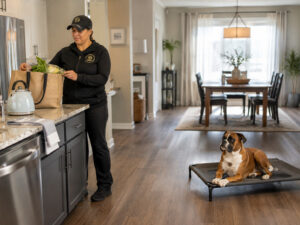 There are structured training sessions during a K9 Principles Board and Train.
Depending on the program, your dog may work on skills such as sit, down, place, loose-leash walking, recall, impulse control, staying in position, polite greetings, or off-leash obedience.
But the most important training often happens between those sessions.
A dog can learn to sit perfectly during a ten-minute training session and still drag someone through the front door five minutes later.
That is why we train throughout real life.
When your dog comes out of their crate, there is an opportunity to practise calm behaviour.
When we go through a doorway, there is an opportunity to practise impulse control.
When we walk through the house, there is an opportunity to reinforce following direction.
When someone is preparing food, there is an opportunity to practise place.
When another dog moves through the room, there is an opportunity to practise neutrality.
When we go outside, there is an opportunity to reinforce leash manners and engagement.
Dog training becomes part of the day instead of something that only happens when a training session officially begins.
Your Dog Learns How to Live Calmly Inside a Home
A well-trained dog is not simply a dog who knows commands.
They also need household manners.
This is one of the biggest advantages of a home-based Board and Train program.
Dogs learn inside the type of environment where their owners actually need the behaviour.
We work on settling.
We work on waiting.
We work on being calm around everyday movement.
We work on giving people space instead of constantly demanding interaction.
We work on staying on place while normal household activity continues around them.
These skills may not look dramatic in a training video, but they can completely change what living with a dog feels like.
A dog who can calmly relax while you cook dinner is easier to live with.
A dog who can stay on place while someone enters the house is easier to live with.
A dog who can switch off instead of constantly searching for stimulation is easier to live with.
That is the real goal.
Training Gradually Moves Into the Real World
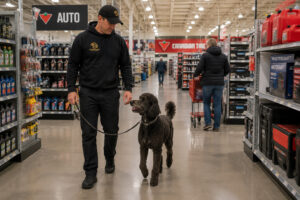 Dogs are extremely good at learning where certain rules apply.
A dog may walk beautifully inside a quiet training room and completely forget everything the moment they step into a busy parking lot.
That is why training needs to move beyond one environment.
As your dog progresses, training may take place in neighbourhoods, parks, parking lots, pet-friendly stores, retail environments, or other suitable public locations.
The specific environments depend on the dog, their training program, and what they are ready to handle.
We do not simply throw dogs into overwhelming situations and hope they figure it out.
Distractions are introduced progressively.
The purpose is to teach the dog that the same expectations still apply when the world becomes more interesting.
This is a major part of effective dog training in Hamilton and the surrounding area because owners do not live inside controlled training rooms.
They walk through busy neighbourhoods. They visit parks. They pass other dogs. They take their dogs into stores. They have people arrive at their homes.
Training needs to prepare the dog for real life.
Good Behaviour Is Repeated Until It Becomes Familiar
Dogs become good at what they practise.
Unfortunately, that applies to unwanted behaviour just as much as good behaviour.
A dog who pulls every day becomes extremely experienced at pulling.
A dog who charges through every doorway becomes very good at charging through doors.
A dog who ignores five recall commands before finally returning has practised ignoring recall five times.
Board and Train gives us the ability to interrupt those patterns and replace them with better ones through repetition and consistency.
Your dog is practising throughout the entire day.
Not once.
Not occasionally.
Repeatedly.
That repetition is one of the biggest reasons Board and Train can create meaningful progress in a relatively short period of time.
The dog begins discovering that calmer, more controlled behaviour is simply how life works. 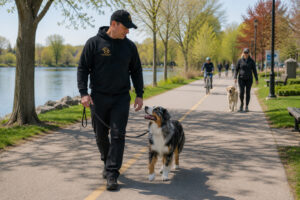
We Are Not Trying to Create a Robot
Some owners worry that professional Board and Train will remove their dog’s personality.
That is not the goal.
Your dog should still be your dog.
They should still enjoy playing, exploring, interacting, relaxing, and being part of the family.
Training simply creates clearer boundaries around those activities.
Freedom becomes easier to provide when the dog understands how to respond when asked.
A dog with reliable recall can often enjoy more freedom.
A dog with better impulse control can participate in more family activities.
A dog who understands place can be included when guests visit instead of constantly being removed from the situation.
Good training should expand a dog’s life rather than shrink it.
You Receive Progress Updates While Your Dog Is With Us
Leaving your dog for Board and Train can feel strange, especially during the first few days.
Owners naturally want to know how their dog is doing.
K9 Principles provides frequent progress updates throughout the program, including photos and videos where appropriate.
These updates allow you to see the training process developing rather than only seeing the finished result.
You may see the first stages of a new behaviour, progress in leash walking, improved place work, greater calmness, or the dog beginning to work around more distractions.
It also helps owners understand that improvement is a process.
Training develops over time through repetition, clarity, and consistent expectations.
Coming Home Is Part of the Training Program
One of the biggest misconceptions about Board and Train is that the program ends when the dog gets dropped back home.
It does not.
Your dog may have learned new skills and developed better habits, but you still need to understand how those skills were created and how to maintain them.
That is why owner education and private follow-up lessons are such an important part of K9 Principles Board and Train programs.
Depending on the program, private lessons are included to teach you how to communicate with your dog, use the training properly, reinforce expectations, and continue building on what your dog has learned.
This is where the work transfers from our home to yours.
We are not simply showing you what your dog can do for us.
We are teaching you how to get the same behaviour.
Board and Train Is Not a Permanent Magic Fix
Board and Train can create tremendous progress.
It can give a dog a much stronger foundation. It can replace poor habits with better ones. It can create structure, improve obedience, develop calmer behaviour, and make everyday life significantly easier.
But dogs are living animals.
Training requires maintenance.
If every expectation disappears once the dog returns home, old habits can gradually return.
That is why we are very clear with owners about what needs to continue.
The good news is that maintaining training is normally much easier than building it from the beginning.
Instead of trying to create every behaviour yourself while juggling work, family, and daily responsibilities, you are receiving a dog who already understands the system.
Your job is to continue using it.
And if questions arise later, K9 Principles Board and Train programs include lifetime email and telephone support.
You are not expected to figure everything out on your own once your dog comes home.
The Real Goal Is to Make Life With Your Dog Easier
The purpose of Board and Train is not to produce impressive obedience videos.
Those can be fun to watch, but they are not the real measure of success.
The real measure is what happens at home.
Can you walk your dog without fighting the leash?
Can you sit down in the evening without your dog constantly demanding attention?
Can someone knock at the door without complete chaos?
Can your dog settle while life continues around them?
Can you give your dog direction and know they understand what you are asking?
Can you include your dog in more of your life because their behaviour is easier to manage?
That is what matters.
For many families searching for Hamilton dog training, the biggest benefit of Board and Train is not simply that the dog learns more commands.
It is that everyday life begins feeling manageable again.
Choosing the Right K9 Principles Board and Train Program
Different dogs need different levels of training.
K9 Principles offers several Board and Train programs based on the dog’s age, training history, goals, and the level of obedience you want to achieve.
Some dogs need a strong introduction to household manners and basic obedience.
Others need a more comprehensive program.
Some owners are looking specifically for advanced off-leash control.
You can explore the full range of programs on our K9 Principles Board and Train page, where you can compare program length, training goals, age requirements, and what is included.
You may also find our related articles helpful, including Why Home-Based Board and Train Is Different from Kennel-Style Training, Board and Train Is Not a Magic Fix—But It Can Change Daily Life, and How Board and Train Helps Create a Calmer, More Peaceful Home.
These articles explain more about the philosophy behind our programs and what owners should realistically expect from professional Board and Train.
What Really Happens During Board and Train? A Lot of Ordinary Life
Perhaps the best way to understand K9 Principles Board and Train is this:
Your dog spends several weeks living a structured version of normal life.
They walk.
They rest.
They eat.
They go outside.
They travel in the vehicle.
They visit appropriate public environments.
They practise obedience.
They learn household manners.
They experience distractions.
They learn how to settle.
And through all of those ordinary moments, training is happening.
That is what creates the change.
It is not one brilliant training session.
It is hundreds of small, consistent interactions that teach the dog what behaviour works and what is expected.
For busy or overwhelmed owners, that level of daily consistency can be extremely difficult to create on their own.
Board and Train gives the dog an opportunity to build those habits first, so the owner has a much stronger foundation to continue when the dog returns home.
A Better-Trained Dog Can Change the Way Home Feels
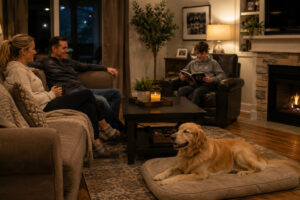 When a dog’s behaviour is difficult, it can quietly affect the entire household.
You plan around walks.
You manage the front door.
You worry about visitors.
You avoid certain places.
You spend a surprising amount of mental energy thinking about what the dog might do next.
Good training can change that.
Not because your dog suddenly becomes perfect.
But because communication becomes clearer.
Expectations become more predictable.
Your dog understands more.
You understand how to guide them.
And daily life becomes calmer.
If you are considering Board and Train and want to understand which program would be the best fit for your dog, explore the K9 Principles Board and Train programs or submit an enquiry through our website.
K9 Principles is based in Caledonia and provides home-based Board and Train for families throughout Hamilton, Haldimand County, the greater Toronto area, and surrounding communities.
Your dog does not need to become a different dog.
They may simply need the structure, training, and guidance that allows the best version of them to become easier to live with.
Contact us for more information:
- Name: K9 Principles
- Address: Haldimand County, Greater Hamilton Area, Burlington, and Most of Norfolk County
- Phone: 289 880-3382
- Email: k9principlesinc@gmail.com
- Website: www.k9principles.ca
FAQs
-
A1. Your dog stays inside the K9 Principles home in Caledonia. Dogs are not housed in outdoor kennel runs, detached kennel buildings, or outbuildings. This allows training to happen within a real household environment where everyday manners can be developed naturally.
