







There is a point many dog owners reach where life with their dog simply feels harder than it should.
Every walk becomes work. Guests arriving at the door creates chaos. The dog will not settle when the family wants to relax. Jumping, pulling, barking, ignoring commands and constant over-excitement slowly become part of everyday life.
You may know what you want your dog to do. You may even understand some of the training involved. The problem is finding enough time, consistency and energy to change the behaviour while still handling work, family and everything else life demands.
That is where Board and Train can make an enormous difference.
But it is important to understand what Board and Train really is.
It is not a magical reset button. Your dog does not disappear for a few weeks and return permanently perfect.
What a properly designed Board and Train program can do is something far more valuable: build a strong foundation of training, structure and better habits that can dramatically change what everyday life with your dog feels like.
Board and Train Should Never Be Sold as Magic
Any dog trainer who promises that your dog will return home permanently “fixed” is giving you an unrealistic picture of dog training.
Dogs are living animals. Their behaviour is influenced by training, environment, routine, reinforcement, excitement, stress and the people around them.
Even a beautifully trained dog still needs clear expectations and consistency after returning home.
At K9 Principles, we believe owners deserve an honest explanation of what Board and Train can accomplish.
Our job is to do the intensive daily training that many busy families simply cannot fit into their schedules. We establish structure, build reliable skills, develop better habits and teach the dog how to make calmer choices.
Then we teach you how to maintain those changes at home.
That combination can completely change the experience of living with your dog.
What Board and Train Can Change
The biggest changes are often not flashy obedience exercises.
They are the small things that happen dozens of times every day.
Your dog waits instead of exploding through the doorway.
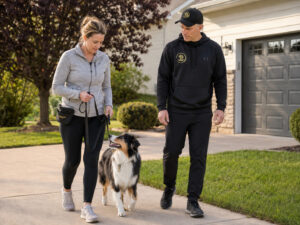
Your dog walks beside you instead of dragging you down the pavement.
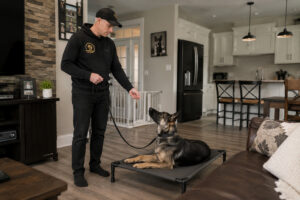
Your dog goes to place while dinner is being prepared.
Your dog settles in the house rather than constantly pacing, demanding attention or looking for trouble.
Your dog begins responding when asked instead of turning every simple request into a negotiation.
These changes create something many overwhelmed owners desperately want: breathing room.
Good dog training makes daily life easier because the dog begins understanding what is expected.
That is one of the main goals behind K9 Principles Board and Train programs.
Why Repetition Changes Behaviour
Dogs do not develop reliable habits because something was practised three times during a training session.
Reliable behaviour comes from repetition.
A dog needs opportunities to practise the same expectations again and again until those responses become familiar.
That is one of the biggest advantages of Board and Train.
During a home-based Board and Train program, training is not limited to one formal session in the morning and another in the afternoon.
It happens throughout the day.
Walking through doors becomes training.
Getting out of the crate becomes training.
Meal preparation becomes training.
Going outside becomes training.
Relaxing while people move around the house becomes training.
Walks become training.
Loading into the vehicle becomes training.
Waiting calmly becomes training.
Real life provides hundreds of small opportunities to reinforce better behaviour.
That repetition is extremely difficult for many working families to reproduce while managing everything else in their lives.
Our Dogs Live in a Home—Because Real Life Matters
Not all Board and Train programs operate the same way.
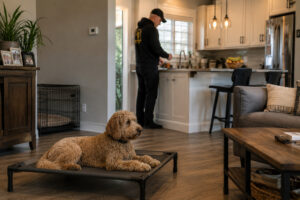
At K9 Principles, dogs live inside our home in Caledonia during their program.
They are not housed in outdoor kennel runs. They are not kept in detached kennel buildings or outbuildings and brought out only when it is time for a training session.
That difference matters.
If the goal is to teach a dog how to behave better inside a family home, we believe the dog should actually practise living in one.
Home life presents situations that a traditional kennel environment cannot fully recreate.
Dogs hear doors opening. They experience household movement. They learn to settle when nothing exciting is happening. They practise calm behaviour while people eat, work, relax and move throughout the house.
These ordinary moments are where many owners struggle most.
They are also where some of the most important training happens.
For more information about how our programs work, readers can explore the main K9 Principles Board and Train page, where each program and its structure is explained in greater detail.
Structure Creates Clarity
Many behavioural problems become more difficult when a dog has very little structure.
That does not mean a dog needs to live under constant control.
It means the dog benefits from understanding what behaviours lead to success.
When should I wait?
When should I follow?
Where should I settle?
What happens when the door opens?
What should I do when someone enters the house?
What does “place” actually mean?
What happens when I feel excited?
Clear answers reduce confusion.
During Board and Train, we build structure into everyday situations so the dog repeatedly practises behaviours that make household life easier.
Over time, those behaviours begin replacing the habits that were causing stress.
Calm Behaviour Must Be Practised Too
Many owners think dog training is mainly about teaching commands.
Sit.
Down.
Stay.
Come.
Heel.
Those skills matter, but there is another skill that is often just as important.
Doing nothing.
Some dogs have never really learned how to settle.
They constantly follow people around the house, demand interaction, react to every sound, race towards doors, patrol windows or become restless whenever the environment becomes quiet.
Calmness is something dogs can practise.
A good Board and Train program creates regular opportunities for the dog to experience activity and then come back down.
They learn that not every moment needs to involve excitement.
For many families, this is one of the changes that makes the biggest difference at home.
You may also want to read our related article, How Board and Train Helps Create a Calmer, More Peaceful Home, which looks more closely at why teaching a dog to settle can transform the atmosphere inside a household.
The Goal Is Not a Robot Dog
Good dog training should not remove your dog’s personality.
A playful dog can still be playful.
An energetic dog can still enjoy running, exploring and working.
A social dog can still enjoy interacting with people.
The goal is control.
Your dog should be able to enjoy life without every moment becoming chaotic.
There is a major difference between excitement and uncontrollable excitement.
There is a difference between enthusiasm and dragging an owner down the road.
There is a difference between greeting someone and launching into them.
Training gives dogs boundaries around their behaviour.
Those boundaries make it easier for dogs to participate in more of family life.
Board and Train Does the Heavy Lifting
One of the realities of changing behaviour is that the beginning is often the hardest part.
You are teaching something new while simultaneously trying to prevent the dog from practising old habits.
That takes time.
It takes repetition.
It takes timing.
And it takes consistency.
For someone already overwhelmed by their dog’s behaviour, that can feel like another full-time job.
Board and Train allows a professional dog trainer to take responsibility for that intensive early stage.
We do the repetitions.
We establish the routines.
We build the foundation.
We work through the mistakes.
We gradually increase distractions.
We create clearer expectations.
Instead of starting from the beginning, the owner receives a dog that already understands a new system.
That is why our core philosophy is simple: we do the daily training so you can get your life back.
For families struggling to maintain training around work and family responsibilities, our article Why Dog Training Is So Hard to Maintain When Life Is Already Busy explains why lack of consistency is often a lifestyle problem rather than a lack of effort.
But You Still Have an Important Role
The owner’s role does not disappear because the dog attended Board and Train.
It simply changes.
You should not have to recreate weeks of professional training from scratch.
But you do need to understand how the training works.
That is why owner education is such an important part of the K9 Principles process.
Depending on the program, private follow-up lessons help transfer the training back into your home and daily routine.
We show you how commands have been taught, what expectations have been established and how to respond when the dog tests an old habit.
This transition is critical.
A dog may understand exactly what is expected with the trainer. The next step is teaching the dog that those same expectations apply with you.
Progress Updates Keep You Connected
Sending your dog away for training can feel like a major decision.
You should not have to wonder what is happening.
Throughout K9 Principles Board and Train programs, we provide regular progress updates that may include photographs and videos.
These updates allow owners to see what their dog is learning and how the training is progressing.
They also help prepare owners for the transition home because you are already becoming familiar with the behaviours, routines and expectations being built.
Board and Train should never feel like dropping your dog into a mystery program and hoping for the best.
You should understand the process.
What Happens After the Dog Comes Home Matters
The day your dog comes home is not the end of training.
In many ways, it is the beginning of the next stage.
The dog has spent weeks learning a clearer way of living.
Now those same habits need to become part of your household.
That does not mean you suddenly need to spend hours every day running formal training drills.
It means using what the dog already knows.
Ask for place while you prepare dinner.
Use leash structure on your walks.
Maintain doorway manners.
Follow through when you give a command.
Reward the behaviours you want repeated.
Keep expectations predictable.
These simple moments preserve the work that has already been done.
K9 Principles also provides lifetime email and telephone support with our Board and Train programs, so clients have somewhere to turn when questions come up later.
That support matters because dog training continues as life changes.
Experience Matters When You Hand Someone Your Dog
Board and Train requires trust.
You are allowing someone else to live with, handle and train your dog.
That decision should never be based on a flashy video alone.
K9 Principles brings more than 30 years of dog-training experience to our programs.
We also work as the exclusive dog-training partner for the Hamilton/Burlington SPCA and Hamilton Animal Services, giving us extensive experience working with dogs and owners with very different training needs.
Our approach is built around practical behaviour, clear communication and creating skills that matter outside a training environment.
For people searching for dog training in Hamilton, that experience becomes especially important when comparing different Board and Train programs.
Not every program has the same philosophy, living environment or level of owner support.
Home-Based Board and Train Is Different
There is an important distinction between training a dog inside a kennel facility and teaching that dog how to function inside everyday home life.
Both environments can teach obedience.
But household manners require household experience.
A dog that needs to stop jumping on visitors should practise appropriate greetings.
A dog that struggles to settle should practise settling while people go about normal activities.
A dog that lacks doorway control should encounter real doors throughout the day.
A dog that becomes demanding in the house should learn that quiet behaviour has value.
This is why the home-based model is central to K9 Principles.
Our article Why Home-Based Board and Train Is Different from Kennel-Style Training goes deeper into this distinction and explains why environment can influence the type of behaviour a dog practises throughout the program.
Serving Hamilton, Haldimand County and the Greater Toronto Area
K9 Principles is located in Caledonia, Ontario, and provides Board and Train programs for families throughout Hamilton, Haldimand County and the greater Toronto area.
For owners researching Hamilton dog training, Board and Train can be particularly valuable when traditional weekly lessons have become difficult to maintain or when behaviour is creating constant pressure at home.
It is not about replacing the relationship between dog and owner.
It is about creating a stronger starting point for that relationship.
A trained dog is easier to communicate with.
A dog with clearer boundaries is easier to live with.
A dog that understands how to settle can become part of family life without constantly creating tension.
Those are meaningful changes.
Board and Train Cannot Remove Every Future Challenge
Dogs continue learning throughout their lives.
Adolescence happens.
Routines change.
Families move.
New environments appear.
Behaviour can occasionally slip when expectations become inconsistent.
That is normal.
The value of Board and Train is not that your dog will never make another mistake.
The value is that both you and your dog now have a system to return to.
Instead of wondering what to do, you have established commands, routines and expectations.
Instead of beginning from chaos, you have a foundation.
That can make future challenges dramatically easier to manage.
It Does Not Have to Be Magic to Change Your Life
 Board and Train is not a magic fix.
It is structured, repetitive, professional dog training carried out every day in an environment designed to build better habits.
The real transformation is often found in ordinary moments.
Walking without fighting the leash.
Opening the front door without chaos.
Eating dinner while the dog rests quietly.
Having visitors over without constant management.
Giving a command and knowing your dog understands what it means.
Enjoying your dog again instead of constantly managing the next problem.
That is what good training can change.
At K9 Principles, our home-based Board and Train programs are designed to create that foundation while giving busy and overwhelmed owners relief from having to do all the difficult early training themselves.
Your dog lives in our home. We build the training, structure and better habits. Then we show you how to carry those results into your own life.
If daily life with your dog has become more stressful than enjoyable, explore the K9 Principles Board and Train programs or submit an enquiry through our website. We can help determine whether Board and Train is the right next step for you and your dog.
Contact us for more information:
- Name: K9 Principles
- Address: Haldimand County, Greater Hamilton Area, Burlington, and Most of Norfolk County
- Phone: 289 880-3382
- Email: k9principlesinc@gmail.com
- Website: www.k9principles.ca
FAQs
-
A1. No. Board and Train can create significant behavioural improvements and establish strong training foundations, but owners still need to maintain reasonable structure and consistency after the dog returns home. K9 Principles includes owner education and follow-up support to help make that transition easier.
