







You know your dog needs consistency.
You know the jumping needs to stop. The pulling needs work. The recall could be better. The barking, rushing through doors, ignoring commands or struggling to settle are making daily life harder than it should be.
You may even know exactly what you are supposed to practise.
The problem is finding the time and energy to actually do it.
After work, family responsibilities, appointments, errands, meals, household jobs and everything else that fills a normal week, dog training can quickly become another item on an already overwhelming list.
That does not mean you do not care about your dog.
It means life is busy.
And when training is inconsistent, the behaviours you are trying to change often become stronger simply because your dog keeps practising them throughout everyday life.
This is one of the biggest reasons families come to K9 Principles for Board and Train.
They are not looking for someone to magically “fix” their dog. They are looking for experienced professional help creating the structure, repetition and consistency they simply do not have enough hours in the day to provide themselves.
Knowing What to Do and Having Time to Do It Are Two Different Things
Most dog owners understand that training requires practice.
The challenge is that good dog training rarely happens through one long training session once or twice a week. Dogs learn through repetition, patterns and what happens during normal daily life.
That means working on calm behaviour when someone comes to the door.
It means reinforcing good leash manners during walks.
It means practising place while dinner is being prepared.
It means asking for patience before going through a doorway.
It means reinforcing recall when distractions appear.
It means repeating these expectations consistently enough that they begin to become normal behaviour.
None of these things sound impossible individually.
Put them together while also working a full-time job, raising children, maintaining a home and handling the rest of everyday life, and suddenly consistent dog training becomes much harder.
Your Dog Is Learning Even When You Are Not Training
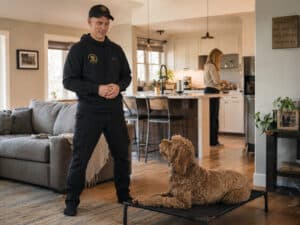
One of the most important things dog owners can understand is that dogs are learning all day.
Training does not begin when you pick up a treat pouch and say, “Let’s practise.”
Your dog is learning when they pull you towards another dog and eventually get closer to it.
They are learning when they jump at the door and receive attention.
They are learning when they bark out the window every afternoon.
They are learning when they ignore the first three recalls but eventually come on the fourth.
They are learning when they pace around the house and never practise simply switching off.
Every repetition teaches something.
That is why maintaining dog training can feel so frustrating. You may spend ten minutes practising one behaviour, while your dog spends the rest of the day rehearsing something completely different.
Inconsistency Is Usually a Lifestyle Problem, Not a Motivation Problem
Busy owners are often harder on themselves than they need to be.
They assume the problem is that they are not disciplined enough or committed enough.
Usually, that is not what we see.
The real problem is that consistent training has to compete with everything else demanding your attention.
Monday may be a great training day.
Tuesday you work late.
Wednesday the children have activities.
Thursday you are exhausted.
Friday you just want to relax.
Then the weekend arrives, errands pile up, family plans happen and suddenly another week has disappeared.
Your dog did not stop learning during that week. The established habits simply continued.
That gap between knowing what needs to happen and realistically being able to make it happen is exactly where professional training support can make a tremendous difference.
Why Small Behaviour Problems Become Big Household Problems
A dog pulling on the lead might seem manageable at first.
Jumping may feel harmless when the dog is young.
Ignoring recall may not seem serious when the backyard is fenced.
Demand barking might simply be annoying.
But behaviour rarely stays neatly contained.
Pulling makes walks unpleasant, so walks happen less often.
Jumping makes guests uncomfortable.
Poor impulse control begins showing up around doors, food, visitors and other dogs.
A dog that cannot settle creates constant movement and disruption in the home.
Eventually, the household starts changing around the dog.
You avoid certain walks.
You stop inviting people over.
You put the dog away when visitors arrive.
Family members become frustrated.
Simple routines become complicated.
This is often when owners begin searching for professional dog training in Hamilton or exploring whether a Board and Train program could help.
They are not necessarily looking for perfection.
They want everyday life to become easier again.
Good Dog Training Is Built Through Structure, Not Constant Commands
One misconception about dog training is that well-trained dogs spend their entire lives being told what to do.
Good training should actually create the opposite.
A dog that understands household structure usually requires fewer instructions because expectations become predictable.
The dog learns that rushing through doors does not work.
They learn where to settle while meals are prepared.
They learn how to walk without constantly dragging someone down the pavement.
They learn that jumping is unnecessary.
They learn that coming when called matters.
They learn how to relax when nothing exciting is happening.
Structure reduces confusion.
And when a dog understands what is expected, life generally becomes calmer for everyone.

Why Board and Train Can Help Busy Families Build Momentum
Board and Train creates something many busy households struggle to create on their own: concentrated consistency.
At K9 Principles, your dog is not simply taken out for several formal training sessions each day and then returned to a kennel.
Training is woven throughout the dog’s entire day.
That means manners around doors.
Calm behaviour inside the home.
Leash work.
Place training.
Impulse control.
Obedience.
Recall foundations.
Appropriate behaviour during feeding.
Settling while normal household activities happen.
Learning how to move through everyday life with clearer expectations.
Those repetitions add up quickly because training is not limited to a scheduled 20-minute session.
This is one of the major advantages of a properly structured residential dog training program.
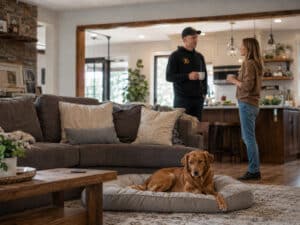
Your Dog Lives Inside Our Home
K9 Principles operates differently from many traditional kennel-based Board and Train facilities.
Dogs staying with us live inside our Caledonia home.
They are not housed in outdoor kennel runs.
They are not kept in a detached kennel building.
They are not trained for part of the day and then moved into an outbuilding for the rest.
They experience real household life.
That matters because most owners are not trying to create a competition dog that only behaves on a training field.
They want a dog that can live comfortably in their home.
A dog that can settle.
A dog that understands boundaries.
A dog that can move through doors calmly.
A dog that can relax while people eat, work, watch television or go about their normal routine.
By living inside our home, dogs have repeated opportunities to practise exactly those skills.
If you are comparing Hamilton dog training options or researching Board and Train programs throughout the greater Toronto and Hamilton area, this distinction is worth understanding.
Training Throughout the Day Changes the Learning Process
Imagine trying to teach someone a new language for 20 minutes each evening while they spend the remaining waking hours speaking their old language.
Progress would happen, but slowly.
Dog training can work the same way.
A formal session might improve a behaviour, but the greatest change often happens when the same expectations continue throughout the day.
A dog learning place may practise while meals are prepared, while someone works at a desk and while the household relaxes in the evening.
A dog learning leash manners may practise during several short outings rather than one exhausting walk.
A dog learning impulse control encounters small opportunities to practise patience again and again.
This creates repetition without making every moment feel like a formal lesson.
The goal is not simply to teach commands.
The goal is to change the dog’s daily habits.
Board and Train Is Not a Magical Reset Button
We are very clear about this.
Board and Train does not permanently install perfect behaviour into a dog.
Dogs are living animals. Behaviour changes with environment, reinforcement, routines and owner follow-through.
The advantage of Board and Train is that we can do the intensive early work for you.
We can create the foundation.
We can establish clearer expectations.
We can build stronger habits.
We can improve communication.
We can show the dog what calm, structured behaviour looks like.
Then we teach you how to continue it.
That handover matters.
Without owner education, even excellent training can gradually fade.
That is why K9 Principles includes private follow-up lessons where appropriate, along with ongoing guidance designed to help owners understand how to maintain what their dog has learned.
Our programs also include progress updates during your dog’s stay and lifetime email and telephone support, so you are not simply handed a leash at the end and expected to figure everything out yourself.
You Still Have a Role — But It Becomes More Manageable
A good Board and Train program should reduce your workload, not pretend you will never have to participate again.
Your job after training is different.
Instead of trying to build every behaviour from the beginning while also dealing with frustration and inconsistency, you are maintaining an established system.
You are reinforcing skills your dog already understands.
You are continuing routines that have already been practised.
You are learning how to communicate clearly rather than experimenting every night with a different technique you found online.
For many owners, that feels far more achievable.
We do the heavy lifting at the beginning.
Then we help you carry the training forward.
Experience Matters When You Are Trusting Someone With Your Dog
Sending your dog away for training is a significant decision.
You should know who is caring for them, how they are living and what experience stands behind the program.
K9 Principles brings more than 30 years of dog-training experience to the dogs and families we work with.
We are also the exclusive dog-training partner for the Hamilton/Burlington SPCA and Hamilton Animal Services.
That experience influences much more than how we teach sit, down or recall.
It helps us understand behaviour, recognise when a training plan needs adjusting and build programs around the individual dog rather than forcing every dog through exactly the same process.
Whether someone finds us while searching for dog training in Hamilton, Hamilton dog training, Board and Train near Hamilton or residential dog training in Southern Ontario, our focus remains the same: practical training that improves everyday life.
The Goal Is Not More Training — It Is an Easier Life
Most owners do not contact us because they want to spend more time thinking about dog training.
They contact us because they want to think about it less.
They want walks that do not feel like work.
They want visitors to arrive without chaos.
They want their dog to settle while the family relaxes.
They want better manners around doors.
They want clearer communication.
They want to enjoy their dog instead of constantly managing behaviour.
That is the real purpose of training.
A well-trained dog is not impressive simply because they know commands.
Training becomes valuable when those skills make everyday life calmer and more enjoyable.

Board and Train Can Give Busy Owners a Starting Point They Can Actually Maintain
For some families, weekly lessons are exactly what they need.
For others, life is already stretched too thin.
If you have repeatedly tried to train consistently but work schedules, family responsibilities or everyday demands keep getting in the way, Board and Train may provide the concentrated foundation your dog needs.
Our home-based Board and Train programs in Caledonia serve families throughout Haldimand County, Hamilton and the greater Toronto and Hamilton area.
Your dog lives with us inside our home, receives training throughout real daily routines and returns with a clearer understanding of the behaviours and expectations that make life easier.
You can learn more by visiting our main Board and Train programs page, where we explain the different training options available and who each program is designed for.
If you are still deciding whether residential training fits your situation, you may also want to read Why Board and Train Works for Stressed Dog Owners and How Board and Train Helps Create a Calmer, More Peaceful Home. Together, these articles explain how removing the pressure of doing every training repetition yourself can help families create better long-term routines.
You Do Not Need More Hours in the Day — You Need a Better Training System
Dog training becomes difficult when it depends entirely on finding spare time that rarely exists.
That is why so many good intentions disappear into busy schedules.
The solution is not guilt.
It is creating enough structure, repetition and professional support for new behaviours to become realistic to maintain.
K9 Principles Board and Train gives your dog the opportunity to build those habits in a real home environment while you step away from the pressure of trying to do everything yourself.
We handle the daily training.
We build the structure.
We practise the manners.
We teach the behaviours.
Then we show you how to maintain them when your dog comes home.
If life with your dog has become harder than you expected, explore the K9 Principles Board and Train programs or submit an enquiry today. We can help you determine whether Board and Train is the right next step for your dog and your household.
Contact us for more information:
- Name: K9 Principles
- Address: Haldimand County, Greater Hamilton Area, Burlington, and Most of Norfolk County
- Phone: 289 880-3382
- Email: k9principlesinc@gmail.com
- Website: www.k9principles.ca
FAQs
-
A1. Yes. Board and Train can be especially helpful for owners who understand that their dog needs consistent training but struggle to provide enough repetition around work, family and everyday responsibilities. It allows a professional trainer to establish stronger foundations before teaching the owner how to maintain them at home.
