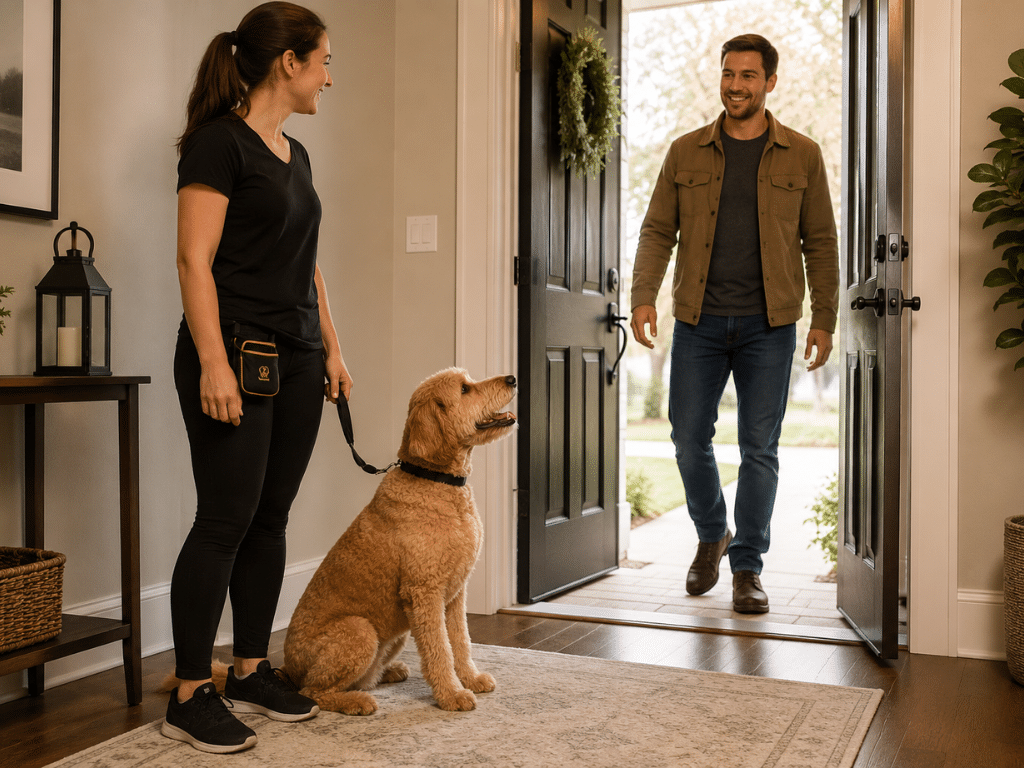




One of the most common things dog owners tell us is, “My dog is friendly, but they just get too excited.” They are not dealing with a dog that dislikes people. They are dealing with a dog that loves people so much that their brain almost falls out of their ears the second someone walks through the door, looks at them, talks to them, or comes within range. The jumping starts. The barking starts. The spinning starts. The lead pulling starts. The owner feels embarrassed, the guest feels overwhelmed, and the dog keeps rehearsing the exact behaviour everyone wants to stop. At K9 Principles, we see this all the time in our dog training in Hamilton, and the first thing we want owners to understand is this: calm greetings are not about taking away your dog’s joy. They are about teaching your dog how to handle excitement without losing control. A dog can be social, happy, affectionate, and full of personality while still learning to keep four paws on the floor, wait for permission, and greet people with manners. Calm greetings are one of the most useful life skills a dog can learn because they affect everyday life. They affect visitors coming to your home. They affect walks through your neighbourhood. They affect vet visits, grooming appointments, family gatherings, cottage weekends, camping trips, and public outings. When your dog can greet calmly, your whole life with them becomes easier, safer, and more enjoyable.
Why Calm Greetings Matter More Than Most Dog Owners Realise
Calm greetings are not just about stopping a dog from jumping on Grandma when she walks in the door. They are about building emotional control. They are about teaching the dog that excitement does not mean explosion. They are about helping owners create a dog that can think, listen, and respond even when something exciting is happening. Many owners focus on the obvious behaviour, such as jumping, barking, mouthing, or pulling, but the bigger issue is often arousal. The dog sees a person and instantly goes from zero to one hundred. Once that happens, the owner is no longer working with a thinking dog. They are working with a dog that is reacting to the moment. This is why calm greeting work is such an important part of dog training. It teaches the dog that people are not a trigger to lose control. People are a cue to check in, settle, and wait for guidance. That one shift can make a massive difference in the home and out in public. A dog that can stay calm around people is easier to walk, easier to travel with, easier to bring around family, and much easier to include in daily life. This is especially important for larger dogs, young dogs, powerful breeds, nervous dogs, and dogs that already struggle with impulse control. Even when the behaviour is friendly, it can still be unsafe. A friendly dog can scratch someone, knock over a child, frighten a visitor, or pull an owner off balance. At K9 Principles, our approach to Hamilton dog training is always practical. We are not just trying to create obedience in a training room. We are trying to create dogs that owners can live with confidently in the real world.
The Biggest Mistake Owners Make During Greetings
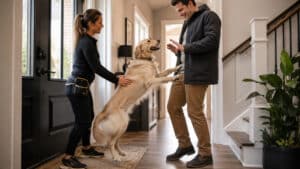
The biggest mistake most owners make is accidentally rewarding the exact behaviour they want to stop. This happens constantly, and most people do not realise they are doing it. The dog jumps, and the person touches them. The dog barks, and everyone talks to them. The dog paws, spins, or mouths, and the guest laughs, pushes them away, or says, “It’s okay, I don’t mind dogs.” To a dog, all of that can feel like engagement. Even negative attention can still be attention. If the dog’s goal is to interact with the person, then being touched, spoken to, looked at, or wrestled away may still reward the behaviour. This is why so many dogs keep jumping even when owners say “off” a hundred times. The dog has learned that jumping works. It gets people involved. It creates movement. It creates noise. It creates contact. It creates a reaction. From the dog’s point of view, the behaviour is successful. Good dog training starts by asking a simple question: what is the dog getting out of this behaviour? In greeting situations, the answer is often access to people, attention, excitement, or relief from frustration. Once we understand that, we can change the pattern. Calm behaviour should create access. Chaotic behaviour should not. That does not mean being harsh, angry, or unfair. It means being clear. If the dog jumps, the greeting pauses. If the dog barks and lunges, the dog does not move closer. If the dog pulls towards someone on a walk, they do not get to drag the owner over. If the dog can sit, check in, keep four paws on the floor, or wait calmly, then access can happen. This simple shift is often where calm greetings begin.
Calm Does Not Mean Cold, Robotic, or Unfriendly
Some owners worry that if they ask their dog to greet calmly, they are somehow taking away their dog’s personality. They may say, “But he just loves people,” or “She is only excited,” or “I do not want him to stop being social.” This is understandable, but it misses the point. Calm greeting training does not teach a dog to dislike people. It teaches the dog that access to people comes through self-control. A calm dog can still wag their tail. A calm dog can still enjoy attention. A calm dog can still be social, affectionate, and happy. The difference is that the dog is not throwing their body at people, screaming at the door, dragging the owner across the pavement, or making every greeting feel like a wrestling match. In our dog training in Hamilton, we often explain it this way: excitement is not the problem. Uncontrolled excitement is the problem. A dog that is excited but still able to listen is in a much better place than a dog that is so overstimulated they cannot respond to anything. Calm greetings give the dog a framework. They teach the dog how to get what they want in a way that works for the household, the guest, and the owner. This is a fairer system for the dog because instead of constantly being corrected for making poor choices, they are taught exactly what good choices look like. That is where real progress happens.
What a Calm Greeting Should Actually Look Like
A calm greeting does not have to look the same for every dog. This is important because too many owners think there is only one correct picture. For one dog, a calm greeting might mean sitting beside the owner while the guest enters. For another dog, it might mean going to a place bed and waiting until released. For another dog, it might mean walking past people on a loose lead without trying to meet them. For a nervous dog, a calm greeting might mean not greeting at all until they feel safe. The goal is not to force every dog into the same mould. The goal is to create a greeting routine that gives the dog clarity and gives the owner control. At a basic level, a calm greeting usually means the dog is not jumping, barking excessively, mouthing, pawing, rushing, pulling, or invading space. The dog should be able to remain mentally available. That means they can hear the owner, respond to cues, and settle after the exciting moment passes. A dog that cannot recover after a greeting is not truly calm. They may have stopped jumping, but if they are still panting, pacing, whining, or fixating, they are still over-aroused. This is why calm greeting work should not stop at “sit.” A sit is only useful if the dog is actually learning self-control. Many dogs can sit while vibrating with excitement, then explode the second they are released. Proper dog training looks deeper than the position. We want to teach the dog to regulate themselves, not just hold a shape for two seconds.
Why Dogs Jump, Bark, Pull, Mouth, or Spin When Greeting People
Dogs struggle with greetings for different reasons, and understanding the reason matters. Some dogs jump because they have been rewarded for it since puppyhood. Everyone laughed when the puppy jumped, picked them up, talked to them, and made a big fuss. Then the puppy grew into a stronger adolescent dog, and suddenly the same behaviour was no longer cute. Other dogs jump because they are trying to reach faces and hands. Some bark because they are frustrated and want access faster. Some bark because they are nervous and unsure. Some mouth because they are overstimulated and do not know what else to do with their excitement. Some spin, leap, and pace because the arrival of people has become a major event in the home. This is why it is not enough to label the dog as “friendly” or “bad.” The behaviour needs to be understood. A happy, social dog that jumps on guests needs a different plan than a fearful dog that barks at visitors from across the room. A frustrated greeter on a walk needs a different plan than a dog that guards the owner from approaching people. At K9 Principles, we look at the full picture because good Hamilton dog training should never be based on guessing. We look at the dog’s body language, history, intensity, recovery time, environment, and what the dog is trying to achieve. Once the reason behind the behaviour is clearer, the training plan becomes much more effective.
Impulse Control Is the Foundation of Calm Greetings
Calm greetings are really impulse control in disguise. The dog wants something, and they need to learn that they cannot have it by throwing themselves at it. That lesson applies far beyond greetings. It applies to doors, food bowls, toys, other dogs, people, smells, wildlife, and distractions on walks. When a dog learns impulse control, they learn how to pause before acting. They learn that waiting can be rewarding. They learn that checking in with the owner can open doors, both literally and figuratively. This is why foundation work matters so much. A dog that cannot sit still in the kitchen when nothing is happening will likely struggle to sit calmly when guests arrive. A dog that cannot walk on a loose lead in a quiet area will likely struggle to pass people on a busy street. A dog that cannot stay on a place bed when the house is calm will likely struggle when the doorbell rings. Owners often want to fix the big, dramatic behaviour first, but the answer is usually built through smaller skills practised consistently. Sit, down, stay, place, loose lead walking, engagement, recall, threshold manners, and calm release cues all support calm greetings. This is why dog training should never be viewed as a collection of random cues. Each skill should connect to real life. When taught properly, those foundation skills become tools the owner can use when the dog is excited, distracted, or unsure.
Teaching Your Dog That Calm Behaviour Opens the Door
One of the most powerful lessons a dog can learn is that calm behaviour creates access. This means the dog begins to understand that calm choices make good things happen, while pushy choices delay what they want. If the dog jumps at the door, the door does not open yet. If the dog barks and lunges towards a guest, they do not move closer yet. If the dog pulls towards a person on a walk, they do not get to greet yet. If the dog keeps four paws on the floor, checks in, sits, waits, or remains on place, then the greeting can move forward. This is not about withholding everything from the dog. It is about making the path to reward very clear. The dog is not left guessing. They learn, “When I do this, I get access. When I do that, the access pauses.” For many dogs, this is a game-changer. Owners also need to understand that timing matters. If the dog jumps and then sits for half a second, and the person immediately explodes into an excited greeting, the dog may not learn calmness. They may learn that sitting briefly is part of the launch sequence. We want the dog to actually settle into the behaviour before the greeting happens. In our dog training in Hamilton, we often slow the whole process down. The slower the owner moves, the clearer the dog becomes. Rushing greetings usually creates more chaos. Controlled greetings create better learning.
Why Your Guests Need Training Too
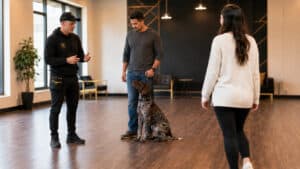
One of the hardest parts of teaching calm greetings is not always the dog. Sometimes it is the people. Guests often mean well, but they can easily undo the owner’s work. They walk in with high energy, bend over the dog, talk in an excited voice, wave their hands, laugh when the dog jumps, or say, “Oh, it’s fine, I love dogs.” The problem is that the dog hears all of that as permission to continue. If owners want calm greetings, guests need rules too. Before someone enters the home, the owner should explain what they need. The guest should know not to talk to the dog immediately, not to touch the dog while they are jumping, not to encourage excitement, and not to ignore the owner’s instructions. This can feel awkward at first, but it is necessary. Your dog cannot learn a consistent rule if every visitor plays by a different one. The same applies on walks. Strangers may ask to pet your dog, or they may reach without asking. Owners need to feel comfortable advocating for their dog. A simple, calm response such as, “We are training, so we are not greeting right now,” can protect the dog’s progress. This is especially important for puppies, nervous dogs, reactive dogs, and dogs that are working through overexcitement. Good dog training is not only about teaching the dog. It is also about teaching the humans how to support the dog properly.
Door Greetings: Stopping the Explosion at the Front Door
The front door is one of the most exciting places in the house for many dogs. It predicts visitors, movement, voices, shoes, bags, food deliveries, family members returning home, and sometimes other dogs. By the time the guest is standing inside the doorway, many dogs are already over their threshold. This is why waiting until the dog is already jumping all over someone is too late. Door greeting training should start before the guest enters. The dog may need to be on lead, behind a barrier, on a place bed, or held at a distance where they can still think. The owner should control the setup instead of hoping the dog makes a good decision in the most exciting moment. For some dogs, place training is the best option. The dog learns that when the doorbell rings or someone knocks, their job is to go to place and stay there until released. For other dogs, a lead may be used so the owner can prevent jumping while rewarding calm behaviour. The key is that the dog should not be allowed to rehearse the same chaotic greeting again and again. Every time the dog charges the door and jumps on someone, the habit gets stronger. This does not mean the dog can never say hello. It means the greeting should only happen when the dog is calm enough to handle it. In Hamilton dog training, we often remind owners that management is not failure. Management prevents rehearsal, and prevention gives training a chance to work.

Walk Greetings: Your Dog Does Not Need to Meet Everyone
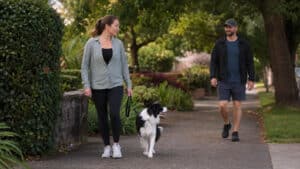
Many greeting problems on walks come from the belief that a social dog should meet everyone. Owners often allow puppies or young dogs to greet every person they pass because they think it is good socialisation. The issue is that the dog can begin to expect access every time they see someone. Then, when access is not allowed, frustration builds. The dog starts pulling, whining, barking, bouncing, or lunging because they have learned that people are always available. This is not calm social behaviour. This is entitlement and frustration. A well-trained dog should be able to see people without needing to interact with them. That does not mean your dog can never greet someone on a walk. It means greetings should be permission-based, controlled, and occasional. The dog should learn that most people are just part of the environment. They are not an automatic invitation. This is a major part of practical dog training because the real world is full of people. Your dog will see neighbours, children, joggers, cyclists, workers, delivery drivers, and other dog owners. If every person becomes a trigger for excitement, walks become stressful. If the dog learns to pass calmly, check in, and stay on a loose lead, walks become far more enjoyable. For many owners looking for dog training in Hamilton, this is one of the biggest quality-of-life changes they can make.
Puppy Greetings: Start Before the Habit Becomes a Problem
Puppy jumping is one of the most common behaviours that owners accidentally create. When a tiny puppy jumps up, people often laugh, bend down, pick them up, talk excitedly, and reward the behaviour without meaning to. The puppy learns that jumping is a brilliant strategy. Then the puppy grows. The paws get bigger, the nails get sharper, the body gets stronger, and the behaviour becomes much less enjoyable. This is why calm greeting training should begin early. Puppies should learn that four paws on the floor earns attention. They should learn that sitting or standing calmly makes people come closer. They should learn that mouthing, jumping, barking, and grabbing clothing do not create the greeting they want. The earlier this is taught, the easier it is. Puppy owners should also be careful with how other people interact with their puppy. Everyone wants to meet the cute puppy, but not every greeting is helpful. Overly excited greetings can teach the puppy to become frantic around people. Gentle, structured greetings help the puppy build confidence and control. At K9 Principles, our puppy training focuses heavily on building the right habits before the wrong habits become deeply rehearsed. This is one of the reasons early dog training is so valuable. It is much easier to prevent a greeting problem than to undo months of practice.
Overexcited Dogs Need Structure, Not More Excitement
Some dogs are not fearful, aggressive, or unsure. They are simply overexcited. They love people, they love movement, they love attention, and they cannot control themselves when the opportunity to interact appears. Owners of these dogs are often told to “socialise them more” or “let them burn it off,” but more excitement does not always create better behaviour. In many cases, it makes the dog even more intense. If every greeting becomes a party, the dog learns to party harder. Overexcited dogs need structure. They need clear rules, calm repetition, thoughtful reward timing, and controlled access. They need to learn that excitement does not make the greeting happen faster. Calmness does. This may mean practising with familiar people first, using a lead, working at a distance, rewarding calm check-ins, and ending the greeting before the dog loses control. It may also mean teaching the dog how to disengage after saying hello. Many dogs can start a greeting, but they cannot end it. They keep jumping, licking, pawing, and pushing for more. A strong training plan teaches both parts. The dog learns how to greet and how to move away. That is real control. In our Hamilton dog training programs, we want dogs to enjoy life, but we also want them to learn that not every exciting thing needs to become an explosion.
Nervous Dogs Need Calm Greetings for a Different Reason
Not every dog that barks, jumps, rushes, or reacts during greetings is happy. Some dogs are nervous. Some are conflicted. Some want to investigate but are not fully comfortable. Some rush forward because they do not know what else to do. Some bark to create distance, even while their body moves forward. This is why owners need to be careful about forcing greetings. A nervous dog should not be pushed into interactions to “get used to it.” That can make the problem worse. Nervous dogs need space, choice, and controlled exposure. For these dogs, calm greetings may begin with no greeting at all. The dog may need to observe from a distance, stay on a place bed, remain behind a barrier, or simply be rewarded for calm behaviour while the guest ignores them. Over time, the dog can learn that people entering the home or passing on walks are not a threat and not a source of pressure. The owner’s job is to protect the dog from being overwhelmed while teaching better coping skills. This is where professional dog training can make a major difference because it helps owners read the dog more accurately. A nervous dog that is pushed too quickly may escalate. A nervous dog that is supported properly can build confidence. Calm greeting work is not only about manners for these dogs. It is about trust.
Why Corrections Alone Do Not Create Calm Greetings
Many owners try to stop greeting problems by correcting the dog every time they jump, bark, pull, or mouth. The problem is that corrections alone do not teach the dog what to do instead. The dog may learn that the owner is unhappy, but they may not understand the correct behaviour that makes the situation work. That creates confusion and frustration. A better approach is to prevent the unwanted behaviour when possible, interrupt it when necessary, and teach a clear replacement behaviour. If the dog jumps, what should they do instead? Sit. Stand calmly. Go to place. Stay beside the owner. Check in. Keep the lead loose. Move away when asked. The replacement behaviour matters because it gives the dog a path to success. At K9 Principles, we believe dog training should be clear and fair. We do not want owners constantly reacting after the dog has already made a poor choice. We want owners setting the dog up to make better choices in the first place. That means using management, rewards, structure, timing, and clear expectations. If a dog is never taught what calm greetings look like, it is unfair to expect them to figure it out during the most exciting moment of the day.
How K9 Principles Helps Build Calm, Reliable Greeting Skills
At K9 Principles, we help owners build calm greetings by looking at the whole picture. We do not simply tell people to stop their dog from jumping. We look at why the behaviour is happening, when it happens, what rewards it, how intense it is, and what skills the dog already has. From there, we create a plan that makes sense for the dog and the household. For some dogs, that plan may include place training for visitors. For others, it may include lead work, impulse control, threshold manners, controlled greetings, puppy foundation training, or private training in the home where the behaviour actually happens. This is one of the biggest benefits of working with K9 Principles for dog training in Hamilton and the surrounding areas. We focus on real life. We want owners to have dogs they can enjoy in their homes, on their walks, around their families, and out in the community. Calm greetings are not a small detail. They are a major part of creating a dog that is easier to live with. Whether your dog is jumping on guests, barking at visitors, pulling towards people on walks, or struggling to settle when excitement appears, the right training can create a much clearer path forward. Good Hamilton dog training should not leave owners feeling embarrassed, frustrated, or unsure. It should give them practical tools they can use every day.
Conclusion: Calm Greetings Are Built Through Clarity, Not Luck
Calm greetings do not happen by accident. Most dogs do not simply grow out of jumping, barking, pulling, or losing control around people. In many cases, they grow into the behaviour because it keeps being practised and rewarded. The good news is that calm greetings can be taught. Dogs can learn that four paws on the floor works better than jumping. They can learn that waiting works better than pushing. They can learn that checking in with the owner works better than dragging towards people. They can learn that guests arriving does not mean chaos. The key is clarity. Owners need to know what they want the dog to do, prevent the dog from rehearsing the wrong behaviour, reward the right behaviour, and make sure the people around the dog follow the same rules. Calm greetings are not about removing joy from your dog’s life. They are about making that joy easier to live with. When your dog can greet calmly, your home feels calmer, your walks feel easier, your guests feel more comfortable, and your dog becomes more included in everyday life. If your dog is struggling with greetings, K9 Principles can help you build a plan that is realistic, fair, and effective. Our dog training in Hamilton is designed to help owners create better manners, stronger control, and dogs they can feel proud to live with.
Conclusion:
Calm greetings do not happen by accident. Most dogs do not simply grow out of jumping, barking, pulling, or losing control around people. In many cases, they grow into the behaviour because it keeps being practised and rewarded. The good news is that calm greetings can be taught. Dogs can learn that four paws on the floor works better than jumping. They can learn that waiting works better than pushing. They can learn that checking in with the owner works better than dragging towards people. They can learn that guests arriving does not mean chaos. The key is clarity. Owners need to know what they want the dog to do, prevent the dog from rehearsing the wrong behaviour, reward the right behaviour, and make sure the people around the dog follow the same rules. Calm greetings are not about removing joy from your dog’s life. They are about making that joy easier to live with. When your dog can greet calmly, your home feels calmer, your walks feel easier, your guests feel more comfortable, and your dog becomes more included in everyday life. If your dog is struggling with greetings, K9 Principles can help you build a plan that is realistic, fair, and effective. Our dog training in Hamilton is designed to help owners create better manners, stronger control, and dogs they can feel proud to live with.
Contact us for more information:
- Name: K9 Principles
- Address: Haldimand County, Greater Hamilton Area, Burlington, and Most of Norfolk County
- Phone: 289 880-3382
- Email: k9principlesinc@gmail.com
- Website: www.k9principles.ca
FAQs
-
A1. To stop your dog from jumping on guests, you need to stop allowing jumping to create attention. This means guests should not touch, talk to, or engage with your dog while they are jumping. Your dog should be taught that calm behaviour, such as four paws on the floor, sitting, standing calmly, or staying on place, is what creates access to people. Using a lead, place bed, barrier, or controlled setup can help prevent the dog from rehearsing the jumping while they learn the new rule.