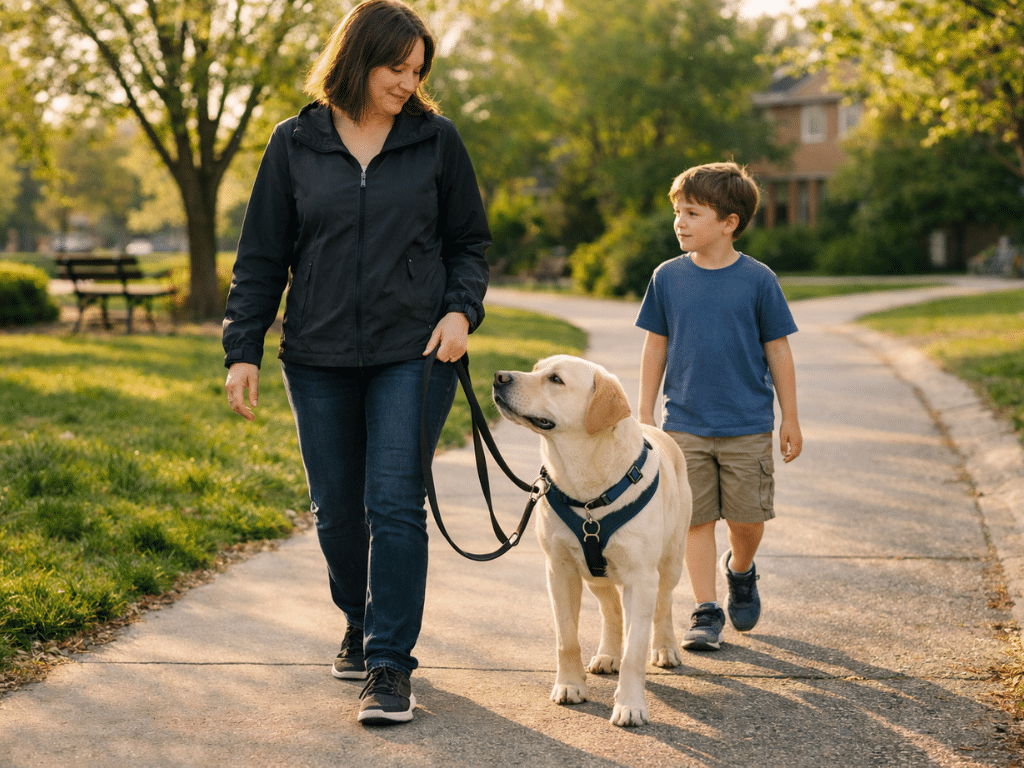





If you just brought home a rescue dog and you have kids, you are probably asking the question every good parent asks first: “How do we make this safe?” You can absolutely build a calm, safe home, but it does not happen by hoping everyone “gets used to each other.” It happens by setting the rules, controlling the environment, and teaching both the dog and the kids what calm looks like. This is exactly what we coach through with our dog training in Hamilton at K9 Principles, because safety and trust are not vibes, they are systems.
In this guide, we are going to walk you through a clear plan you can actually follow. You will learn how to set up zones, how to supervise properly, how to teach kids the right behaviour around dogs, how to spot stress signals early, and how to handle common challenges like jumping, nipping, guarding, and fear. If you are new to dog training, this will still feel doable, because we will keep it practical and real.
Start With the Goal Everyone Can Agree On
Before you train anything, get crystal clear on the target. The goal is not for your dog to “love kids” right away. The goal is for your dog to feel safe around kids, and for your kids to behave in a way that keeps the dog feeling safe. Calm coexistence is a win.
Think of it like teaching a new driver and a toddler to share the same space. You would not put them together in a tight driveway and say, “Be careful.” You would set up cones, clear lanes, rules, and supervision. That is what good dog training looks like inside a family home.
At K9 Principles, we focus on building predictable routines and clear boundaries first, because confidence grows when everyone knows what happens next.
The Non-Negotiables: Management and Supervision
If you remember one thing, make it this: kids and rescue dogs do not “figure it out” without structure. Management means the environment does some of the work for you. Supervision means an adult is actively present and ready to step in, not “kind of watching” while scrolling on a phone.
Active supervision means you are close enough to guide the moment before it goes sideways. If you cannot actively supervise, you manage instead. That might mean the dog is behind a gate, on a lead with you, or in a separate room with a calm activity. This is not punishment. This is prevention, and prevention is love.

A lot of “out of nowhere” bites are not out of nowhere at all. They are a predictable outcome of too much freedom, too much noise, and not enough adult control of the scene.
Set Up Zones That Make Calm the Default
Your home needs zones that help everyone succeed. You want at least one kid zone where the dog cannot follow, and at least one dog zone where kids cannot follow. When both sides have a place to decompress, you get fewer explosions and more calm.

A dog zone might be a mat, a crate, or a gated area where the dog can settle with a chew or food toy. A kid zone might be a playroom or a sectioned-off space where toys are everywhere and excitement is allowed. The magic is that these zones remove conflict before it starts.
At K9 Principles, we call this “building calm into the floorplan.” It is a huge part of successful Hamilton dog training in family homes, because it turns chaos into a routine.
Teach Kids the House Rules Around Dogs
Kids do not automatically know what is rude or scary to a dog. They need rules they can actually remember, and they need adults who enforce those rules every single time. You are not being strict. You are being clear.
The simplest kid rules are the most powerful: do not hug the dog, do not climb on the dog, do not grab the collar, do not put your face near the dog’s face, and do not bother the dog when the dog is eating or resting. You also want to teach kids what “leave the dog alone” looks like, because that is a skill, not a suggestion.
If your child is very young, your job is not to “teach respect” through lectures. Your job is to manage space and guide hands. We would rather see a toddler redirected and the dog protected than a child “trying to learn” by pushing boundaries with a dog that is still adjusting.
Recognise Stress Signals Before They Become a Problem
Most families wait until the dog growls, snaps, or lunges, and then they panic. The better move is learning the early signals so you can change the picture before the dog feels cornered.

Stress can look like turning the head away, licking lips, yawning when tiredness makes no sense, freezing, whale eye, backing up, hiding, pacing, panting when it is not hot, or suddenly getting “busy” sniffing the floor. Some dogs get quiet and shut down. Some get wiggly and mouthy. Both can be stress.
If your dog is giving stress signals around your kids, that does not mean the dog is bad. It means the dog is uncomfortable, and your job is to lower pressure immediately. This is where dog training becomes safety training, because your timing matters more than your intentions.
Your First Two Weeks: A Simple Integration Plan
Early on, your dog does not need to “meet everyone properly.” Your dog needs to learn that kids predict calm, not chaos. Start with short, structured exposures where your dog can be successful, and end before the dog gets overwhelmed.
We like the idea of “boring wins.” Your dog sees the kids from a comfortable distance, you reinforce calm, and nothing big happens. Your dog hears the sounds of your home, and you create a routine that says, “This house is predictable.” Meanwhile, your kids learn that the dog has a space and rules, and that calm gets them more access, not less.
If you want this to go smoothly fast, this is exactly what our In-Home Private training is built for. With dog training in Hamilton done in your real home, we can set up your zones, your supervision plan, and your routines so you are not guessing in the moment when things get busy.
Build Calm Routines That Make Everyone Safer
Most kid-and-dog problems are not really “behaviour problems.” They are routine problems. When a dog is under-rested, over-stimulated, and surrounded by unpredictable kid energy, you see more jumping, nipping, barking, and guarding. When a dog has structure, you see more calm.
Daily calm routines should include planned rest, controlled play, predictable potty breaks, and simple training moments that teach the dog how to settle and how to check in. A rescue dog does not need constant entertainment. A rescue dog needs a rhythm that lowers arousal.
At K9 Principles, we build calm with small cues that fit real family life. You are not doing a training session for an hour. You are teaching “go settle,” “come,” “leave it,” and “place” in the moments where they matter, because that is how practical Hamilton dog training works in a busy home.
Jumping Up: Stop the Chaos Without Making It a Drama
Jumping is usually a mix of excitement and history. Kids move fast, squeal, and wave hands around, and many dogs find that wildly rewarding. If your dog jumps on kids, the solution is not telling the kids to “be brave” and tolerate it. The solution is controlling access and rewarding four paws on the floor.

Start by preventing rehearsal. Use a lead, a gate, or a tether when kids are active, because every successful jump strengthens the habit. Then teach an easy alternative like sitting or going to a mat, and pay it heavily when kids are present. You can also coach kids to stand still and become “boring” if the dog jumps, but only when you can supervise closely enough to keep it safe.
This is one of those moments where a tailored plan matters. With In-Home Private training, we can build a clean routine at your front door, your hallway, or wherever the jumping happens most, because dog training in Hamilton should fit your actual layout, not a generic tip online.
Nipping and Mouthiness: What It Means and What To Do
Nipping around kids is common, and it is scary, and it needs a real plan. Sometimes it is herding behaviour, sometimes it is over-arousal, sometimes it is frustration, and sometimes it is fear. The reason matters, because the solution changes.
Your first step is always management. Kids running around with a mouthy dog in the same space is a bad combo, even if everyone means well. Put gates up, keep the dog on lead during high-energy times, and give the dog a calm job like a chew on a mat when kids are active.
Then you teach replacement skills. We want the dog to orient to you instead of to the kids’ hands, ankles, or clothes. We build a strong recall, a strong “leave it,” and a strong settle routine. We also lower the dog’s overall arousal through rest and predictable routines. If the nipping is happening because your dog is overwhelmed, you do not fix it by “correcting” the dog harder. You fix it by lowering pressure and teaching calm, which is the heart of good dog training.
Guarding: Food, Toys, Spaces, and People
Resource guarding can show up as stiffening, hovering, freezing, growling, snapping, or rushing in to grab and flee. With kids, you treat guarding as a safety issue first, not a “training challenge you can experiment with.” The biggest mistake families make is letting kids take toys away “to show the dog who is boss.” That is how bites happen.
Your immediate plan is separation around resources. Feed the dog away from kids. Pick up high-value chews and toys when kids are loose in the same room. Block access to the dog’s bed or crate so kids cannot approach. Teach kids that the dog’s stuff is off-limits, full stop.
Then you build positive associations carefully. We want the dog to learn that a person approaching predicts good things, not loss. This is the kind of work we love doing in our In-Home Private training, because we can control the picture, keep everyone safe, and build trust the right way. When people search for Hamilton dog training issues with guarding issues, what they really want is clarity and safety, and that is exactly what we bring into the home.
Fearful Rescue Dogs: How To Prevent Panic and Build Confidence
Some rescue dogs are not “naughty” around kids. They are scared. Kids can be loud, fast, and unpredictable, and a fearful dog may try to flee, hide, freeze, or escalate if they feel trapped.
Your job is to give the dog control and distance. A fearful dog should always have an escape route and a protected rest space. Do not force interactions. Do not encourage kids to “go say hi.” Let the dog choose to approach, and keep kids calm and still when the dog is nearby.
Confidence grows from predictable, low-pressure exposure. If your dog is fearful, the most helpful thing you can do is build calm routines and teach your dog where to go to feel safe. This is a big reason families choose to do their dog training in Hamilton with us, because we can coach you in real time and adjust the plan based on what your dog is telling us in your living room, not in a sterile classroom.
When You Need Professional Help Right Away
If you see hard staring, repeated freezing, growling around kids, snapping, lunging, or any bite, you do not “wait and see.” You treat that as a sign the dog is over threshold and the current setup is unsafe. You also take seriously any pattern where the dog guards spaces or resources from kids, or where a child cannot reliably follow rules.
At K9 Principles, we do not guess. We build an individual plan, we set up management that works for your home, and we coach you through the exact situations that are triggering the concern. Our In-Home Private training is designed for this, because the safest progress happens in the environment where the problem actually shows up. That is what practical dog training support looks like in the real world.
Conclusion:
If you are feeling nervous about rescue dogs and kids, that does not mean you made a mistake. It means you care enough to do it properly. Safety comes from structure, and calm coexistence comes from clear zones, real supervision, kid rules that are enforced, and routines that teach your dog what to do instead of what not to do. If you want a plan that is tailored to your home, your kids, and your rescue dog, we would love to help. Reach out to us at K9 Principles for In-Home Private training, and we will build a clear, safe path forward together through dog training in Hamilton that actually fits your life.
Contact us for more information:
- Name: K9 Principles
- Address: Haldimand County, Greater Hamilton Area, Burlington, and Most of Norfolk County
- Phone: 289 880-3382
- Email: k9principlesinc@gmail.com
- Website: www.k9principles.ca
FAQs
-
A1. Every dog is different, but most rescue dogs need weeks to months to truly relax in a home with kids because kids add movement, noise, and unpredictability. You can speed up comfort by using management, calm routines, and short, successful exposures instead of forced interactions, which is exactly what we build through Hamilton dog training plans at K9 Principles.