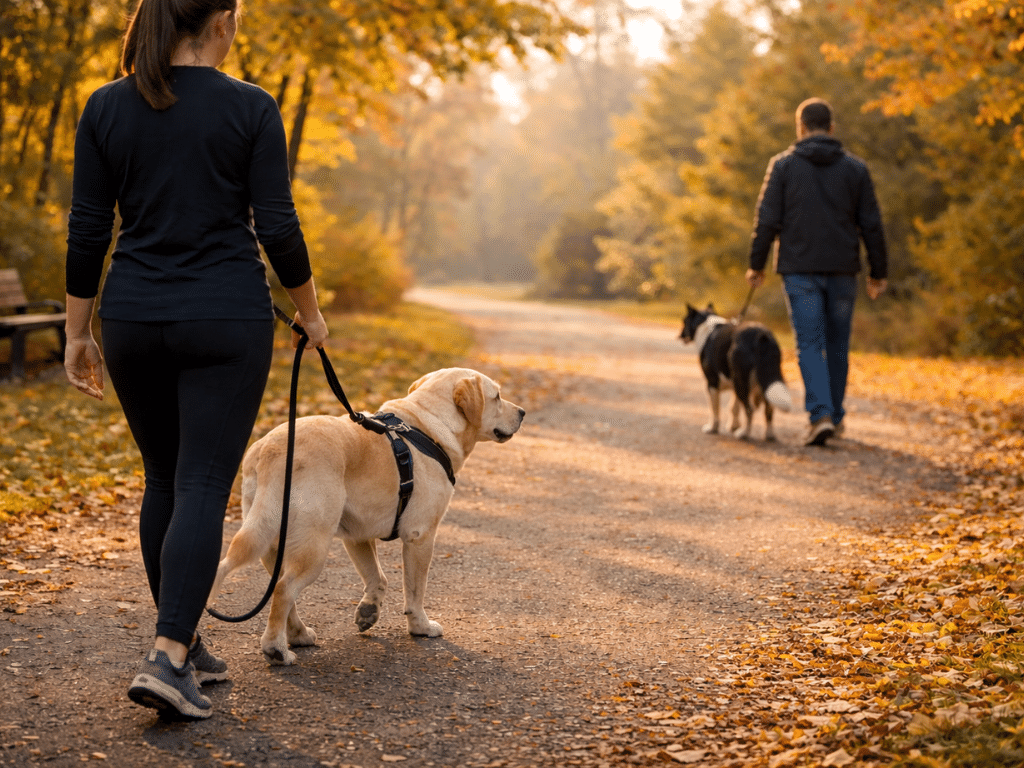





Bringing home a rescue dog can feel like the best decision you have made in ages, right up until you picture the first meeting with your current dog and think, “What if this goes sideways in ten seconds?” That fear is valid. A rushed intro can create a fight, a fear response, or months of tension that never needed to exist.
At K9 Principles, we see this all the time with our dog training in Hamilton. People mean well, they just do what looks “normal” in movies: face-to-face greetings in the doorway, excited voices, tight leads, toys everywhere, and two dogs expected to “work it out.” That is how you accidentally manufacture conflict.
This guide will walk you through a safer, calmer way to do it. You will learn how to set up first meetings, how to manage your home so nobody feels cornered, how to prevent resource conflicts before they start, and how to build positive associations gradually so both dogs can actually relax. This is practical Hamilton dog training advice you can use immediately.
The Big Mindset Shift: You Are Not Introducing “Dogs,” You Are Introducing Emotions
Two dogs can look “fine” and still be loading the emotional spring that explodes later. That is why successful introductions are less about the moment of contact and more about what each dog feels during the process.
If your resident dog feels replaced, crowded, or worried about losing space and resources, you will see guarding, hovering, blocking, or sudden snapping. If your new rescue dog feels trapped, pushed, or overwhelmed, you will see freezing, avoidance, defensiveness, or panic energy. Neither dog is “being bad.” They are protecting themselves.
The goal is simple: both dogs should feel safe enough that they can choose calm. When that happens, the behaviour follows. That is the foundation of good dog training, especially during major life changes.
Before the First Meeting: Set Your Home Up Like You’re Hosting Two Strangers
Think of it like this: you would not invite a stranger into your house and immediately lock them in a small room with your best mate and say, “Sort it out.” You would create space, structure, and clear rules. Dogs need the same courtesy.
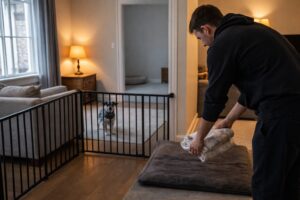
Before your rescue dog arrives, decide where each dog will rest, eat, chew, and decompress. Your resident dog should keep their normal routine as much as possible because routine is security. Your rescue dog should have a quiet decompression zone that is not “the middle of everything” and not in your resident dog’s favourite spot.
Remove triggers before they become drama. Pick up bowls, chews, bones, food puzzles, high-value toys, and anything your resident dog might guard. Even if your dog has never guarded in their life, adding a new dog can flip that switch. Preventing it is easier than fixing it later.
If you have baby gates, use them. If you do not, you can still create separation with closed doors and leash management, but gates make your life cleaner and calmer. At K9 Principles, we use simple home management constantly in our Hamilton dog training plans because it gives you safety without stress.
The First Meeting: Neutral Territory, Parallel Movement, No Pressure
The safest first meeting is not a greeting. It is a shared experience with space.
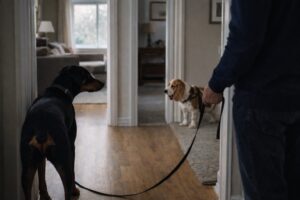
Meet outside on neutral territory, ideally somewhere quiet. Avoid your doorway. Avoid your living room. Avoid your backyard if your resident dog treats it like their personal kingdom. Start with both dogs on separate leads, handled by separate adults if possible. Keep the leads loose. Tight leads tell dogs, “Something is happening,” and they respond accordingly.
Begin with parallel walking at a distance where both dogs can notice each other without staring, stiffening, or pulling. You are looking for loose bodies, normal sniffing, ears and tails that are not locked in, and the ability to disengage. If you get that, you can gradually close the distance while still walking in the same direction. 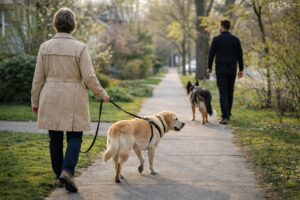
When you finally allow a brief sniff, keep it short, keep it casual, and then move on. A great early intro often looks almost boring. That is exactly what you want.
If either dog fixates, freezes, hard-stares, stalks, or surges forward, you are too close or moving too fast. Create space and go back to parallel movement. Space is not a failure. Space is the plan.
Leash Skills That Prevent Chaos: Slack, Angle, and Exit Routes
Most “disasters” happen because people accidentally trap the dogs in a social situation they cannot escape. Dogs do not like forced greetings. They like choice.
You want slack leads, not because you are being relaxed, but because slack gives dogs better body language and better decision-making. You also want angles, not head-on approaches. Head-on greetings are socially intense for dogs, especially when one or both are stressed.
Always keep an exit route. If you are in a narrow hallway, you are gambling. If you are in a wide driveway or quiet park path, you have options. If you are in your front entry with furniture and boots and a wall behind the dog, you are building a pressure cooker.
This is one of the simplest things we fix with dog training in Hamilton sessions because a tiny change in handling can turn “They hate each other” into “Oh, they can actually breathe.”
Coming Home After the Meeting: “Same House” Does Not Mean “Same Space” Yet
After a good outdoor intro, people often assume it is time to walk inside together and let them mingle. That is where things often fall apart. Indoor space is tighter, more valuable, and full of resources. Even friendly dogs can get snappy inside on day one.
Bring the rescue dog into the home calmly and set them up in their decompression zone. Your resident dog should have normal access to you, normal reassurance, and normal routine. You are not “showing them who is boss.” You are showing them nothing is being taken away.
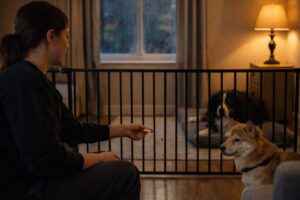
Use gates or separation to allow both dogs to see and smell each other without being forced into contact. This is where calm begins. The goal is not constant interaction. The goal is peaceful co-existence that slowly becomes friendship.
If you are thinking, “But shouldn’t they work it out?” No. Dogs that “work it out” often practise conflict until it becomes a habit. We would rather practise calm until calm becomes the habit.
Preventing Resource Conflicts: Food, Toys, Attention, and Space
Resource conflict is not just about food. It is about anything a dog values.
Food is obvious, so feed separately, doors closed or gates up, and pick up bowls afterwards. Chews and high-value toys should be used only when dogs are separated in the early stages. Later, you can reintroduce them with structured rules, but early on it is not worth the risk.
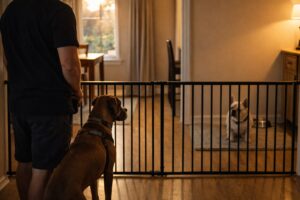
Attention is the sneaky one. Some dogs guard their owners. They wedge between, they block, they stare the other dog down, and then people think it is “jealousy.” It is more like insecurity. The fix is not pushing the dog away dramatically. The fix is structure and fairness.
Give your resident dog predictable attention, and give your rescue dog predictable calm support, without forcing “togetherness.” If both dogs learn that good things happen when the other dog is nearby, guarding tends to fade instead of grow.
Space is also a resource. Couches, beds, doorways, and hallways can become conflict zones. Early on, keep furniture access simple. If you allow couch time, do it one dog at a time. If your dogs sleep in your room, be careful, because nighttime pressure can trigger conflict fast. When in doubt, separate for sleep until the relationship is stable.
This is everyday dog training work: set the picture so the dog can succeed.
Building Positive Associations: Calm Pairing Beats Forced Friendship
A positive association is not “they played once.” A positive association is a repeated pattern where each dog consistently predicts safety, space, and good things when the other dog appears.
The easiest way to do this is calm pairing. When the dogs see each other through a gate, good things happen. When they walk parallel outside, good things happen. When one dog rests on a mat and the other dog moves around, calm is reinforced and everyone stays safe.
Do not aim for excitement. Aim for neutral. Neutral is the gateway to trust. Excitement often tips into arousal, and arousal is where nipping, barking, and scuffles happen.
At K9 Principles, we build these associations in the real environments that create the stress, which is why our In-Home Private Hamilton dog training is so effective. We are not guessing in a classroom. We are working right where your dogs live.
The First Day Plan: Keep It Boring on Purpose
On day one, your only job is safety and decompression. That is it.
Your rescue dog should explore the home in short, guided sessions, not full access. Your resident dog should see that life is normal and predictable. Keep both dogs on routine. Short walks. Easy potty breaks. Calm meals. Plenty of rest.
Use separation most of the day. Let them see each other through gates, swap scents by rotating spaces, and do short parallel walks outside if the first meeting went well. Avoid face-to-face greetings indoors. Avoid toys on the floor. Avoid high-energy play.
If you are thinking, “This feels strict,” think of it as scaffolding. You are building a structure that stops fear and conflict from taking root. Later, when they are comfortable, you loosen it. That is smart dog training, not overcontrol.
The First Week Plan: Tiny Wins, Repeated Often
In the first week, you are collecting calm reps. You want dozens of small, successful moments rather than one big “they seemed fine” gamble.
You can increase parallel walks and start doing short shared time in the same room with clear structure. Use a gate or keep one dog on a lead while the other is free, then swap. That way nobody feels trapped, and you can prevent rude hovering or pushy behaviour before it escalates.
Start teaching simple calm cues that reduce friction, like moving away from food prep areas, settling on a mat, and coming to you when you call. This is not about obedience for obedience’s sake. It is about creating predictable patterns so both dogs feel safe.
If your rescue dog is still very shut down or very frantic, do not interpret that as their final personality. The first week is not “the real dog.” It is the dog in transition. Go slower than you think you need to. Slow now is fast later.
The First Month Plan: Gradual Freedom With Rules That Make Sense
By the first month, many dogs can start sharing more space calmly, but only if the early structure was solid. This is where people get overconfident and reintroduce every trigger at once.
Increase shared time when both dogs are already calm. That might be after a walk, after a sniffy decompression outing, or after a meal. Avoid introducing shared couch time, shared chews, and tight indoor play all at once. Add one new “freedom” at a time and watch how both dogs handle it.
If play happens, keep it short and interrupt it while it is still good. You are not “ruining fun.” You are preventing arousal from tipping into conflict. Healthy play is loose, bouncy, and mutual. Problem play is stiff, pinning, cornering, relentless chasing, or one dog trying to escape.
If you want the relationship to last, you protect it. That is the long game of dog training in Hamilton homes with multiple dogs.
Warning Signs You Should Not Ignore: When DIY Turns Risky
Some behaviours are normal adjustment. Others are warning flares.
If you see repeated hard staring, stalking, silent tension, freezing when the other dog enters, snapping “out of nowhere,” guarding doorways, hovering over beds, or blocking access to you, you need to take it seriously. If one dog is consistently hiding, shaking, refusing to move, or reacting defensively, that is not “they will get used to it.” That is stress building.
If either dog has inflicted a puncture wound, grabbed and held, or repeatedly escalated despite management, that is not a time for hopeful experiments. That is a time for a professional plan.
This is exactly where In-Home Private training shines. At K9 Principles, we come to your home, watch the patterns that are actually happening, and build an individual plan that fits your dogs, your layout, and your real routine. That is how you prevent a “small issue” from becoming a household crisis.
When dog training in Hamilton Should Be Hands-On: The Fastest Route to Safety and Calm
There is a point where reading tips is not enough, not because you failed, but because your dogs deserve a custom plan.
If the introduction is already tense, if the rescue dog has an unknown history, if your resident dog has ever shown guarding or reactivity, or if you are simply not confident handling two dogs at once, getting support early saves you time and stress. It also protects both dogs from practising behaviour you do not want.
Our In-Home Private training is built for this. We work right in the environments causing the concerns, we coach you in real time, and we create a step-by-step plan you can actually follow. If your dogs need foundation skills that make life smoother long-term, our Level 1 group classes are a strong next step once home life is stable.
This is Hamilton dog training designed to prevent problems, not just react to them.
Conclusion: Calm Introductions Build the Kind of Home You Actually Want
The goal is not to “get through” the first meeting. The goal is to build a home where both dogs can relax, share space safely, and trust that nothing needs to be defended. When you use neutral territory, controlled indoor set-ups, smart resource management, and gradual positive associations, you are not being overprotective. You are being fair and effective.
If you want help making this smooth and safe, reach out to us at K9 Principles. Our In-Home Private training gives you an individual plan, hands-on coaching, and real support right where your dogs live, so you do not have to guess your way through something that can go wrong fast.
Contact us for more information:
- Name: K9 Principles
- Address: Haldimand County, Greater Hamilton Area, Burlington, and Most of Norfolk County
- Phone: 289 880-3382
- Email: k9principlesinc@gmail.com
- Website: www.k9principles.ca
FAQs
-
A1. You should keep them separated until you can consistently see calm behaviour through barriers and during parallel time together, and until neither dog is showing tension around space, people, or resources. For many homes, that means structured separation for days or weeks, not hours, with gradual increases in shared time as both dogs prove they can handle it calmly.