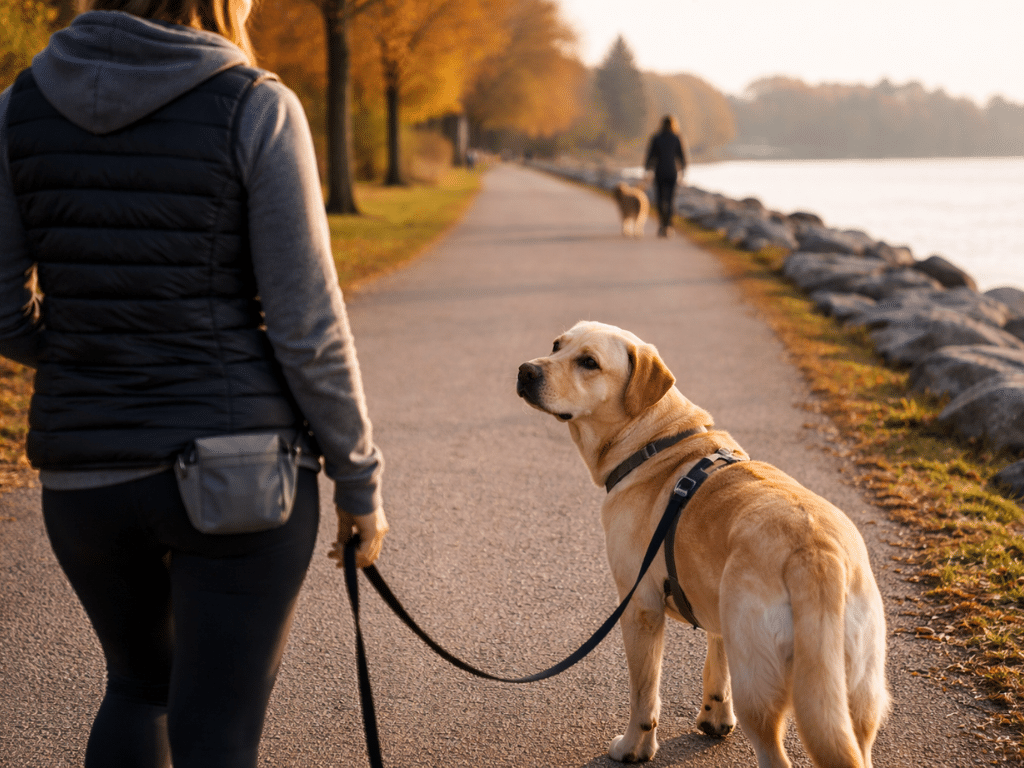





If you have a rescue dog who loses their mind on lead, you are not alone, and you are not failing. Leash reactivity is one of the most common reasons people reach out for Hamilton dog training, and it is also one of the most misunderstood. It looks like “bad behaviour”, but it is usually a dog who is overwhelmed, stuck, or trying to control space the only way they know how.
At K9 Principles, we treat leash reactivity like a skills problem, not a moral problem. We use practical dog training that changes the picture for your dog, and we do it without gambling on “they’ll figure it out” moments that make things worse.
What Leash Reactivity Actually Is, and What It Is Not
Leash reactivity is a big emotional response that shows up when your dog is on lead and something triggers them. That trigger might be another dog, a person, a bike, a doorway, a car pulling in, or even the sound of tags jingling behind them. The reaction might look like barking, lunging, growling, spinning, freezing, or screaming, and it can shift fast from one walk to the next.
It is not “dominance”. It is not your dog being “spiteful”. It is not your dog trying to embarrass you on the sidewalk. Reactivity is usually a mix of stress and survival strategies, and the lead adds pressure because it removes options like moving away, curving, or pausing at a comfortable distance.
When you understand that, you stop trying to win the moment and start building a plan that changes your dog’s emotional response over time. That is where real dog training begins.
Why It Happens in Rescue Dogs: Fear, Frustration, and Confusing Feelings
Rescue dogs often come with gaps in learning, social experiences, and predictability. Some have had scary encounters. Some have been punished for warning signals. Some have learned that the world is random, loud, and full of surprises. Even a “friendly” rescue dog can become reactive if they feel trapped on lead.
Fear-based reactivity is the classic “go away” display. Your dog sees something they do not trust, they cannot create space easily, and they explode to push the trigger back. It is not confidence. It is a bluff that sometimes works, which is why it sticks.
Frustration-based reactivity is different. This is the dog who desperately wants to greet, chase, play, or interact, but the lead blocks them. That frustration can flip into barking and lunging because your dog is basically shouting, “Let me get there!” The tricky part is that fear and frustration can live in the same dog, sometimes in the same walk.
With Hamilton dog training, we see this blend all the time, especially in rescue dogs who are still learning what is safe, what is expected, and how to cope when they feel big feelings.
Triggers Are More Than “Other Dogs”
Most people say, “My dog is reactive to other dogs,” and that might be true, but it is rarely the full story. Triggers stack. Think of stress like a cup that fills all day. When the cup is already near the top, one small thing tips it over.
Your dog might be fine with a dog across the street at 8 a.m., then lose it at a dog fifty feet away at 5 p.m. because the day already included delivery trucks, a barking neighbour dog, a slippery floor, a visitor, or poor sleep. Rescue dogs are especially prone to this because their baseline stress can be higher while they settle into a new life.
At K9 Principles, we look at what sets the stage, not just what sets off the fireworks. That approach makes dog training in Hamilton feel simpler, because you stop trying to fix the entire world and start controlling the pieces you actually can.
Threshold: The Invisible Line Where Learning Stops
Threshold is the point where your dog goes from “I can notice that” to “I cannot cope with that”. Under threshold, your dog can take food, respond to a cue, sniff, blink, and make choices. Over threshold, your dog’s brain is in emergency mode, and learning is basically offline.
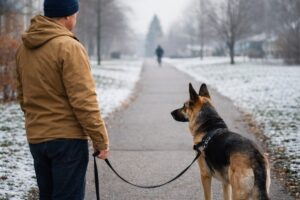
This is why yelling, jerking the lead, or repeating cues does not work in the moment. Your dog is not refusing. Your dog is flooded. If we keep dragging them into situations that push them over threshold, we are not “socialising”. We are rehearsing panic.
A helpful analogy is volume. Under threshold is a radio at a reasonable level. Over threshold is the volume suddenly cranked to max. You cannot have a calm conversation with the radio screaming. You turn it down first. In dog training, distance is one of the best volume knobs we have.
Why “Letting Them Work It Out” Makes It Worse
“Let them work it out” usually means putting the dog close enough to react and hoping they stop reacting. The problem is that reactivity is self-reinforcing. When your dog barks and lunges, the trigger often moves away anyway. Your dog learns, “That worked. Do it again next time.”
Even when the trigger does not move away, your dog still rehearses the emotional pattern. The body practises adrenaline. The brain practises scanning. The lead practises tension. Over time, your dog becomes quicker to react and harder to recover. This is why you can feel things “getting worse” even if you are walking every day and trying your best.
At K9 Principles, we do not train in chaos and hope. We use dog training that prevents rehearsals while we build skills that replace the blow-up with something your dog can actually do.
Your First Goal Is Not “No Barking”, It Is “No Explosions”
Most owners start with a goal like, “I want my dog to stop barking at dogs,” but a better first goal is, “I want my dog to stay under threshold and recover fast.” That is how you build a dog who can learn.
If you can keep your dog under threshold more often than not, you will see calmer walks, better engagement, and fewer surprises that spiral. That is also where confidence grows, because your dog starts collecting safe experiences instead of scary ones.
This is a big part of what we do in dog training in Hamilton through our In-Home Private Training, because we can work with you in the exact streets, paths, and times of day that create the problem, rather than guessing in a sterile setting.
Safety and Management for Daily Walks in Hamilton
Before we talk training, we protect everyone involved. Safety is not “giving up”. Safety is what makes the training possible.
We want equipment that keeps you in control without adding pain or panic. A secure harness with a front and back attachment can be a game changer for many reactive dogs because it reduces the power of lunging and helps you steer without a wrestling match. We also want a lead length that gives your dog room to move and you room to create distance, while still keeping things safe on sidewalks.
We also plan routes like we are playing chess, not checkers. Quiet streets, wide paths, predictable sightlines, and escape options matter. If you walk straight into tight bottlenecks where you cannot create space, you are basically setting yourself up for a reaction. We would rather do a shorter walk that stays clean than a long walk that turns into a disaster.
This is the unglamorous truth of Hamilton dog training for leash reactivity: your management choices on Tuesday determine how well your training goes on Saturday.
Distance Is the Foundation: How to Use Space Without Feeling Defeated
Distance is not avoidance. Distance is training. When you increase distance, you drop intensity. When intensity drops, your dog can think. When your dog can think, you can teach.
Start by finding your dog’s working distance from common triggers. That might be fifty feet, or it might be two hundred. There is no shame in a large number. Rescue dogs often need more space at first, and that is normal.
Then you practise staying at that distance while your dog notices the trigger and still succeeds. Success might mean looking at the trigger and looking back to you. Success might mean sniffing the ground and staying loose. Success might mean eating food calmly. You are building a new default response, and that takes repetition under threshold.
This is why we love practical dog training plans that measure progress by calm choices, not by “did the trigger disappear”.
Pattern Work: Predictable Games That Calm the Brain
Pattern work is one of our favourite tools at K9 Principles because it gives your dog something predictable to do when the world feels unpredictable. When your dog knows what comes next, their body relaxes and their brain stops spiralling.
A simple pattern could be a steady rhythm of feeding as you walk, then pausing, then feeding again, with the same cadence every time you see a trigger at distance. Another pattern could be a predictable turn-and-go routine that your dog learns means, “We’re leaving, and that’s safe.”
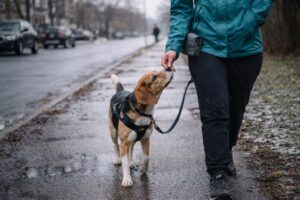
Pattern work is not bribery. It is nervous system training. You are teaching your dog, “When I feel something big, I have a job I can do, and my human will guide me.” That is the opposite of “work it out”.
This is the kind of dog training in Hamilton that makes walks feel possible again, because you stop improvising in stressful moments.
Engagement: Teaching Your Dog to Choose You on Purpose
Engagement is your dog practising the skill of checking in with you in real environments. Not in the kitchen. Not in the living room. On the actual sidewalk, with real distractions, at distances where your dog can still succeed.

We build engagement with tiny, repeatable moments. Your dog looks at you, you mark it, you pay it. Your dog follows your movement, you mark it, you pay it. Your dog responds to a simple cue like “this way” or “let’s go”, you mark it, you pay it. Over time, your dog learns that you are relevant outside, not just inside.
Engagement is also how you stop feeling helpless. When you have a reliable way to get your dog’s attention, you can prevent reactions before they happen, instead of cleaning up after them.
In Hamilton dog training, this is often the turning point for first-time owners, because it replaces dread with a plan you can actually execute.
Controlled Set-Ups: Practise on Purpose, Not by Accident
Random encounters are the worst classroom for leash reactivity. They are unpredictable, too intense, and usually too close. Controlled set-ups let us control distance, angles, timing, and duration so your dog can succeed.
A controlled set-up might involve working near a quiet parking lot where you can see triggers at a distance and move away easily. It might involve a calm helper dog at a planned distance, rather than a surprise dog popping out of a doorway. It might involve rehearsing your turn-and-go pattern before you even need it.
Set-ups are how we take the “maybe” out of training. They are also how we stop the rehearsal loop that keeps reactivity alive.
This is a major reason our In-Home Private Training works so well for reactive rescue dogs. At K9 Principles, we can build controlled set-ups in the exact environments where your dog struggles, which makes the dog training feel relevant and fast-moving.
A Practical Training Plan You Can Start This Week
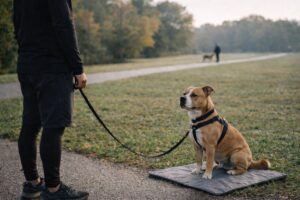
We want you walking with a plan, not walking with hope. Start by picking times and routes where you can create space. Then decide what your “default response” will be when you see a trigger at a workable distance. For many dogs, the best default is a simple pattern plus a calm check-in.
Next, decide what you will do when the trigger is too close. This is where your emergency routine matters. You turn, you move away, you keep your lead calm, and you run your predictable pattern. You do not stop and debate. You do not wait for your dog to “get used to it”. You protect threshold like it is your job, because it is.
Finally, you track progress in a realistic way. You are looking for fewer explosions, faster recovery, and a dog who can notice triggers without melting down. That is meaningful progress, even if your dog still barks sometimes while they learn.
This is also where a smart Hamilton dog training plan saves you months. If you want this laid out clearly for your specific dog, our In-Home Private Training at K9 Principles is built for exactly that. We create an individual plan, we coach you in real time, and we adjust it based on what your dog shows us, not what we wish was true.
When You Need More Support: The Best Next Step with K9 Principles
If your walks feel like a daily gamble, you should not have to figure this out alone. Leash reactivity gets better when you stop rehearsals, protect threshold, and build skills with purpose, but it also gets better faster when someone experienced can see the tiny details you cannot see yet.
Our first recommendation is In-Home Private Training, because we can work right where the problem happens and coach you through real scenarios safely. We build your handling skills, your dog’s coping skills, and your plan for the exact triggers you face in Hamilton.
If your dog needs a broader foundation to expand on, our Level 1 group classes can be a strong next layer once your dog can handle the environment. If you are overwhelmed or short on time, our Home School Academy may be your best option, because we can do the training for you and hand you back a dog with clearer skills and calmer habits.
No matter which path fits you, the goal is the same. We want you to enjoy your dog, not manage a daily crisis, and we want your dog to feel safe enough to learn.
Conclusion
Leash reactivity in rescue dogs is not a personality flaw, and it is not something your dog should be forced to “work out” in the moment. It is a stress response that gets stronger through rehearsal and weaker through smart, consistent dog training that stays under threshold. When you use distance, predictable pattern work, real engagement, and controlled set-ups, your dog stops practising panic and starts practising skills. If you are ready to turn your walks into something you can actually look forward to, reach out to K9 Principles about In-Home Private Training. We will build a plan that fits your dog, your neighbourhood, and your real life, so dog training in Hamilton finally feels clear instead of confusing.
Contact us for more information:
- Name: K9 Principles
- Address: Haldimand County, Greater Hamilton Area, Burlington, and Most of Norfolk County
- Phone: 289 880-3382
- Email: k9principlesinc@gmail.com
- Website: www.k9principles.ca
FAQs
-
A1. It depends on how long the behaviour has been rehearsed, how intense the triggers are, and how consistently you can keep your dog under threshold. Most owners notice meaningful changes within weeks when they stop rehearsals and train with distance and predictable patterns, but the deeper “this feels easy now” confidence usually takes months of consistent practice.