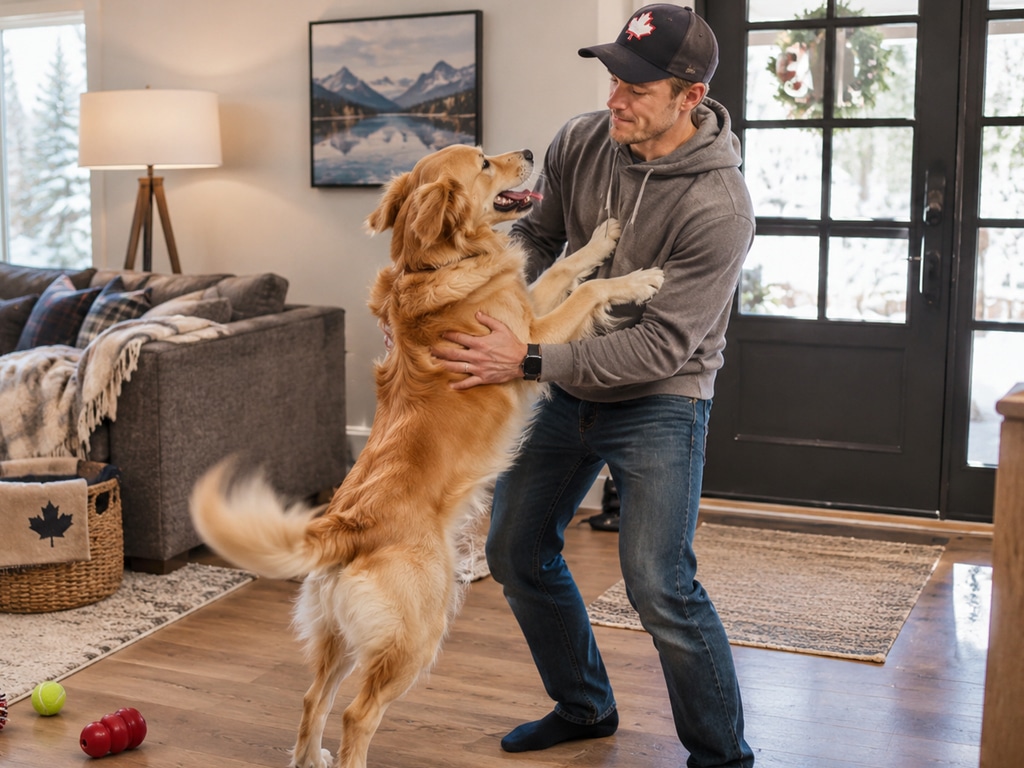


You love your dog, but some days, living with them can feel absolutely exhausting. They jump on visitors, bark at every little noise, pull on walks and seem incapable of sitting still for more than a few minutes. Even relaxing on the sofa becomes a challenge because your dog constantly demands attention.
Sound familiar?
One of the most common frustrations we hear from dog owners is, “My dog just doesn’t know how to calm down.”
Here’s something that might surprise you. Calmness is a skill. And just like sitting, staying or walking politely on a lead, it’s something dogs can learn.
At K9 Principles, we’ve spent more than 30 years helping dogs and their owners overcome challenging behaviours. Through our experience providing dog training in Hamilton, Caledonia, Burlington and surrounding communities, we’ve discovered that many dogs labelled as hyperactive, stubborn or out of control simply haven’t learned how to manage their excitement.
They’re not necessarily bad dogs. They’re dogs that need clearer expectations, consistent guidance and the opportunity to develop better habits.
The good news? You don’t have to eliminate your dog’s personality or natural enthusiasm to create a calmer household.
With the right approach, you can teach your dog when it’s time to have fun, when it’s time to listen and, perhaps most importantly, when it’s time to relax.
Why Some Dogs Struggle to Be Calm
Before you can change your dog’s behaviour, you need to understand what’s causing it.
Not every excitable dog is hyperactive, and not every dog that struggles to settle has the same underlying problem. Some dogs have naturally high energy levels, while others become overstimulated by their surroundings. Some have learned that demanding attention gets results, while others struggle with anxiety, frustration or inconsistent household routines.
Age plays an important role too. Puppies and adolescent dogs are still developing impulse control and emotional regulation. They explore their surroundings, react quickly to exciting situations and often struggle to make good decisions without guidance.
Breed characteristics can also influence behaviour. A young Border Collie, Belgian Malinois or Labrador Retriever may have different physical and mental needs than a lower-energy companion breed. However, breed alone doesn’t determine whether a dog can learn to relax.
One of the biggest mistakes owners make is confusing physical tiredness with emotional calmness.
A dog might return from a long walk, collapse on the floor for twenty minutes and then start racing around the house again. The exercise addressed a physical need, but it didn’t necessarily teach the dog how to settle independently.
A tired dog isn’t automatically a calm dog.
We also need to distinguish excitement from anxiety. A dog that constantly paces, pants, startles easily or struggles to rest might be experiencing stress or discomfort rather than simply having too much energy.
At K9 Principles, we look beyond the behaviour itself. We consider the dog’s age, temperament, environment and learning history before determining the most appropriate training approach.
This matters because two dogs displaying similar behaviours may require entirely different solutions.
Understanding why your dog struggles is the first step towards creating lasting change.
Why More Exercise Isn’t Always the Answer
When owners describe an overexcited dog, one of the first suggestions they receive is to provide more exercise.
Take longer walks. Throw the ball more often. Visit the dog park. Find something that will finally burn off all that energy.
Exercise is essential for a dog’s physical and mental well-being, but there’s a problem with treating it as the only solution.
You can improve your dog’s physical fitness without improving their ability to control excitement.
Think about a dog that plays fetch for an hour every afternoon. Initially, thirty minutes might leave the dog exhausted. Over time, however, the dog becomes fitter and develops greater endurance.
Now it takes forty-five minutes to achieve the same level of tiredness. Eventually, even an hour might not be enough.
Meanwhile, the dog still jumps on visitors, pulls on walks and struggles to relax inside the house.
Why? Because exercise and self-control are two different skills.
Physical activity satisfies your dog’s need for movement and exploration. Training teaches them how to behave appropriately in different situations.

Both matter, but one doesn’t replace the other.
Constant high-intensity activities can also leave some dogs highly aroused, particularly when there are few opportunities to recover afterwards.
This doesn’t mean you should stop exercising your dog. It means you should balance physical activity with mental stimulation, training and proper rest.
Sniffing walks, appropriate enrichment, short obedience sessions and structured relaxation periods can all contribute to a healthier routine.
If your dog can run for two hours but can’t lie quietly in the living room for ten minutes, the next step probably isn’t another hour of running.
It’s teaching your dog how to switch off.
How Owners Unintentionally Encourage Chaotic Behaviour
Here’s something many dog owners don’t realise.
Some of the behaviours that frustrate us most are the same behaviours we’ve unintentionally helped our dogs develop.
Dogs learn through experience. When a behaviour produces something valuable, that behaviour becomes more likely to happen again.
Imagine coming home from work and having your dog jump all over you. You tell them to get down, push them away and repeatedly say their name.
From your perspective, you’re correcting the behaviour.
But from your dog’s perspective, jumping might have successfully produced exactly what they wanted: your attention.
Even negative attention can sometimes be rewarding.
The same thing happens with demand barking.
Your dog barks while you’re watching television. You respond by telling them to be quiet. They stop briefly, then start again. Eventually, you get up and give them attention or something to occupy themselves.
Without realising it, you may have taught your dog that barking makes things happen.
Consider what happens before a walk.
You pick up the lead, and your dog starts spinning, barking and racing around the hallway. You struggle to attach the lead, eventually open the door and head outside.
What did your dog learn?
That frantic behaviour is part of the routine leading to something exciting.
This is why dog training shouldn’t be limited to formal lessons. Every interaction provides an opportunity for learning.
Inconsistent expectations can make things even more confusing. Perhaps your dog is allowed to jump on family members but gets corrected for jumping on visitors. Maybe pulling on the lead is tolerated during casual walks but discouraged when you’re in a hurry.
From your dog’s perspective, the rules keep changing.
Instead, decide what behaviours you want and consistently reinforce them.
If you want polite greetings, reward four paws on the floor. If you want a calmer departure, teach your dog that settled behaviour leads to the walk beginning.
Remember that not all barking or attention-seeking indicates a training problem. Dogs also communicate genuine needs, discomfort and anxiety. Understanding the reason behind the behaviour is important.
At K9 Principles, we frequently find that small adjustments to everyday interactions can produce meaningful improvements.
Sometimes, changing your dog’s behaviour starts with changing how you respond to it.
Structure, Boundaries and Consistency: Creating a Calmer Household
Imagine going to work every day without knowing what’s expected of you. One day, something is acceptable. The next, you get in trouble for doing exactly the same thing.
It would be frustrating and confusing.
Dogs also benefit from clear expectations and predictable routines.
Structure helps them understand what happens throughout the day, which behaviours are appropriate and how to navigate family life successfully.
It doesn’t mean controlling every movement your dog makes. It means creating an environment where good habits become easier to develop.
Consider what happens when visitors arrive.
Without a plan, your dog might rush towards the door, bark, jump on guests and become increasingly excited while everyone tries to manage the situation.
With structure, your dog has a familiar routine.
Perhaps they’re taught to go to a designated Place, remain there while visitors enter and receive permission to greet people once everyone has settled.
The difference is that your dog understands what’s expected because the behaviour has been taught and practised.
The same approach applies to feeding times, walks, play sessions and periods of rest.
Appropriate management tools can also help. Baby gates can prevent a young dog from repeatedly practising unwanted behaviours, while a properly introduced crate can provide a comfortable place to rest.
However, management and training aren’t the same thing.
A baby gate might prevent jumping, but it doesn’t teach polite greetings. A crate provides a resting space, but it doesn’t automatically teach your dog to relax throughout the house.
Management prevents problems while training develops the skills needed for greater freedom.
As your dog becomes more reliable, you can gradually increase their independence.
One principle we reinforce through our Hamilton dog training programs is that freedom should match the dog’s current ability to make good choices.
A young dog that constantly steals household objects, jumps on furniture or pesters family members might simply have too much unsupervised freedom before learning the household rules.
Clear expectations, consistent routines and appropriate supervision can prevent unwanted habits from becoming established.
The goal isn’t to restrict your dog’s life. It’s to help them develop the skills required to enjoy more freedom responsibly.
Teaching Your Dog an Off Switch: The Skill Many Owners Overlook
If there’s one concept we’d love more dog owners to understand, it’s the importance of teaching an off switch.
An off switch is your dog’s ability to move from activity or excitement into a calmer state and remain settled when nothing particularly interesting is happening.
Some dogs develop this naturally. Others need guidance.
Think about dogs that constantly carry toys to their owners, pace around the house, follow every movement or become restless whenever someone sits down.
These dogs may have learned how to play, interact and demand attention, but they’ve had very little practice simply doing nothing.
And for some dogs, doing nothing is surprisingly difficult.
The first step is recognising and rewarding calm behaviour when it happens naturally.
Suppose your dog voluntarily lies down near you while you’re reading. Rather than waiting until they begin demanding attention, quietly acknowledge the appropriate behaviour.
You might calmly place a small treat between their paws without creating additional excitement.
Over time, these experiences help your dog associate relaxation with positive outcomes.
The key is keeping the interaction calm.
If you enthusiastically praise your dog, repeatedly pat them and turn the moment into a celebration, you may accidentally encourage them to become active again.
Next, provide opportunities to practise settling in a comfortable environment.
Choose a quiet area and encourage your dog to relax on a bed or mat. Initially, you may only achieve a few seconds of settled behaviour.
That’s perfectly fine.
Reward those brief moments and gradually increase the duration.
It’s also important to understand the difference between a dog holding an obedience position and a dog genuinely relaxing.
A dog can remain in a Down position while staring intensely at its owner, muscles tense and waiting for the next instruction.
That’s obedience, but it isn’t necessarily relaxation.
A genuinely relaxed dog typically displays softer body language, reduced environmental scanning and a willingness to disengage from activity. PICTURE 3 HERE
As your dog improves, begin practising in different areas of the house.
Start while you’re sitting quietly. Later, practise while preparing a meal, folding laundry or moving around the room.
Gradually introduce everyday distractions without overwhelming your dog.
If they repeatedly get up or become frustrated, reduce the difficulty and build success from there.
Rest is also an essential part of the process. Puppies and adolescent dogs, in particular, need adequate sleep and opportunities to recover from stimulating activities.
At K9 Principles, we consider the ability to settle an important part of practical dog training in Hamilton because it influences almost every aspect of daily life.
A dog that can relax while family activities continue around them is much easier to live with than one that constantly needs entertainment.
Ultimately, we’re not trying to create a dog that never gets excited.
We’re teaching a dog that knows how to enjoy activity and then comfortably switch off.
Place Training: A Practical Tool for Developing Self-Control
One of the most useful household skills we teach at K9 Principles is the Place cue.
Place training teaches your dog to go to a designated bed, mat or raised platform and remain there until released.
It sounds simple, but when properly developed, this skill can make everyday activities significantly easier.
Imagine preparing dinner without your dog weaving between your legs or begging for food.
Picture answering the front door without having to physically restrain your dog while visitors enter.
Or consider being able to sit down for an evening without your dog constantly demanding attention.
Place training gives your dog a clear job during these situations. PICTURE 4 HERE
The first step is choosing a suitable surface that’s comfortable, stable and large enough for your dog.
Begin by encouraging your dog onto the designated area and rewarding them for doing so.
Initially, focus on making the location familiar and rewarding.
Once your dog understands the exercise, introduce a consistent verbal cue and begin developing duration.
Start with short periods of success rather than immediately expecting your dog to remain there for twenty minutes.
Gradually increase the time before rewarding.
Next, introduce simple distractions.
Take a step away, return and reward. Walk around the room. Sit on a nearby chair. Pick up an everyday object.
As your dog becomes more reliable, gradually increase the difficulty.
Always teach a clear release cue so your dog understands when the exercise has finished.
One mistake owners make is attempting to use Place training during highly exciting situations before properly establishing the behaviour.
If your dog can only remain on Place for fifteen seconds in a quiet living room, expecting them to stay there while five visitors arrive is unrealistic.
Build the foundation first.
We also need to make an important distinction.
Place training teaches controlled behaviour, while relaxation training teaches a dog how to settle emotionally.
The two skills complement each other, but they’re not identical.
A dog can reliably remain on Place while still feeling excited or anxious. That’s why we encourage owners to work on both impulse control and genuine relaxation.
When practised consistently, Place training provides a valuable tool for managing mealtimes, visitors and ordinary household activities.
And as your dog becomes more reliable, it creates opportunities for greater freedom and participation in family life.
Bringing Calm Behaviour Into Everyday Life
Teaching calm behaviour inside a quiet living room is one thing. Maintaining that behaviour when life becomes exciting is another.
This is where many owners struggle.
Your dog might listen beautifully at home but appear to forget everything they’ve learned the moment you step outside.
That doesn’t necessarily mean they’re being stubborn.
Dogs don’t automatically understand that a behaviour learned in one environment applies equally to every other situation.
A dog that walks perfectly on a loose lead in the driveway may still struggle when passing other dogs, pedestrians or unfamiliar smells.
The solution is progressive training.
Begin in environments where your dog can remain successful, then gradually introduce more challenging distractions.
For example, if your dog becomes overexcited around other dogs, practise maintaining attention and loose-lead walking at a comfortable distance.
As your dog improves, gradually reduce the distance while continuing to reinforce appropriate behaviour.
If the dog becomes overwhelmed, increase the distance and simplify the exercise.
We also encourage owners to practise calmness before exciting activities begin.
If your dog becomes frantic when you pick up the lead, start teaching patience during your departure routine.
If they jump and bark while you prepare dinner, practise rewarding calm waiting.
If visitors cause chaos, establish a predictable greeting routine before expecting your dog to handle a busy gathering.
These small exercises help dogs learn that excitement doesn’t automatically mean losing control.
Daily routines should also include appropriate exercise, enrichment, rest and opportunities for independent relaxation.
The objective isn’t to turn every interaction into a formal training session.
It’s to make good behaviour part of normal life.
At K9 Principles, we believe effective dog training should extend beyond the classroom and into the situations owners encounter every day.
A dog that listens perfectly during a training session but becomes unmanageable on a neighbourhood walk still has important skills to develop.
That’s why our approach to Hamilton dog training focuses on practical results that help owners enjoy their dogs at home and in public.
As training progresses, look for small improvements.
Perhaps your dog begins settling more quickly after excitement, responds with fewer reminders or remains calm when someone walks past the house.
These changes matter.
Progress isn’t always perfectly consistent, and occasional setbacks are normal.
What matters is developing reliable habits through practice, patience and clear communication.
When Professional Dog Training Makes the Difference
Sometimes, despite their best efforts, owners struggle to create the changes they want.
Perhaps their dog has been jumping on visitors for years. Maybe walks have become so stressful that the family avoids taking the dog anywhere. Or perhaps the household revolves around constant barking, restlessness and supervision.
These situations don’t necessarily mean the dog is incapable of learning.
Often, what’s missing is an individualised training plan that addresses both the unwanted behaviour and the habits surrounding it.
At K9 Principles, we provide professional dog training in Hamilton, Caledonia, Burlington and surrounding communities, helping owners develop better household manners, impulse control and reliable obedience.
With more than 30 years of professional dog training experience, we’re proud to be trusted dog trainers for the Hamilton/Burlington SPCA and Hamilton Animal Services.
One of the most important things we’ve learned is that no two dogs are exactly alike.
An excitable young Labrador requires a different approach from an anxious rescue dog struggling to settle in unfamiliar surroundings.
That’s why we focus on understanding each dog rather than applying the same training program to everyone.
Our In-Home Private Training allow us to address the behaviours causing difficulties within the dog’s everyday environment.
For owners who need more intensive support, we also offer home-based Board & Train programs.
Unlike traditional kennel-based facilities, dogs participating in our Board & Train programs live inside a real home, where training can be incorporated into household routines and everyday activities.
We deliberately limit the number of dogs in our care to provide individualised attention.
Just as importantly, we recognise that training must transfer back to the owner.
Our Board & Train programs include private transition training and lifetime phone and email support, helping owners maintain the progress their dogs have achieved.
We begin by teaching dogs through clear communication and positive reinforcement, establishing the behaviours we want before introducing appropriate boundaries and expectations.
Our objective isn’t simply to stop unwanted behaviour.
It’s to teach dogs what to do instead and give owners the knowledge and confidence to maintain those skills.
Professional training should make everyday life easier, not just produce impressive results during a lesson. PICTURE 5 HERE
Conclusion: A Calmer Dog Creates a Better Life for Everyone
Living with an overexcited dog can be exhausting, but constant chaos doesn’t have to become your normal.
The journey from chaos to calm isn’t about removing your dog’s personality or enthusiasm for life.
It’s about teaching them when excitement is appropriate, how to respond to guidance and how to relax when nothing exciting is happening.
Exercise, mental stimulation, structure, boundaries and consistent training all play important roles.
But perhaps the most valuable lesson is understanding that calmness doesn’t always come naturally.
For many dogs, it’s something that must be deliberately taught.
At K9 Principles, our goal is to help owners build better communication, reliable behaviour and a more enjoyable relationship with their dogs.
Whether you’re struggling with an overexcited puppy or an adult dog that has never learned to settle, professional guidance can make a meaningful difference.
Ready to go from chaos to calm?
Discover how K9 Principles can help with professional dog training in Hamilton, Burlington, Caledonia and surrounding communities.
Visit www.k9principles.ca to learn more about our private lessons, group obedience classes and home-based Board & Train programs.
Because a well-trained dog doesn’t have to be calm every moment of the day. They simply need to learn when it’s time to have fun and when it’s time to settle.
Contact us for more information:
- Name: K9 Principles
- Address: Haldimand County, Greater Hamilton Area, Burlington, and Most of Norfolk County
- Phone: 289 880-3382
- Email: k9principlesinc@gmail.com
- Website: www.k9principles.ca
FAQs
-
A1. Yes. Many overexcited dogs can learn to become calmer through consistent training, structured routines, appropriate exercise and opportunities to practise relaxation. The key is teaching calm behaviour rather than relying solely on physical exhaustion. At K9 Principles, we help owners develop practical skills that improve impulse control, household manners and responsiveness. Dogs experiencing significant anxiety or unexplained restlessness may also benefit from veterinary or specialised behavioural support.