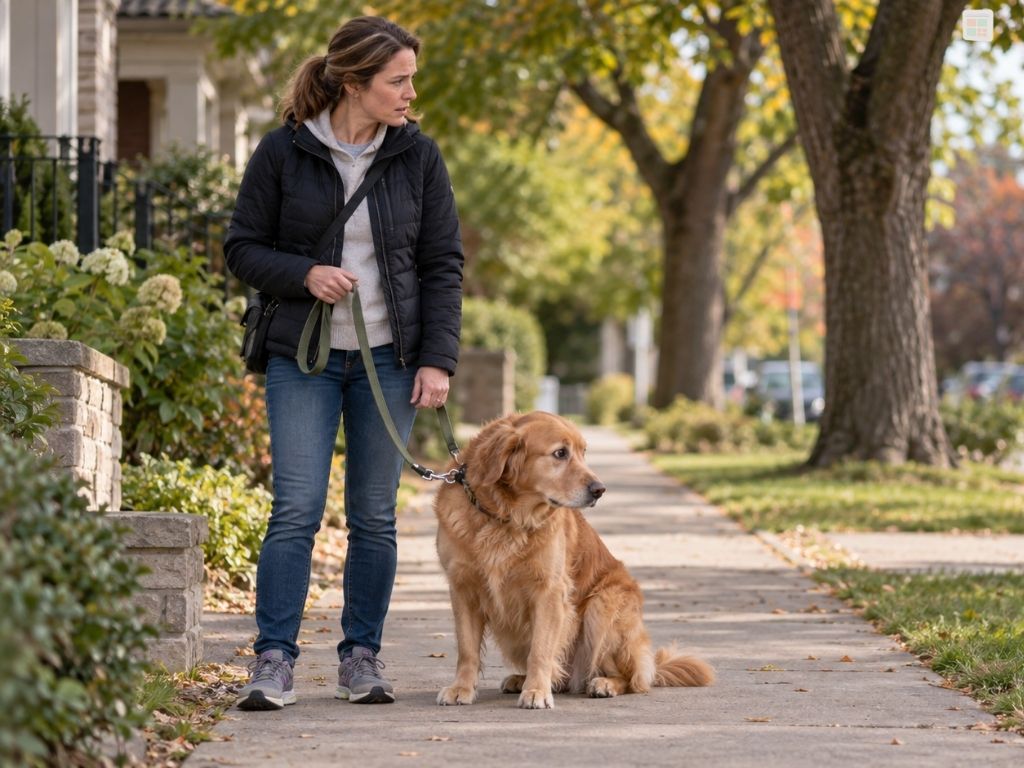


Your dog starts barking when a stranger approaches. They freeze when another dog walks past. Perhaps they refuse to enter a particular room, hide during thunderstorms, or suddenly growl at someone they’ve met before.
Most owners see these behaviours and immediately wonder how to stop them. But what if the behaviour isn’t actually the problem?
What if your dog is afraid?
Fear in dogs is one of the most misunderstood causes of unwanted behaviour. A dog that appears aggressive, stubborn, disobedient, or difficult may actually be struggling with an emotional response they don’t know how to handle.
At K9 Principles Dog Training, we’ve spent over 30 years helping owners understand their dogs and address challenging behaviours. One of the most important lessons we’ve learned is that successful training starts with understanding why a dog behaves the way they do.
Before you can change a behaviour, you need to understand what’s driving it.
Understanding Fear in Dogs: Why Behaviour Isn’t Always What It Seems
Fear is a natural survival response. Just like people, dogs experience fear when they believe something could threaten their safety.
Sometimes that fear is reasonable. Other times, a dog may respond fearfully to something harmless, such as a person wearing a hat, a bicycle leaning against a fence, or an unfamiliar noise.
The important distinction is that dogs respond to what they perceive as threatening, not necessarily what is actually dangerous.
Consider a dog barking aggressively at someone approaching their home. The owner might believe the dog is being protective, territorial, or deliberately difficult. However, the dog may be barking because they’re uncomfortable and want that person to stay away.
Another dog experiencing the same fear might retreat, hide, or freeze instead.
Different dogs can express the same emotion in completely different ways.
This is why effective dog training looks beyond the behaviour itself. Simply stopping the barking doesn’t necessarily address the fear that caused it.
A dog can become quieter without becoming more confident.
And that’s an important distinction.
What Causes Fear in Dogs?
There isn’t one single explanation for why dogs develop fearful behaviour. In most cases, several factors contribute to how a dog responds to the world around them.
Genetics and temperament play a significant role. Some dogs are naturally more cautious, sensitive, or easily startled than others. Two puppies from the same litter can have very different personalities, even when raised in similar environments.
Early socialisation is another important factor. During puppyhood, dogs go through critical developmental periods when their experiences can influence how they respond to unfamiliar people, animals, sounds, surfaces, and environments later in life.
Puppies who have limited positive exposure to everyday experiences may become more cautious as they mature.
However, socialisation isn’t simply about exposing a puppy to as many things as possible. The quality of those experiences matters enormously. Overwhelming a puppy can create problems rather than prevent them.
Negative experiences can also contribute to fear. A dog frightened by another dog, involved in a traumatic incident, or repeatedly placed in uncomfortable situations may develop lasting associations.
Sometimes those associations are surprisingly specific. A dog frightened by a loud noise near a particular doorway may become reluctant to walk through that doorway again.
Changes in routine or environment can also influence behaviour. Moving homes, introducing new family members, or changing a dog’s living arrangements can create uncertainty.
Medical conditions shouldn’t be overlooked either. Pain, illness, changes in hearing, or deteriorating vision can make previously comfortable situations frightening.
If your dog’s fear develops suddenly or their behaviour changes significantly, a veterinary examination should be an early step.
Understanding the cause helps determine the most appropriate approach to training.
The 10 Signs Your Dog Is Experiencing Fear

Not every frightened dog trembles or runs away. Some signs of fear are subtle and easily missed, especially when owners are focused on more obvious behaviours.
Learning to recognise your dog’s body language allows you to respond before fear develops into a bigger problem.
Sign 1 – Trembling or Shaking: A frightened dog may physically tremble, even when they’re not cold. This is commonly seen during thunderstorms, fireworks, veterinary visits, or unfamiliar experiences. However, shaking can also have medical causes.
Sign 2 – Tail Tucked Between the Legs: A lowered or tightly tucked tail can indicate fear or uncertainty. Some dogs naturally carry their tails low, so it’s important to recognise what’s normal for your individual dog.
Sign 3 – Ears Pulled Backwards: Dogs may flatten or pull their ears backwards when uncomfortable. Ear position alone doesn’t confirm fear, but combined with other signals, it can provide valuable information.
Sign 4 – Avoiding Eye Contact or Turning Away: A dog that repeatedly turns their head, looks away, or moves their body away from someone may be communicating discomfort. These signals are often missed when people insist on approaching or petting a reluctant dog.
Sign 5 – Excessive Lip Licking or Yawning: Lip licking and yawning aren’t always associated with food or tiredness. When they occur during stressful interactions, they may indicate tension or uncertainty.
Sign 6 – Freezing or Becoming Completely Still: One of the most overlooked warning signs is a dog suddenly becoming motionless. Owners sometimes mistake this for calm behaviour or obedience. In reality, the dog may be overwhelmed and unsure how to respond.
Sign 7 – Hiding or Attempting to Escape: Some dogs retreat behind their owners, hide under furniture, or desperately try to leave a situation. Escape behaviour is an obvious indication that the dog doesn’t feel comfortable.
Sign 8 – Barking, Growling, or Lunging: Fear doesn’t always make dogs retreat. Some dogs respond defensively by displaying behaviours designed to increase distance between themselves and whatever frightens them.
Sign 9 – Refusing Food or Becoming Unresponsive: A dog that normally loves treats may suddenly refuse them when overwhelmed. They may also struggle to respond to familiar commands because their attention is focused on the perceived threat.
Sign 10 – Panting, Pacing, or Excessive Vigilance: Rapid breathing without physical exertion, repeated pacing, or constantly scanning the environment can indicate anxiety or fear.
It’s important to remember that no single behaviour automatically proves a dog is frightened. The dog’s environment, individual personality, physical condition, and overall body language must all be considered.
The earlier you recognise these signals, the better opportunity you have to prevent the situation from escalating.
Fear vs Aggression: Why Some Frightened Dogs Bark, Growl, or Lunge
One of the biggest misconceptions in dog behaviour is that an aggressive-looking dog must be confident, dominant, or deliberately challenging its owner.
In reality, fear can be a powerful motivation behind defensive aggression.
Imagine a dog that becomes frightened whenever unfamiliar people approach. Initially, the dog might attempt to move away. But if people repeatedly ignore those attempts and continue approaching, the dog may begin barking or growling.
If barking causes people to retreat, the dog learns something important: barking works.
The behaviour may become stronger because it successfully creates the distance the dog wants.
Over time, the dog might begin reacting earlier, barking when someone is still several metres away rather than waiting until they’re close.
What appears to be worsening aggression may actually be an increasingly established strategy for dealing with fear.
This is particularly important when considering leash reactivity. Dogs on leash have fewer opportunities to move away from uncomfortable situations. Some respond by barking, lunging, or pulling towards the perceived threat.
However, not all reactive behaviour is fear-based. Frustration, excitement, territorial responses, and other motivations can produce similar outward behaviours.
This is why identifying the motivation behind a reaction is essential.
Punishing growling or other warning signals without addressing the underlying discomfort can also create additional risks. A dog may stop giving an obvious warning while remaining frightened.
A quiet dog isn’t necessarily a comfortable dog.
Professional dog training should consider both the visible behaviour and the emotional response contributing to it.
Why Fearful Dogs Aren’t Necessarily Abused Dogs
When people see a dog cowering, retreating from strangers, or becoming frightened by everyday experiences, they often assume the dog must have been abused.
Although mistreatment can certainly contribute to fear, it isn’t the only explanation.
A dog can come from a loving home, receive excellent care, and still develop significant fears.
Genetics, individual temperament, limited early socialisation, medical problems, and unexpected experiences can all influence confidence.
Even dogs with extensive socialisation can develop fears later in life.
This is particularly relevant for rescue dogs. Owners may understandably try to explain every fearful response by imagining something traumatic in the dog’s past.
But without knowing the dog’s history, those explanations remain assumptions.
Rather than concentrating entirely on what may or may not have happened previously, it’s often more productive to focus on how the dog responds today and what can be done to improve their future experiences.
A dog’s past can help explain behaviour, but it doesn’t always determine what they’re capable of learning.
How Fear Affects Your Dog’s Ability to Learn
Have you ever tried asking your dog to sit when another dog is barking nearby, only to discover that your normally obedient companion suddenly acts as though they’ve never heard the command before?
That doesn’t necessarily mean your dog is ignoring you.
Fear can interfere with attention, decision-making, and the ability to respond to familiar cues.
When dogs become highly stressed, their attention often shifts towards monitoring potential threats.
A dog that performs perfectly in a quiet living room may struggle with the same exercise on a busy pavement.
This is where the concept of a dog’s threshold becomes important.
A dog working below their fear threshold can usually notice a trigger while remaining comfortable enough to learn, respond, and recover.
Once the situation becomes too intense, the dog may bark, freeze, attempt to escape, or become unable to concentrate.
Continuing to demand obedience in that overwhelmed state is unlikely to produce the learning you’re hoping for.
Instead, training needs to be adjusted.
That might mean increasing the distance from another dog, reducing distractions, shortening the training session, or choosing a quieter environment.
An important part of successful Hamilton dog training is helping owners understand when their dogs are ready to learn and when the environment is asking too much.
Strong foundations begin in situations where the dog can succeed, before gradually progressing towards more challenging environments.
Common Mistakes Owners Make When Helping a Fearful Dog
Most owners genuinely want to help their dogs overcome fear. Unfortunately, some well-intentioned approaches can make the problem worse.
One common mistake is forcing interactions.
An owner might insist that their frightened dog greet a stranger because they believe the dog will realise the person is friendly.
But forcing a dog into an uncomfortable interaction can increase fear and reduce their sense of safety.
Another mistake is repeatedly exposing a dog to something frightening, hoping they’ll eventually become accustomed to it.
There’s an important difference between carefully managed exposure and overwhelming a dog.
Gradual desensitisation introduces a trigger at an intensity the dog can comfortably manage.
Flooding exposes the dog to a frightening situation at an intensity they cannot easily escape.
Repeated overwhelming exposure can worsen fear rather than resolve it.
Punishing fear-related behaviours is another concern.
Yelling at a frightened dog, using harsh physical corrections, or attempting to suppress defensive responses can add stress to an already uncomfortable situation.
According to the American Veterinary Society of Animal Behavior, reward-based training and carefully managed behaviour modification are recommended for addressing fear-related problems.
Some owners also worry that comforting a frightened dog will reward their fear.
Fear is an emotional response, not a deliberate behaviour performed to earn affection. Calm reassurance and allowing a dog to seek support do not automatically make fear worse.
However, comforting a dog shouldn’t replace an appropriate training plan or become an excuse to repeatedly expose them to overwhelming situations.
Finally, inconsistency can create problems.
A dog that is allowed to avoid frightening interactions one day but forced into them the next may struggle to predict what will happen.
Predictability, patience, and clear communication are particularly important for fearful dogs.
How to Build Confidence in a Fearful Dog

Building confidence isn’t about teaching a dog to tolerate everything the world throws at them.
It’s about helping them develop the skills and emotional resilience needed to handle everyday situations more comfortably.
The first step is identifying what frightens your dog.
Does their behaviour change around unfamiliar people, other dogs, loud noises, particular surfaces, or specific environments? How close does the trigger need to be before your dog becomes uncomfortable?
Once those patterns are understood, training can begin at an appropriate level.
For example, a dog frightened by unfamiliar people may initially practise remaining relaxed while observing someone from a considerable distance.
At that distance, the dog might notice the person without barking, freezing, or trying to escape.
Positive experiences can then be introduced while the dog remains comfortable.
Over time, the distance may be reduced gradually, provided the dog continues showing signs of comfort.
This process combines gradual desensitisation with counterconditioning, helping the dog develop a more positive emotional response to something previously frightening.
Foundation obedience training also plays an important role.
Skills such as coming when called, walking on a loose leash, settling on a designated mat, and responding to simple cues help establish communication between the dog and owner.
These exercises should be taught in comfortable environments before being practised around distractions.
Confidence-building activities can also help.
Simple scent games, exploring unfamiliar but safe objects, walking across different surfaces, and learning achievable new behaviours can provide opportunities for success.
The goal isn’t to pressure the dog into completing an exercise.
The goal is to create positive learning experiences.
Owners should pay attention to small improvements. A dog voluntarily approaching an unfamiliar object, recovering more quickly after hearing a noise, or choosing to look back at their owner instead of reacting may be demonstrating meaningful progress.
It’s equally important to recognise that confidence doesn’t develop at the same speed in every situation.
A dog may become comfortable around visitors at home while continuing to struggle with strangers on walks.
Training needs to account for these differences.
Perhaps most importantly, confidence-building requires patience.
Trying to rush the process can undo progress that took weeks to establish.
The right training program meets the dog where they are today and helps them move forward at a pace they can manage.
Can Adult Dogs Overcome Fear, and When Is Professional Training Needed?
A common question we hear is whether an older dog can overcome fears they’ve experienced for years.
The encouraging answer is that adult dogs can absolutely learn new responses and develop greater confidence.
Dogs continue learning throughout their lives.
However, expectations need to remain realistic.
A mildly nervous dog may make substantial progress relatively quickly, while a dog with longstanding, severe fears may need a more extensive behaviour modification program.
Some dogs will become comfortable in situations they previously avoided. Others may always require some management around particular triggers.
Success shouldn’t be measured entirely by whether a dog becomes completely fearless.
Sometimes success means a dog can walk past another dog without reacting, remain comfortable when visitors arrive, or recover more quickly after an unexpected noise.
Those changes can significantly improve quality of life for both dog and owner.
Professional guidance becomes particularly important when fear begins interfering with everyday activities or creates safety concerns.
Dogs displaying defensive aggression, repeated panic, escalating reactions, or an inability to recover from stressful experiences benefit from an individual assessment.
Sudden behavioural changes, particularly in previously confident dogs, should be assessed by a veterinarian to rule out underlying medical causes.
For severe or persistent fears, a veterinarian may recommend additional behavioural support or medication alongside training.
At K9 Principles Dog Training, we understand that no two dogs experience fear in exactly the same way.
That’s why our In-Home Private Training focus on understanding the individual dog, identifying contributing factors, and developing practical strategies that owners can apply in everyday life.
Working directly in the home allows us to observe behaviours in familiar surroundings and address challenges where they actually occur.
With over 30 years of professional dog training experience, and as the trusted dog trainers for the Hamilton/Burlington SPCA and Hamilton Animal Services, we’ve worked with dogs displaying a wide range of behavioural challenges.
Our approach places a strong emphasis on developing solid foundations, improving communication, and helping owners understand what their dogs need to succeed.
Whether you’re dealing with fear-related reactivity, nervousness around unfamiliar people, or a dog that struggles in new environments, professional dog training in Hamilton can provide the guidance needed to develop an individualised plan.
Conclusion: A Confident Dog Starts With Understanding
Fearful behaviour can be frustrating, especially when owners don’t understand why their dog reacts the way they do.
But fear isn’t stubbornness, defiance, or something a dog can simply choose to switch off.
It’s an emotional response that deserves to be understood.
When owners learn to recognise subtle warning signs, identify triggers, and create appropriate learning opportunities, they can begin helping their dogs develop healthier responses.
That doesn’t mean ignoring unwanted behaviour or avoiding training expectations.
It means establishing those expectations in a way that allows the dog to learn successfully.
Confidence grows through positive experiences, predictable communication, and gradual progress.
At K9 Principles Dog Training, we believe understanding behaviour is the foundation of meaningful change.
If your dog struggles with fear, anxiety, or reactivity, we can help you better understand what’s happening and develop a practical training programme suited to your dog’s needs.
Your dog doesn’t need to face every fear overnight. They need someone who understands how to help them move forward.
Your Dog’s Fear Doesn’t Have to Control Your Life

Are you avoiding walks because your dog reacts to people or other dogs? Do visitors create chaos in your home? Are you constantly worried about how your dog will respond to unfamiliar situations?
Living with a fearful or reactive dog can be exhausting, frustrating, and sometimes overwhelming.
But you don’t have to figure it all out on your own.
At K9 Principles Dog Training, our in-home private training programmes are designed to tackle challenging behaviours where they happen — in your home, on your walks, and in the environments your dog encounters every day.
With over 30 years of professional dog training experience, and as the trusted dog trainers for the Hamilton/Burlington SPCA and Hamilton Animal Services, we bring extensive experience, practical solutions, and individualised training directly to you.
We don’t believe in simply putting a temporary stop to unwanted behaviour. We work to understand what’s driving it, build stronger foundations, and teach you how to help your dog develop better responses.
Stop planning your life around your dog’s fears. Start building the confidence and control you both deserve.
If you’re looking for professional dog training in Hamilton, Burlington, Caledonia, or the surrounding communities, we’re here to help.
Book your in-home private dog training with K9 Principles today.
Visit www.k9principles.ca to learn more about our private training programmes and take the first step towards a calmer, more confident dog.
Contact us for more information:
- Name: K9 Principles
- Address: Haldimand County, Greater Hamilton Area, Burlington, and Most of Norfolk County
- Phone: 289 880-3382
- Email: k9principlesinc@gmail.com
- Website: www.k9principles.ca
FAQs
-
A1. Fear and aggression aren’t necessarily opposites. A frightened dog may display aggressive behaviour to create distance from something they perceive as threatening. Look at the dog’s overall body language, the situations that trigger their reactions, and whether they’re attempting to escape, avoid, or confront the situation. Because aggression can have several motivations, an individual assessment is often the best way to understand what’s happening.