





Halloween is an exciting time for families. Children dress up, neighbourhoods fill with decorations, and trick-or-treaters make their way from house to house collecting sweets. But while we’re enjoying the festivities, our dogs may be having a completely different experience.
Imagine being at home when suddenly the doorbell starts ringing every few minutes. Strangers wearing unusual clothing and frightening masks appear at the door. Children are shouting, decorations are flashing, and the household routine has completely changed. For a dog, Halloween can be confusing, overwhelming and sometimes downright frightening.
At K9 Principles Dog Training, we’ve spent more than 30 years helping dogs and their owners work through behavioural challenges. One thing we’ve learned is that situations like Halloween can reveal training problems that owners might not notice during everyday life.
The good news? With a little preparation, realistic expectations and an understanding of your dog’s behaviour, Halloween doesn’t have to become a stressful experience.
Whether you have a confident adult dog, an excitable puppy or a dog that struggles with anxiety or reactivity, these Halloween dog safety tips will help you prepare for a more comfortable evening.
Understand Why Halloween Can Be Stressful for Dogs
Dogs thrive when they understand their environment and know what to expect. Halloween introduces unfamiliar sights, sounds, smells and activities, often all at once.
Think about how your dog normally responds when someone approaches your front door. Perhaps they bark, race towards the entrance or become overly excited. Now imagine that happening 30 or 40 times in one evening.
Even dogs that are normally friendly with visitors may become overwhelmed by the constant activity.
Costumes add another challenge. Dogs rely heavily on body language, facial expressions and familiar appearances to understand the people around them. Masks, oversized clothing and unusual movements can make even familiar people appear threatening.
Some dogs respond by barking or retreating. Others become increasingly excited and struggle to settle.
Understanding that these responses are often driven by fear, uncertainty or excitement is the first step towards helping your dog succeed.
Begin Preparing Your Dog Before Halloween Arrives
One of the biggest mistakes owners make is waiting until Halloween night to address their dog’s behaviour.
If your dog normally barks uncontrollably when the doorbell rings, expecting them to remain quiet while dozens of strangers approach your home isn’t realistic.
Preparation should begin well before October 31st.
Start by practising with your doorbell or knocking sounds when there aren’t any visitors. Keep the volume and intensity low enough that your dog can remain relaxed. Reward calm responses and gradually build towards more realistic situations.
You can also practise basic obedience exercises such as Sit, Down, Stay and Place.
These cues give your dog familiar behaviours to focus on when the environment becomes exciting.
For puppies, carefully introducing Halloween decorations before the big night can help build confidence. Allow your puppy to investigate unfamiliar objects at their own pace, rewarding curiosity and calm behaviour.
Never force your dog towards something they’re frightened of.
Effective dog training is about creating understanding and confidence, not simply demanding obedience regardless of how the dog feels.
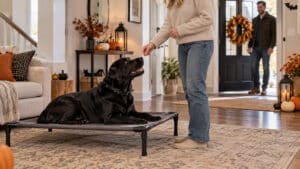
Teach Your Dog to Stay Calm When the Doorbell Rings
Does your dog lose their mind every time someone rings the doorbell?
You’re certainly not alone.
For many dogs, the doorbell has become a reliable signal that something exciting is about to happen. Someone arrives, the door opens, people talk, and the dog gets caught up in the activity.
Over time, this pattern can create increasingly intense reactions.
One of the most valuable skills you can teach is a reliable Place command.
Place teaches your dog to go to a designated location, such as a raised dog bed or mat, and remain there until released.
Instead of racing towards the front door, your dog learns an alternative behaviour that is predictable and rewarding.
Begin practising when the house is quiet. Once your dog understands the cue, gradually introduce distractions such as knocking, doorbell sounds and familiar visitors.
Reward your dog for remaining relaxed and responding correctly.
Remember, however, that a dog who is genuinely frightened of visitors needs more than obedience cues. Their emotional response must also be addressed through appropriate training which is where our In-Home Private dog training excels.
For dogs with significant door-related anxiety or reactivity, an individual training program may be more suitable than attempting to resolve the behaviour independently.
This is one of the many concerns we address through our In-Home private dog training in Hamilton, Burlington and surrounding communities.

Create a Safe Space Away From the Halloween Excitement
Here’s something many owners overlook: your dog doesn’t have to participate in Halloween.
In fact, for some dogs, the best Halloween experience is one where they barely notice anything unusual happening.
Creating a quiet, comfortable space away from the front entrance can make an enormous difference.
Choose a room where your dog already feels secure. Provide familiar bedding, fresh water and an appropriate chew or enrichment activity.
Closing the curtains can help reduce visual stimulation from people walking past windows. Soft background music or a television may also help mask some outdoor noises.
If your dog is comfortable in a crate, that may be another suitable option. However, Halloween night isn’t the time to introduce crate confinement to a dog that has never learned to relax inside one. The goal is to create a positive environment, not another source of stress.
For dogs that bark at strangers, struggle with excitement or become anxious around unfamiliar people, physical separation from the front door is often the most practical solution.
There’s nothing wrong with choosing management over training during an unusually busy evening.
Be Careful With Halloween Costumes and Decorations
We understand why people love dressing their dogs up for Halloween. Some costumes are entertaining, and the photographs can be adorable.
However, not every dog enjoys wearing clothing.
Watch your dog’s body language carefully. A dog that freezes, lowers their head, repeatedly tries to remove the costume or refuses to move may be uncomfortable.
Costumes should never restrict movement, breathing, hearing or vision. Avoid loose accessories that could become caught on furniture or create a choking hazard.
A simple Halloween-themed bandana may be a better choice for dogs that tolerate accessories but aren’t comfortable wearing full costumes.
It’s equally important to remember that people in costumes can be frightening to dogs.
A child wearing a large mask, carrying unusual props or moving unpredictably may look completely different from the people your dog normally encounters.
Don’t force your dog to approach someone in costume simply to prove that they’re friendly.
Allow them to observe from a comfortable distance, and reward relaxed behaviour.
Decorations can create similar challenges. Inflatable characters, motion-activated displays and flashing lights may startle dogs that haven’t encountered them before.
If your dog is uncertain, increase the distance rather than trying to make them investigate.
Prevent Door Dashing and Accidental Escapes
Halloween creates one of the most obvious opportunities for a dog to escape from the house.
With the front door opening repeatedly throughout the evening, even a dog that has never attempted to run outside may suddenly find themselves with an opportunity.
Excitement, fear or curiosity can cause a dog to move towards the doorway unexpectedly.
This is why management should always come before relying entirely on obedience.
Consider using a secure baby gate, closing an interior door or keeping your dog in another room while trick-or-treaters are visiting.
Make sure identification tags are current and that your dog’s microchip registration contains accurate contact information.
A reliable Stay command and good doorway manners are valuable skills, but they shouldn’t be your only protection.
Through our Hamilton dog training programs, we regularly emphasize impulse control and door boundaries because these behaviours have practical applications far beyond the training classroom.
A dog that understands how to wait calmly at an open door is easier to manage during deliveries, family gatherings and everyday activities.
Halloween simply highlights why these skills are so important.
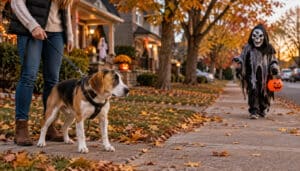
Learn to Recognize When Your Dog Is Overwhelmed
Dogs don’t always communicate stress through obvious barking or growling.
Sometimes the earliest signs are much more subtle.
You may notice repeated lip licking, yawning, pacing, trembling, excessive panting or difficulty settling.
Some dogs begin avoiding eye contact, retreating from activity or refusing treats they would normally enjoy.
Others become increasingly restless, vocal or reactive.
These behaviours can indicate that your dog is struggling with the environment.
One important concept in dog behaviour is the idea of a threshold. When a dog becomes too frightened or excited, their ability to respond to familiar commands may decrease significantly.
An owner may interpret this as stubbornness or disobedience when, in reality, the dog is overwhelmed.
If your dog is struggling, reduce the intensity of the situation.
Move them somewhere quieter, create distance from the trigger and allow them to recover.
Don’t insist that they remain in an uncomfortable situation simply because you want them to become accustomed to it.
Building confidence requires controlled experiences that your dog can handle successfully.
Keep Halloween Sweets and Decorations Out of Reach
While behaviour is our primary focus, Halloween also introduces several physical hazards that owners need to consider.
Chocolate is one of the best-known dangers, but it’s certainly not the only concern.
Some sugar-free sweets and chewing gums contain xylitol, a sweetener that can be extremely dangerous for dogs. Raisins and grapes are also toxic, while candy wrappers can create choking hazards or intestinal blockages.
Keep Halloween treats in secure containers and remind children not to share their sweets with the family dog.
Decorations deserve attention as well.
Electrical cords, candles, batteries, glow sticks and small decorative objects can all create unnecessary risks, particularly for curious puppies.
Battery-powered candles are generally a safer choice than open flames, provided they remain out of your dog’s reach.
If your dog consumes chocolate, xylitol or another potentially toxic substance, contact your veterinarian or an emergency veterinary clinic immediately. Don’t wait for symptoms to develop or attempt to induce vomiting without veterinary direction.
A little prevention goes a long way towards avoiding an emergency.
Think Carefully Before Taking Your Dog Trick-or-Treating
Just because your dog enjoys walks doesn’t mean they’ll enjoy trick-or-treating.
A typical neighbourhood walk is very different from walking through crowded streets filled with excited children, unfamiliar costumes, flashing lights and unpredictable movement.
For some dogs, this environment can become overwhelming very quickly.
Reactive dogs may struggle with people approaching from different directions. Nervous dogs may become frightened by costumes, while excitable dogs may find it difficult to remain calm around so much activity.
Even friendly, well-socialized dogs can have limits.
If your dog has previously shown anxiety, reactivity or difficulty coping with crowds, our recommendation is to leave them at home in a comfortable, secure environment.
If you choose to take a confident, well-trained dog along, use a secure leash and harness, avoid crowded areas and watch their body language closely.
Never allow unfamiliar people or children to approach and touch your dog without your permission.
Remember that your dog doesn’t understand why everyone is dressed differently or behaving unusually.
They only know what they’re experiencing in that moment.
Give Puppies, Reactive Dogs and Newly Adopted Dogs Extra Consideration
Not every dog approaches Halloween with the same experience or confidence.
Puppies are still learning about the world. While positive exposure to new environments can be beneficial, too much stimulation can have the opposite effect.
Allow puppies to observe decorations, costumes and outdoor activity from a comfortable distance rather than expecting them to participate in everything.
For dogs that struggle with reactivity towards strangers, Halloween can be particularly challenging.
Repeatedly exposing a reactive dog to unfamiliar people approaching the house may increase barking, lunging or defensive behaviour.
In these situations, preventing unnecessary encounters is often more beneficial than attempting to use the evening as an intensive training session.
Newly adopted dogs deserve additional consideration.
A dog that has recently entered a new home may still be adjusting to their surroundings, developing trust and learning the household routine.
Introducing an unusually busy evening can add stress to an already significant transition.
At K9 Principles, our experience working with the Hamilton/Burlington SPCA and Hamilton Animal Services has reinforced the importance of understanding each dog’s individual needs and history.
There’s no single Halloween plan that works for every dog.
The right approach is the one that keeps your dog safe, comfortable and able to cope with their surroundings.
Know What to Do If Your Dog Starts Barking, Lunging or Panicking
Even with preparation, some dogs may struggle when Halloween arrives.
Perhaps someone wearing an elaborate costume approaches the house, or the repeated doorbell ringing becomes too much.
Your dog begins barking, pulling, pacing or showing signs of fear.
What should you do?
First, focus on reducing the pressure your dog is experiencing.
Increase the distance between your dog and whatever is causing the reaction. Move them to a quieter part of the house or away from the busy environment.
Avoid forcing interactions or repeatedly demanding commands when your dog is already overwhelmed.
If your dog can still respond calmly to familiar cues, reward those responses. If they cannot, focus on helping them settle rather than pushing through the situation.
It’s also important to recognize the difference between temporarily managing a behaviour and making lasting improvements.
Moving your dog away from a stressful situation can prevent further escalation, but it doesn’t necessarily resolve the underlying fear, frustration or reactivity.
Those concerns are best addressed through a structured training plan that identifies why the behaviour is occurring and develops appropriate skills over time.
Professional dog training can help owners understand these patterns and learn how to respond before situations escalate.
Halloween Behaviour Problems Often Reveal Everyday Training Gaps
Here’s something worth considering.
If your dog struggles to settle when people approach the house on Halloween, there’s a good chance similar challenges happen throughout the year.
Maybe your dog barks excessively when deliveries arrive, jumps on visitors, rushes through doorways or becomes overly excited whenever something changes in their environment.
Halloween doesn’t necessarily create these behaviours. It often makes existing challenges more noticeable.
That’s why we encourage owners to look beyond simply surviving one evening.
Teaching impulse control, reliable obedience, calmness around distractions and appropriate responses to visitors can improve everyday life for both dogs and owners.
At K9 Principles Dog Training, we offer several programs designed to help owners work towards these goals.
Our group obedience classes focus on important foundation skills, including Sit, Down, Stay, Recall, Place, leash manners and impulse control.
For dogs struggling with reactivity, anxiety or more specific behavioural concerns, our In-Home Private Training allows us to address challenges where they actually occur.
We also offer comprehensive Board & Train programs for owners who need a more intensive training solution, with individualized training, private transition lessons and ongoing support.
With over 30 years of professional experience, K9 Principles provides dog training in Hamilton, Burlington, Caledonia and surrounding communities, helping owners develop practical skills they can use in everyday situations.
Halloween may be one night of the year, but the benefits of proper training can last far beyond October.
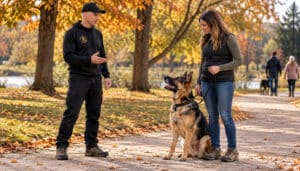
Conclusion: A Successful Halloween Starts With Understanding Your Dog
Halloween should be enjoyable, but your dog’s well-being should always come first.
Some dogs can comfortably relax while trick-or-treaters visit. Others are better off spending the evening in a quiet room, away from the constant activity.
Neither situation represents success or failure in dog training.
The goal is to understand your dog’s abilities, recognize their limits and create an environment where they feel safe.
Prepare early, practise important skills, manage the front door carefully and pay attention to your dog’s body language.
Most importantly, don’t measure your dog’s progress by how much Halloween excitement they can tolerate.
Measure it by their growing confidence, ability to settle and willingness to respond to you in everyday situations.
If barking, reactivity, overexcitement or difficulty settling are ongoing concerns, professional training can help you work towards lasting improvements.
At K9 Principles, we believe a strong training foundation makes everyday life easier for both dogs and their owners.
Whether you’re looking for Hamilton dog training, private lessons in your home or a structured Board & Train program, our experienced team is here to help.
Visit www.k9principles.ca to learn more about our programs and how we can help you build a better relationship with your dog.
Contact us for more information:
- Name: K9 Principles
- Address: Haldimand County, Greater Hamilton Area, Burlington, and Most of Norfolk County
- Phone: 289 880-3382
- Email: k9principlesinc@gmail.com
- Website: www.k9principles.ca
FAQs
-
A1. Halloween introduces unusual sounds, unfamiliar people, costumes and repeated activity around your home. These changes can cause excitement, uncertainty or fear, leading to increased barking. Managing your dog’s environment and practising calm responses to visitors before Halloween can help reduce these reactions.
