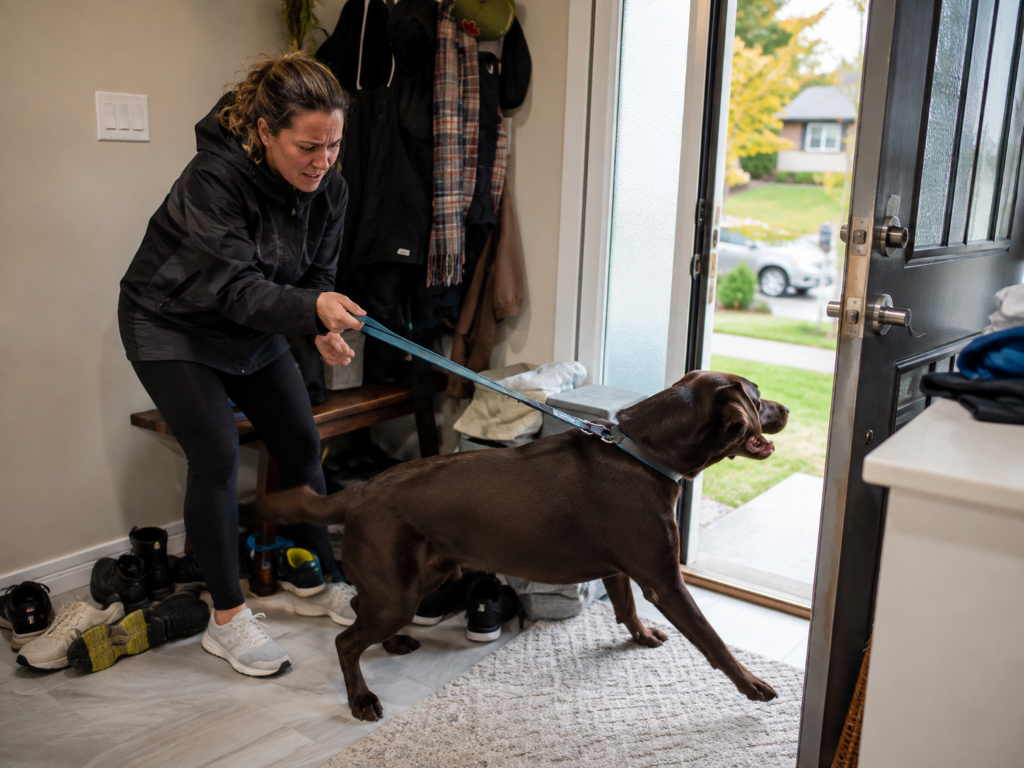





Maybe the walks have become harder.
Your dog is pulling more. Barking at other dogs. Ignoring you when something exciting appears. Jumping on visitors. Charging through doors. Refusing to settle. Perhaps the behaviour is not terrible every day, which makes it easy to tell yourself that you will deal with it when life settles down.
Then another week passes.
Work gets busy. The kids need something. The weather turns bad. You are tired at the end of the day. Training becomes something you fully intend to start tomorrow.
Meanwhile, your dog keeps practising the same behaviour.
This is one of the most frustrating parts of dog behaviour problems. Waiting often feels harmless, but dogs are learning every single day whether we are deliberately training them or not.
At K9 Principles, we have spent more than 30 years helping families understand and change dog behaviour. One thing we have seen repeatedly is that problems are usually easier to address before they have been practised hundreds or thousands of times.
That does not mean you have failed your dog by waiting.
Life gets busy.
It simply means that if your dog is already making daily life difficult, there is rarely an advantage to hoping the behaviour disappears on its own.
Dogs Get Better at What They Practise
Dogs learn through repetition.
If your dog pulls towards every interesting smell and eventually reaches it, pulling has worked.
If barking at another dog creates more distance, barking may feel effective.
If jumping gets attention from visitors, jumping can become a successful strategy.
If ignoring a recall allows another thirty seconds of chasing squirrels, ignoring you has been rewarded by the environment.
The more often these behaviours happen, the more familiar and automatic they can become.
This is why dog training is not simply about teaching commands such as sit, down or stay. Good training also changes the habits your dog uses throughout everyday life.
Waiting gives unwanted habits more opportunities to become established.
Small Problems Can Quietly Become Big Problems
Behaviour issues do not always explode overnight.
Sometimes they creep into your life.
A little pulling becomes a dog you dread walking.
Occasional barking at dogs becomes lunging at the end of the lead.
Excited jumping becomes a dog that must be put away whenever guests arrive.
Ignoring a recall becomes a dog that can no longer safely enjoy the freedom you hoped to give them.
Before long, families start adjusting their lives around the dog.
They walk at quieter times. Stop inviting people over. Avoid certain streets. Stop taking the dog places. Keep the dog behind gates when visitors arrive.
Those adjustments can make life easier temporarily, but they do not necessarily change the behaviour itself.
The goal of good dog behaviour training is not simply to manage life around the problem. Whenever possible, it is to teach the dog better ways of handling everyday situations.
Your Dog Does Not Know You Are Waiting
People often think, “We will work on this when things calm down.”
Your dog has no idea that is the plan.
From your dog’s point of view, life is happening right now.
Every walk is another learning opportunity. Every visitor is another repetition. Every doorway, squirrel, passing dog, meal, car ride and evening at home is teaching something.
This is one reason consistency matters so much.
A dog does not separate a formal ten-minute dog training session from everything else that happens during the day. Behaviour is being shaped constantly.
That principle is also at the heart of the K9 Principles home-based Board and Train program.
Training Should Happen Through Real Daily Life
Formal training sessions are useful, but they are only part of the picture.
A dog can perform a beautiful sit during a quiet training session and still drag someone through the front door five minutes later.
Real improvement comes when good behaviour becomes part of everyday life.
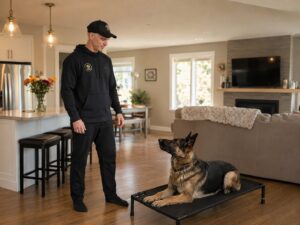
At K9 Principles, dogs in our Board and Train programs live inside our home in Caledonia. They are not housed in outdoor kennel runs, detached kennel buildings or outbuildings.
That distinction matters.
Living inside a home gives us opportunities to work on behaviour throughout the day. Dogs practise waiting at doors, settling when nothing exciting is happening, walking politely, responding around household distractions, resting appropriately and making better choices as normal life happens around them.
Training is not something that begins when a stopwatch starts and ends ten minutes later.
It becomes part of the dog’s day.
If you would like to understand how this differs from traditional kennel-style programs, read our article “Why Home-Based Board and Train Is Different from Kennel-Style Training” and visit our main Board and Train page for a complete explanation of our programs.
Structure Can Make Life Much Clearer for a Dog
Many behaviour problems are made harder by inconsistency.
One day jumping works. The next day it does not.
Pulling is corrected on Monday but allowed on Tuesday because everyone is running late.
The dog is expected to settle sometimes but spends other evenings constantly demanding attention.
This does not make someone a bad dog owner. It makes them human.
Most families have jobs, children, appointments, traffic, errands and responsibilities that have absolutely nothing to do with dog training.
But dogs often thrive when the rules become predictable.
Board and Train gives us an opportunity to create that consistency every day.
The dog begins learning what behaviours work, what behaviours do not, and what we would like them to do instead.
Over time, clearer expectations can help create calmer behaviour, stronger household manners and a dog that is considerably easier to live with.
Waiting Can Allow Emotional Reactions to Become Stronger
Some behaviour problems involve more than manners.
Reactivity is a good example.
A dog may initially become slightly tense when another dog appears. Then barking begins. Eventually the reaction may include pulling, lunging, spinning or complete loss of focus.
Each experience can add another layer to the dog’s emotional response.
This is why good training does not simply focus on stopping noise at the end of the lead. We need to understand what is happening before the explosion and teach the dog how to respond differently.
The sooner those patterns are addressed, the less history we have to work through.
That does not mean an older or experienced reactive dog cannot improve. Many can make tremendous progress.
It simply means there is rarely a benefit in deliberately giving the behaviour another six months to become stronger.
Maturity Alone Does Not Teach Manners
We frequently hear some version of, “I thought he would grow out of it.”
Sometimes maturity does help certain puppy behaviours soften.
But age by itself does not teach loose lead walking.
Age does not teach a reliable recall.
Age does not automatically teach a dog to ignore other dogs, settle around visitors, stop jumping or listen when the environment becomes exciting.
In fact, an adolescent dog becoming bigger, stronger and more confident can make previously manageable behaviours much harder.
A twenty-pound puppy pulling on a lead is inconvenient.
A seventy-pound adult dog doing exactly the same thing can completely change someone’s ability to walk them safely.
Training gives maturity direction.
Busy Owners Often Know What Needs Fixing but Struggle to Find the Time
Many of the people who contact us are not confused about whether their dog needs training.
They already know.
The problem is fitting consistent training into real life.
You may have watched videos. Attended a class. Bought treats. Started practising.
Then work ran late three nights in a row.
The weather was miserable.
Someone got sick.
The dog was difficult on a walk and you simply did not have the energy to turn that walk into another training session.
This is precisely why Board and Train can be such a valuable option for some families.
It creates a period where training, structure and consistency can become the dog’s daily routine while the owner continues handling everything else life requires.
For a deeper look at this challenge, our article “Why Dog Training Is So Hard to Maintain When Life Is Already Busy” explains why struggling to find enough training time is far more common than many owners realise.
Board and Train Creates Momentum
One of the greatest benefits of a well-run Board and Train program is momentum.
Instead of squeezing training into whatever time remains at the end of the day, the dog receives consistent guidance throughout each day.
We can repeat skills appropriately, work through different environments and gradually increase distractions as the dog becomes ready.
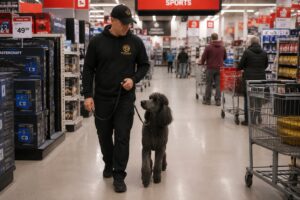
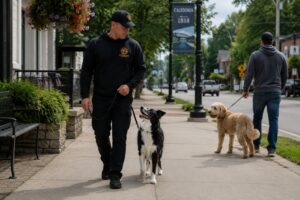
Depending on the individual dog and program, training may move beyond the home into neighbourhoods, public areas and dog-friendly retail environments.
That matters because dogs are extremely good at learning context.
A dog that listens beautifully in the living room may act as if they have never heard their name when they enter a busy store.
Good dog obedience training must eventually help the dog understand that the same expectations apply in different environments.
Board and Train Is Not About Sending Home a Perfect Dog
This needs to be said clearly.
No responsible trainer can place a dog into a program, press a reset button and guarantee that every behaviour will permanently disappear.
Dogs are living animals.
Behaviour requires maintenance.
The environment matters. The owner matters. Continued practice matters.
Our job during Board and Train is to build stronger foundations, create better habits, improve communication and give owners a much better starting point than they had before.
Then we teach the owner how to continue that progress.
That is why our programs include private follow-up instruction where applicable. We show owners what their dog has learned, how to handle them, what expectations need to continue and how to avoid accidentally returning to the old patterns.
Families also receive regular progress updates during their dog’s stay, along with lifetime email and telephone support after the program.
Our article “Board and Train Is Not a Magic Fix—But It Can Change Daily Life” explores this important distinction in greater detail.
The Goal Is to Make Everyday Life Easier
The true measure of dog training is not how impressive a dog looks during a demonstration.
It is what happens on Tuesday evening when someone knocks on your front door.
It is whether you can walk through your neighbourhood without being dragged down the pavement.
It is whether your dog can settle while your family watches television.
It is whether you can take your dog somewhere without spending the entire outing managing chaos.
It is whether you feel comfortable including your dog in your life again.
That is the outcome we care about.
Better manners.
Clearer communication.
More control.
More freedom.
And a calmer relationship between the dog and the people living with them.
Experience Matters When Behaviour Has Become Complicated
Dog behaviour rarely fits neatly into a single category.
Pulling can involve excitement, frustration or habit.
Barking may come from fear, arousal, anticipation or learned behaviour.
A dog that appears stubborn may simply not understand what is expected when distractions increase.
Recognising those differences matters.
K9 Principles brings more than 30 years of dog-training experience to the dogs we work with. We are also the exclusive dog-training partner for the Hamilton/Burlington SPCA and Hamilton Animal Services, giving us extensive experience working with dogs from very different backgrounds and with very different training needs.
Families searching for dog training in Hamilton or comparing Hamilton dog training programs should look beyond the list of commands being promised.
The real question is whether the program can help create a dog that functions better in the life you actually live.
You Do Not Have to Wait Until the Problem Becomes Unmanageable
One of the biggest misconceptions about professional training is that the situation needs to become terrible before asking for help makes sense.
It does not.
You do not need to wait until your shoulder hurts from walking the dog.
You do not need to wait until visitors stop wanting to come over.
You do not need to wait until your dog has practised ignoring you for another year.
And you certainly do not have to wait until you feel completely overwhelmed.
Getting started earlier usually gives us fewer rehearsed habits to change.
That can make the path forward much clearer.
For families across the greater Toronto and Hamilton area, including Haldimand County, our home-based Board and Train programs provide a practical option when consistent training has become difficult to maintain at home.
Tomorrow Usually Looks a Lot Like Today Unless Something Changes
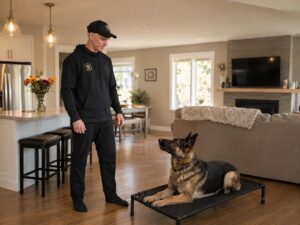
It is easy to hope a behaviour problem will improve with time.
Sometimes it does.
More often, the dog simply becomes more experienced at doing what they have already been doing.
Another month of pulling is another month of practising pulling. Another month of barking at dogs is another month of rehearsing that reaction. Another month of ignoring recalls strengthens a very different habit from the one you ultimately want.
You do not need to feel guilty about the time that has already passed.
What matters is what happens next.
With the right structure, consistency and dog training plan, behaviour can change. Your dog can learn clearer expectations. Daily life can become calmer. Walks can become more enjoyable. Household manners can improve. You can begin enjoying your dog instead of constantly managing them.
K9 Principles offers home-based Board and Train from Caledonia for families throughout Hamilton, Haldimand County and the greater Toronto and Hamilton area. Your dog lives inside our home, trains throughout real daily life and receives the consistent structure needed to begin building better habits.
Explore our Board and Train programs to see which option may suit your dog, or submit an enquiry to K9 Principles and tell us what is making life difficult right now.
Waiting rarely makes behaviour problems easier.
Starting gives you somewhere to go.
Contact us for more information:
- Name: K9 Principles
- Address: Haldimand County, Greater Hamilton Area, Burlington, and Most of Norfolk County
- Phone: 289 880-3382
- Email: k9principlesinc@gmail.com
- Website: www.k9principles.ca
FAQs
-
A1. Some puppy behaviours may decrease with maturity, but most learned behaviours do not disappear simply because a dog gets older. If pulling, barking, jumping, ignoring commands or other behaviours continue to be practised and rewarded, they can become stronger habits. Training teaches the dog what to do instead.