




You know your dog needs training.
The problem is that life does not stop long enough to make it easy.
There is work. Family. Appointments. Traffic. Responsibilities. A hundred things competing for your attention before you even think about finding another hour to work on loose-leash walking, jumping, door manners or staying calm when someone comes to the house.
That is one of the reasons Board and Train can be such an appealing option.
Someone experienced takes over the daily training for a period of time, builds better habits and gives you a stronger foundation to continue when your dog comes home.
But there is an important question that often gets overlooked.
Where does your dog actually live while all of this is happening?
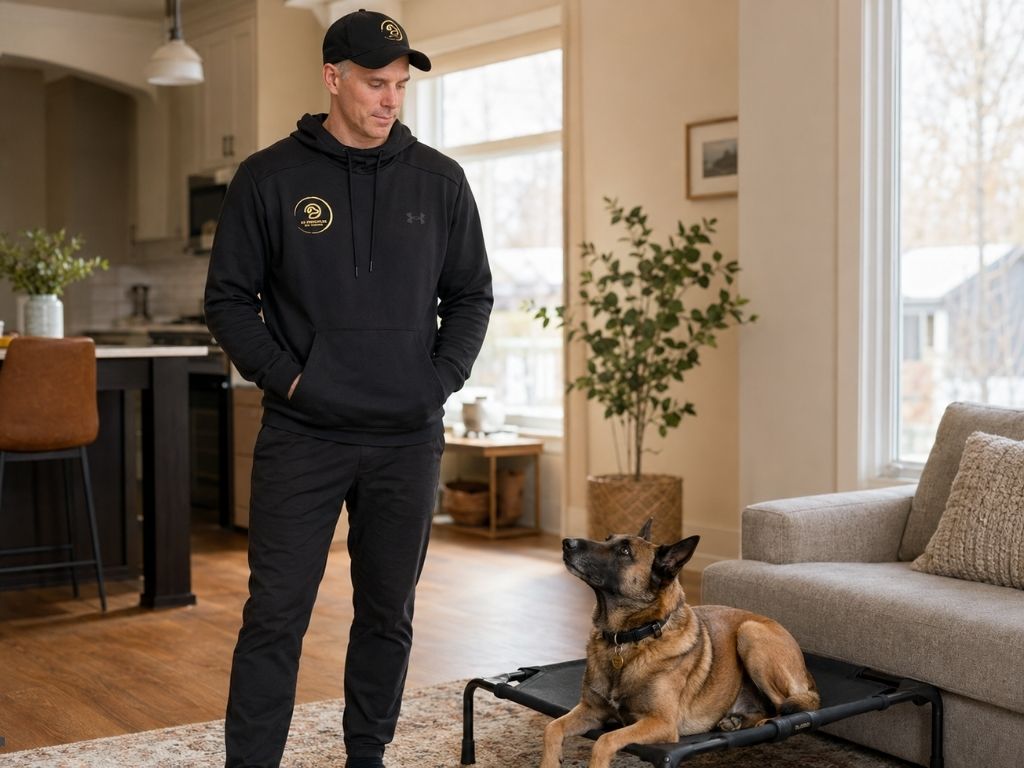
At K9 Principles, our Board and Train dogs live inside our home in Caledonia, Ontario.
They are not housed in rows of outdoor kennel runs. They are not spending most of their day in a detached kennel building or outbuilding before being brought out for scheduled training sessions.
They live around the everyday situations they eventually need to handle successfully with you.
That difference matters.
Board and Train Should Prepare Your Dog for Real Life
Most people are not looking for a dog that behaves beautifully inside a training facility.
They want a dog that is easier to live with at home.
They want to enjoy walking through the neighbourhood without being dragged down the street.
They want to answer the door without chaos.
They want their dog to settle while the family watches television.
They want to cook dinner without a dog constantly underfoot.
They want guests to walk into the house without being jumped on.
They want more communication, more predictability and less stress.
That is why our approach to Board and Train is built around daily life.
Formal training sessions are important, but they are only one part of the process.
The rest happens while the dog is simply living.
What Does Home-Based Board and Train Actually Mean?
When your dog stays with K9 Principles, they become part of the household environment during their program.
That gives us opportunities to work on behaviour throughout the day rather than limiting learning to one or two structured sessions.
Getting out of a crate calmly becomes training.
Walking through a doorway becomes training.
Waiting while food is prepared becomes training.
Settling while people are moving around becomes training.
Going outside becomes training.
Coming back inside becomes training.
Responding when distracted becomes training.
Learning to relax when nothing exciting is happening becomes training too.
These small moments are often where better household behaviour is really created.
A dog does not simply need to know commands. The dog needs to learn how those skills fit into everyday life.
For owners comparing options for dog training in Hamilton, this is one of the biggest differences worth considering.
Why Environment Matters in Dog Training
Dogs are very good at learning patterns.
Unfortunately, they are also very good at learning that different rules apply in different places.
A dog may perform an excellent sit, down, heel or place command during a formal training session and still behave completely differently once daily life begins again.
That happens because obedience and lifestyle behaviour are not exactly the same thing.
We want both.
Your dog needs useful obedience skills, but your dog also needs to understand how to function calmly within a household.
A home environment allows us to work on that connection every day.
Instead of repeatedly moving between a kennel environment and a training environment, the dog is learning while surrounded by many of the same situations they will eventually experience at home with their family.
That gives us opportunities to build habits, not simply practise exercises.
Training Does Not Stop When the Session Ends
One of the biggest misconceptions about professional dog training is that the trainer works with the dog for a scheduled session and then the learning stops.
With home-based Board and Train, we do not see it that way.
The structured session may finish, but expectations remain.
If we have been teaching a dog not to charge through doorways, we do not suddenly forget about door manners because the official training session is over.
If we are teaching a dog to settle on place, we use that skill while real household activity is happening.
If we are working on leash manners, those expectations apply when we are moving the dog from one location to another.
If we are developing impulse control, we look for opportunities to reinforce it throughout normal daily routines.
This consistency is important because dogs learn through repetition.
The more often the right behaviour becomes part of everyday life, the more familiar that behaviour becomes.
Calm Behaviour Has to Be Practised Too
Many owners understandably focus on stopping unwanted behaviours.
Stop jumping.
Stop pulling.
Stop barking.
Stop charging the door.
Stop grabbing things.
Stop bouncing around the house.
But successful dog training is not only about stopping behaviour. We also have to teach the dog what we want instead.
Very often, that means teaching calmness.
Some dogs simply have very little experience doing nothing.
They know how to play. They know how to run. They know how to demand attention. They know how to react when something exciting happens.
They may not know how to switch off.
Home-based Board and Train gives us many opportunities to teach that skill.
A dog can learn that life does not always need to be exciting. They can learn to settle while someone works, cooks, eats or relaxes nearby.
That ability can dramatically change what living with a dog feels like.
It creates more harmony in the home because the dog begins to understand that calm behaviour is part of normal life.
Structure Creates Predictability
Structure is sometimes misunderstood as being overly strict.
That is not what we mean.
Good structure creates clarity.
Dogs tend to do better when they understand what is expected of them.
When rules constantly change, behaviour can become inconsistent. When expectations are clear and consistently reinforced, the dog has a much easier job.
During a K9 Principles Board and Train program, structure may include how the dog moves through doors, behaves around food, walks on leash, responds to commands, settles in the house and manages exciting situations.
The goal is not to create a robotic dog.
The goal is to create a dog that understands how to live successfully within a human household.
For many busy families researching Hamilton dog training, that is the result they are actually searching for.
They do not simply want more commands.
They want daily life to become easier.
Kennel-Style Training and Home-Based Training Are Not the Same Experience
There are excellent trainers who operate kennel-based Board and Train programs, and the quality of a training program should never be judged solely by whether kennels are involved.
But the environment is different.
Traditional kennel-style programs may house dogs in dedicated kennel buildings or runs and bring them out for exercise and training throughout the day.
Our model is different by design.
K9 Principles Board and Train dogs live inside our home.
That means household manners are not something we try to recreate during an occasional training exercise. They are part of the dog’s everyday experience.
We can observe how the dog behaves between sessions.
We can see what happens when they are tired.
We can see how quickly they settle.
We can identify patterns that might not appear during a formal training exercise.
Those observations can help us make better training decisions.
It also allows us to practise the behaviour that matters when the dog eventually returns home.
Real-Life Training Creates More Useful Skills
Imagine a dog that has learned a perfect “place” command inside an empty training room.
That is a good start.
Now imagine that same dog holding place while someone walks across the room, food is being prepared and everyday household activity is happening around them.
That is a much more useful skill.
The same principle applies to many areas of dog training.
Loose-leash walking matters more when distractions appear.
Door manners matter when someone actually comes through the door.
A down stay matters more when the environment is active.
Recall matters more when the dog would rather do something else.
Training becomes valuable when it works outside the controlled exercise where it was originally taught.
Our home-based model gives us opportunities to make those connections throughout the dog’s stay.
Your Dog Still Needs You After Board and Train
Board and Train can accomplish a tremendous amount of work in a concentrated period of time.
What it cannot do is remove the owner from the equation.
Your dog is ultimately coming home to you.
That means you need to understand what the dog has learned, how the training works and what needs to continue.
We do the heavy lifting during the Board and Train program, but successful long-term results still require consistency once your dog returns home.
That is why owner education is an important part of the K9 Principles approach.
Depending on the program, private follow-up lessons help show owners how to use the training correctly and how to maintain the structure that has been created.
We are not interested in simply handing you a trained dog and wishing you luck.
We want you to understand how to keep moving forward.
Our clients also receive lifetime email and telephone support, giving them somewhere to turn when questions come up later.
Board and Train should give you a stronger starting point, not leave you wondering what to do next.
You Should Know What Is Happening While Your Dog Is Away
Sending your dog away for training is a big decision.
We understand that.
For many people, this may be the first time their dog has been away from them for an extended period.
You should not have to spend that time wondering what is happening.
K9 Principles provides regular progress updates throughout our Board and Train programs, including photographs and videos where appropriate.
These updates allow you to see the training taking shape.
You can see the behaviours being worked on, the dog’s progress and the skills being developed.
More importantly, the updates help owners begin understanding the training before their dog even comes home.
That makes the transition back into the household much easier.
Experience Matters When Someone Else Is Training Your Dog
Choosing a Board and Train program means placing a great deal of trust in the trainer.
K9 Principles brings more than 30 years of dog-training experience to that responsibility.
We have worked with dogs and families through a wide range of training challenges, from basic manners and obedience to more difficult behavioural concerns.
K9 Principles is also the exclusive dog-training partner of the Hamilton/Burlington SPCA, a relationship that reflects the level of experience, education and responsibility we bring to our work.
Experience does not mean claiming every dog will become perfect.
It means understanding that dogs are individuals.
They learn at different speeds. They respond differently to pressure, distractions, environments and reinforcement. Training plans sometimes need to change as we learn more about the dog.
That is exactly why an experienced trainer matters.
Board and Train Is Not a Magical Reset Button
We believe strongly in Board and Train, but we also believe in presenting it honestly.
Your dog does not return home permanently “fixed”.
Dogs are living animals, not machines.
Behaviour can change when routines change. Skills can become weaker when they are not used. Old habits can return if they are repeatedly allowed to happen again.
What Board and Train can do is create an enormous head start.
Instead of trying to build every skill from the beginning while already managing a busy household, you receive a dog with established training, clearer expectations and better habits.
Then we teach you how to continue that work.
For many overwhelmed owners, that changes everything.
The task becomes maintaining something that has already been built rather than trying to create the entire foundation while juggling the rest of life.
If you have read our article Why Dog Training Is So Hard to Maintain When Life Is Already Busy, this is exactly where Board and Train can help bridge the gap between knowing what needs to happen and actually having enough time to build it consistently.
The Goal Is to Make Life With Your Dog Easier
Ultimately, this is what matters.
Dog training should improve your life with your dog.
It should make walks more enjoyable.
It should make the house calmer.
It should make communication clearer.
It should reduce the constant need to manage, correct, chase, repeat and negotiate.
It should allow you to enjoy more of the reasons you wanted a dog in the first place.
That is also why our Board and Train series talks so much about stress, time and household harmony.
The goal is not simply to produce impressive obedience.
The goal is to create behaviour that makes everyday life better.
You can also read How Board and Train Helps Create a Calmer, More Peaceful Home for a closer look at how training, structure and predictable routines can change the atmosphere inside your household.
Home-Based Board and Train in Caledonia, Ontario
K9 Principles is located in Caledonia and provides Board and Train services to families throughout Haldimand County, the Greater Hamilton Area and the Greater Toronto Area.
For people searching for dog training in Hamilton, Board and Train offers another option beyond weekly classes or traditional private lessons.
It can be especially valuable when your schedule makes consistent daily training difficult or when your dog’s behaviour has reached the point where you need more help than occasional lessons can provide.
Our Board and Train programs vary based on the dog’s age, training goals and the level of training required.
Programs include options ranging from foundational manners and household obedience to more advanced training.
You can explore the full K9 Principles Board and Train programs to compare the different options and see which program may best match your dog.
Where Your Dog Lives During Training Matters
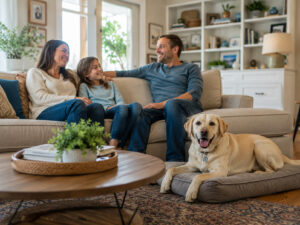
Not all Board and Train programs are built the same way.
At K9 Principles, we made a deliberate choice to keep our program home-based because the behaviour most families care about happens at home and throughout everyday life.
Your dog lives inside our home.
Training happens during structured sessions, but it also continues through doorways, walks, feeding routines, quiet time, household activity and all the ordinary moments that shape a dog’s behaviour.
We build obedience, but we also build structure.
We teach commands, but we also teach household manners.
We practise activity, but we also teach dogs how to settle.
And when your dog comes home, we help you understand how to continue what we started through private follow-up training, owner education and lifetime email and telephone support.
Board and Train is not magic.
It is concentrated, consistent professional training designed to build a stronger foundation and make life with your dog easier.
If you are considering Board and Train in Hamilton, Haldimand County, the Greater Toronto Area or surrounding communities, explore the K9 Principles Board and Train programs or submit an enquiry to tell us about your dog.
We would be happy to help you determine whether Board and Train is the right next step.
Contact us for more information:
- Name: K9 Principles
- Address: Haldimand County, Greater Hamilton Area, Burlington, and Most of Norfolk County
- Phone: 289 880-3382
- Email: k9principlesinc@gmail.com
- Website: www.k9principles.ca
FAQs
-
A1. Board and Train dogs stay inside the K9 Principles home in Caledonia, Ontario. Our program is home-based rather than centred around outdoor kennel runs, detached kennel buildings or outbuildings. This allows dogs to experience household routines and practise manners within a real home environment throughout their stay.