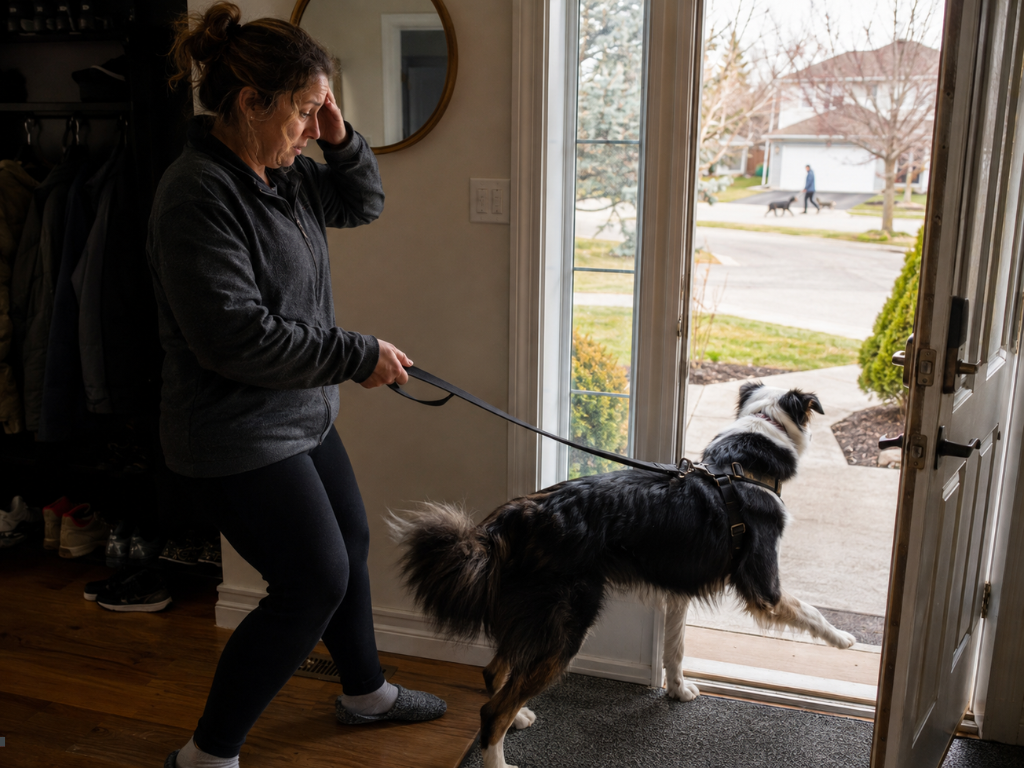





There is a point where living with a difficult dog stops feeling like a training problem and starts feeling like your entire life is being organised around the dog.
You think about who is coming to the house before inviting anyone over.
You check the street before stepping outside.
You choose quieter walking routes because you are worried about what might happen if another dog appears.
You avoid taking your dog places because the pulling, barking, jumping, lunging or general chaos simply is not worth the stress.
Maybe you have stopped having people over as often. Maybe walks have become something you dread instead of enjoy. Maybe every doorway, every visitor and every trip in the car feels like another situation you have to manage.
And somewhere along the way, you realise something uncomfortable.
Your dog’s behaviour has started controlling your life.
That does not mean you have failed your dog. It means the current situation is not working, and something needs to change.
At K9 Principles Dog Training, our Board and Train programs are designed for exactly this kind of situation. We take on the daily training workload, establish clearer structure and better habits, and help create a dog that is easier to live with when they return home.
For many overwhelmed owners, that can be the first real step towards getting their life back.
When Everyday Life Becomes a Management Exercise
Most dog owners can handle the occasional bad walk or embarrassing moment.
The problem begins when those moments stop being occasional.
Your dog pulls so badly that you avoid certain routes. They explode at other dogs, so you walk at unusual times. They jump all over visitors, so you put them in another room whenever someone arrives. They cannot settle, so evenings become constant management. Their recall is unreliable, so freedom is out of the question.
Before long, your decisions start revolving around preventing the next problem.
That is exhausting.
You are not simply living with your dog anymore. You are constantly anticipating them.
Good dog training should reduce that burden. It should create more predictability, better communication and clearer expectations so everyday situations stop feeling like potential battles.
That is one of the main reasons owners come to us looking for Board and Train in Hamilton and the surrounding area.
They are not necessarily looking for a perfect dog.
They are looking for a life that feels manageable again.
You May Not Need More Information. You May Need More Consistency
Most owners struggling with their dogs are not lacking information.
They have watched videos. They have read articles. They have tried advice from friends. They may have attended group classes, booked private lessons or experimented with several different training methods.
The challenge is often turning that information into consistent training every single day.
That is where real life gets in the way.
Work runs late. The children need something. Dinner has to be made. Traffic was terrible. You are tired. The dog is excited. Someone comes to the door. A walk that was supposed to become a training session turns into an exercise in simply getting around the block.
None of this makes someone a bad dog owner.
It makes them human.
But dogs learn through repetition and consistency. When the right behaviours are practised over and over again, they become stronger. When unwanted behaviours are repeatedly rehearsed, those can become stronger too.
Our Board and Train programs remove many of those daily obstacles by allowing us to make training part of the dog’s entire routine.
We do the daily training.
We establish the structure.
We build the foundation.
Then we teach you how to continue it.
Board and Train Gives Training the Time It Needs
There is an enormous difference between practising something for ten minutes and living it throughout the day.
That is one of the greatest advantages of a properly designed residential dog training program.
At K9 Principles, training does not begin when we pick up a leash and end when we put it down.
It happens when the dog comes out of the crate.
It happens while walking through doors.
It happens during feeding.
It happens when settling in the house.
It happens during walks, play, rest periods and everyday movement around the home.
A dog that struggles with impulse control does not only need to practise impulse control during a formal session. They need opportunities to practise it throughout normal life.
A dog that cannot settle does not simply need a “place” command. They need to learn that calm behaviour is part of their daily routine.
A dog with poor manners needs those manners reinforced consistently, not just for a few minutes at a time.
This is why our approach to Board and Train focuses so heavily on real-life structure.
We are not simply teaching commands.
We are teaching the dog a better way to live.
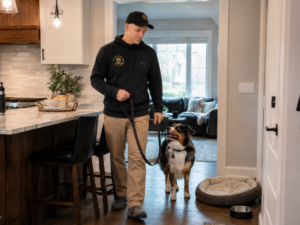
Your Dog Lives Inside Our Home
Not all Board and Train programs operate the same way.
K9 Principles is a home-based Board and Train program located in Caledonia, Ontario, serving the greater Hamilton area and Haldimand County.
Dogs staying with us live inside our home.
They are not housed in outdoor kennel runs.
They are not kept in a detached kennel building.
They are not trained during the day and placed in an outbuilding when the work is finished.
That distinction matters because household behaviour is one of the most important parts of living successfully with a dog.
Dogs need to understand what is expected when people are eating, moving around the kitchen, opening doors, sitting down in the evening or simply trying to relax.
Training inside a real home gives us opportunities to work on those behaviours naturally.
The goal is not simply to create a dog that performs well in a training environment.
The goal is to create better habits that carry into everyday family life.
For owners researching dog training in Hamilton, we believe that difference is worth understanding before choosing any residential training program.
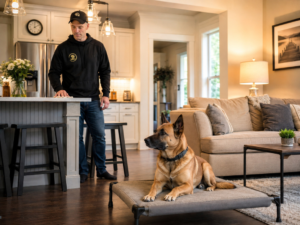
Structure Can Change the Entire Feel of a Household
Many behavioural problems become worse when the dog does not understand what is expected of them.
Everything becomes negotiable.
The dog decides when to demand attention. They rush through doors. They drag people on walks. They jump when excited. They ignore instructions when something more interesting appears. They pace around the house instead of settling.
Structure changes that relationship.
Structure does not mean removing all freedom or turning life into an endless obedience exercise.
It means creating clear, predictable expectations.
The dog learns when it is time to work, when it is time to settle, how to move with their handler, how to wait, how to respond and how to make better choices.
As those habits become more consistent, something important often happens.
The household becomes calmer.
The owner stops repeating themselves constantly.
Daily routines become easier.
The dog becomes easier to include rather than easier to avoid.
That is the outcome we want from dog training.
Not simply better obedience on command, but a better life together.
Better Behaviour Creates More Freedom, Not Less
Owners sometimes worry that structure will make their dog’s life overly strict.
In reality, reliable behaviour usually creates more freedom.
A dog that walks politely can go on more walks.
A dog that settles appropriately can spend more time with the family.
A dog with better manners can be included when visitors arrive.
A dog with stronger recall has the potential to enjoy greater freedom in appropriate environments.
A dog that understands boundaries can participate in more of everyday life.
Poor behaviour often reduces a dog’s world because owners are forced to avoid situations they cannot safely or comfortably manage.
Training expands that world.
This is one reason people searching for Hamilton dog training often contact us after months or even years of working around their dog’s behaviour.
They are tired of arranging life around the problem.
They want to start enjoying their dog again.
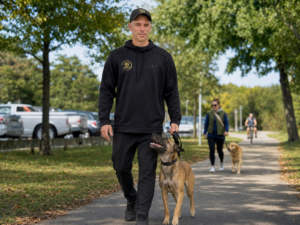
Board and Train Is Not a Magical Reset Button
Board and Train can create significant change, but we are very clear about what it is and what it is not.
It is not magic.
It is not a program where a dog disappears for several weeks and returns permanently trained regardless of what happens afterwards.
Dogs are constantly learning.
The habits we establish during Board and Train need to be understood and maintained by the owner when the dog goes home.
That is why owner education is such an important part of our programs.
Depending on the program, K9 Principles Board and Train includes private follow-up lessons designed to show owners how the training works, how to handle their dog correctly and how to maintain the expectations that have been established.
We want the transition home to make sense.
The dog has been learning a new system. The owner needs to understand that system too.
Board and Train allows us to build the foundation much faster and more consistently than many busy households can reasonably accomplish on their own.
The follow-up work helps transfer that foundation back into real life.
You Should Know What Is Happening While Your Dog Is Away
Leaving your dog with someone for training is a major decision.
You should not have to wonder what is happening.
K9 Principles provides regular progress updates, including photos and videos, so owners can see their dog working, learning and progressing throughout the program.
Those updates also help owners begin understanding the training before their dog even returns home.
You can see what we are asking.
You can see how the dog is responding.
You can see the progression from early learning into more reliable behaviour.
That transparency matters.
Board and Train is not simply about handing over your dog and hoping for the best.
It should be a professional training process where the owner remains informed and becomes part of the long-term result.
Experience Matters When Behaviour Has Become Overwhelming
K9 Principles brings more than 30 years of dog-training experience to the dogs and families we work with.
That experience matters because dogs rarely arrive with problems that fit neatly into one category.
A dog may pull on leash but also struggle with impulse control.
A dog may jump on visitors but also have difficulty settling.
A dog may know several commands perfectly in the kitchen but completely lose focus outside.
Good training requires looking at the whole dog, the home environment, the owner’s goals and the behaviours affecting everyday life.
K9 Principles is also the exclusive dog-training partner for the Hamilton/Burlington SPCA and Hamilton Animal Services.
That relationship reflects the level of trust placed in our training experience and gives us the opportunity to work with a wide variety of dogs and owners throughout the Hamilton area.
Whether someone comes to us through our Board and Train programs, private lessons or group classes, the goal remains the same: create practical training that makes life with the dog better.
The Real Goal Is Not More Commands
Sit is useful.
Down is useful.
Place, recall and loose-lead walking are useful.
But the number of commands your dog knows is not the best measure of successful training.
The better question is this:
Is your dog easier to live with?
Can you walk them without feeling frustrated before you leave the driveway?
Can they settle while you are trying to relax?
Can they listen when distractions are present?
Can you move through normal situations with more confidence?
Can the dog be part of your life instead of controlling how you live it?
Those are the results that matter.
Our Board and Train programs use obedience as part of a much bigger picture involving communication, household manners, impulse control, consistency and structure.
Commands become tools.
The real result is a more manageable relationship.
When Board and Train Makes Sense
Board and Train is particularly valuable for owners who know their dog needs more consistent training than they can currently provide.
Sometimes the barrier is time.
Sometimes it is experience.
Sometimes the dog’s behaviour has become so frustrating that the owner no longer knows where to begin.
Sometimes people simply want professional dog trainers to establish the foundation correctly and then teach them how to maintain it.
There is nothing wrong with choosing professional help.
We hire professionals for important jobs every day because knowledge, repetition and experience matter.
Dog training is no different.
If your dog’s behaviour has gradually taken over your routine, a structured Board and Train program may give you the opportunity to interrupt that cycle and build something better.
Our main K9 Principles Board and Train programs page explains the different training options available and can help you determine which program best matches your dog and your goals.
Readers who recognise themselves in the time and consistency challenges discussed here may also want to read Why Board and Train Works for Stressed Dog Owners, which explores why this training model can be so effective for households already stretched thin.
As this Board and Train article series continues, we will also look more closely at how training creates calmer households, why consistency changes behaviour and what owners should realistically expect when their dog returns home.
The Goal Is to Give You More of Your Life Back
Most people do not get a dog because they want another source of stress.
They picture walks, adventures, evenings together and a dog that becomes part of the family.
When behaviour begins taking over, that picture can feel increasingly far away.
The purpose of training is to close that gap.
At K9 Principles, our home-based Board and Train programs are built around practical daily living. Your dog lives inside our Caledonia home while we work on obedience, manners, structure, impulse control and the habits that affect your everyday relationship.
We do the daily training so that meaningful repetition can happen consistently.
We keep you involved through progress updates.
We provide private follow-up instruction so you understand how to continue the work.
And our clients receive lifetime email and telephone support because questions do not suddenly stop the day a program ends.
Your dog does not need to become perfect.
Your home does not need to become a military camp.
Life simply needs to become easier, calmer and more enjoyable than it is today.
Conclusion: Your Dog Should Be Part of Your Life, Not Control It
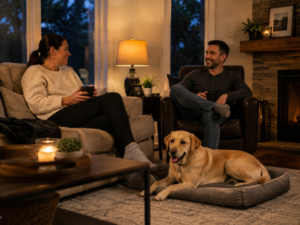
If you are changing your schedule, avoiding visitors, dreading walks or planning your entire day around preventing your dog’s next difficult behaviour, it may be time for a different approach.
You do not have to keep struggling through the same situations hoping they eventually improve.
With more than 30 years of dog-training experience, K9 Principles provides home-based Board and Train in Caledonia for families throughout Hamilton, the greater Hamilton area, and Haldimand County.
Your dog lives in our home.
We do the daily training.
We build structure, manners, and better habits through real everyday life.
Then we help you bring that training home.
Explore our K9 Principles Board and Train programs to learn which option may be right for your dog, or submit an enquiry and tell us what life currently looks like with your dog.
Because good training should not simply give you a dog that knows more commands.
It should give you more freedom to enjoy your life together.
Contact us for more information:
- Name: K9 Principles
- Address: Haldimand County, Greater Hamilton Area, Burlington, and Most of Norfolk County
- Phone: 289 880-3382
- Email: k9principlesinc@gmail.com
- Website: www.k9principles.ca
FAQs
-
A1. Our Board and Train programs can address common problems such as leash pulling, jumping, poor household manners, difficulty settling, unreliable obedience, weak recall, lack of impulse control and other everyday behaviours that make a dog difficult to manage. The appropriate program depends on the individual dog, their behaviour and the owner’s goals.