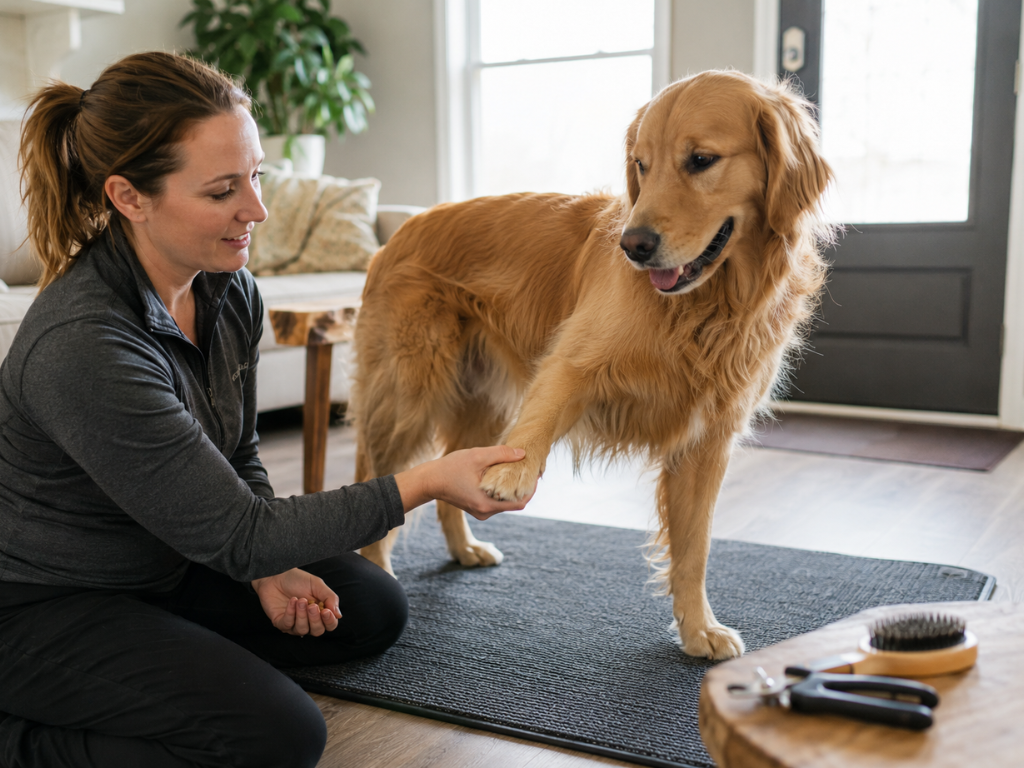





The nail clippers come out and your dog disappears into another room. You reach towards a paw and they immediately pull it away. A routine ear check turns into a wrestling match, while a simple veterinary examination leaves everyone feeling exhausted and frustrated. These situations are incredibly common, but they should not be accepted as an unavoidable part of dog ownership.
Dogs are not born understanding why people need to lift their ears, open their mouths, hold their paws or place unfamiliar equipment against their bodies. From the dog’s perspective, many grooming and veterinary procedures can feel strange, restrictive and unpredictable. Even a friendly dog who enjoys being petted may feel completely different when someone deliberately examines a sensitive area or prevents them from moving away.
Cooperative care is the process of teaching a dog how to participate more calmly in grooming, handling and necessary veterinary procedures. It is not about allowing the dog to avoid all care, and it does not mean that essential treatment becomes optional. It is about preparing the dog before those procedures become urgent, helping them understand what is happening and developing behaviours that make handling safer for everyone.
This type of preparation deserves a place beside recall, leash walking, sit, down and stay in every complete dog training program. A dog may only need to walk politely for part of the day, but throughout their life they will need their nails maintained, ears checked, teeth examined, coat brushed and body handled. The ability to remain calmer during these moments can have a significant effect on their comfort, safety and overall quality of care.
Why Dogs Struggle With Grooming and Veterinary Handling
Handling problems are often labelled as stubbornness, defiance or dominance. In reality, most resistance begins because the dog feels uncertain, uncomfortable or frightened. Pulling a paw away, turning the head, trying to leave or becoming completely still may be early attempts to communicate that the situation feels unsafe.
Many grooming procedures combine several difficult experiences at once. The dog may be standing on a slippery surface, surrounded by unfamiliar smells, listening to loud equipment and being restrained by someone they do not know. At a veterinary clinic, the dog may also be physically uncomfortable, surrounded by other animals or already stressed from travelling in the car.
Previous experiences can make the reaction even stronger. A nail that was accidentally trimmed too closely, an uncomfortable ear infection or a frightening veterinary procedure can create a powerful association. The next time similar equipment appears, the dog may react before anything has actually happened because they have learned to predict discomfort.
Some dogs struggle simply because they were never prepared. Owners may spend months teaching obedience commands but rarely practise touching paws, looking inside ears or holding the collar calmly. The first serious attempt may happen when the dog urgently needs a complete nail trim or medical examination. At that point, there is pressure to finish the procedure, and neither the owner nor the dog has the luxury of learning slowly.
Genetics, temperament and early development may also affect how a dog responds. Some dogs are naturally more sensitive to touch, restraint, unfamiliar people or new environments. Others recover quickly and accept handling with very little preparation. Good dog training recognises the individual dog rather than expecting every dog to respond in exactly the same way.
Handling Tolerance Must Be Trained, Not Assumed
Living with a dog does not automatically give us permission to handle every part of their body without preparation. Affection and purposeful handling are two different experiences. A dog may love having their chest scratched but become uncomfortable when their toes are separated, their tail is lifted or their mouth is opened.
Owners sometimes believe that repeatedly forcing a procedure will teach the dog to tolerate it. This may occasionally produce a dog who stops visibly struggling, but a lack of movement does not always mean the dog is comfortable. Some dogs freeze when they feel overwhelmed. They may appear quiet while their stress continues to increase underneath the surface.
When warning signals are repeatedly ignored, a dog may learn that subtle communication does not work. The head turn becomes a growl. The growl becomes a snap. The snap may eventually become a bite. This progression often appears sudden to the owner, but the dog may have been communicating discomfort for weeks, months or even years.
Punishing a growl does not solve the underlying fear. It may only remove the warning that tells you the dog is reaching their limit. The safer approach is to recognise the warning, stop the immediate situation from escalating and develop a structured training plan that addresses the reason behind the reaction.
Cooperative care teaches the dog predictable behaviours and creates clear expectations. The dog may learn to stand on a mat, rest their chin on a towel, offer a paw or lie calmly on one side. These behaviours give the dog something specific to do instead of simply being held in position while unfamiliar things happen.
This training also benefits the person performing the procedure. A groomer, veterinary technician or owner can work more accurately when the dog is not twisting, pulling or attempting to escape. Better positioning can reduce the chance of accidental injury and make necessary care faster and less confrontational.
Recognising Stress Before Your Dog Feels Forced to Escalate
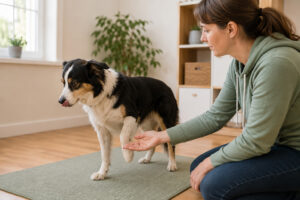
Dogs rarely move from complete comfort to biting without displaying something in between. The challenge is that many early stress signals are subtle and easily overlooked. A dog may turn their head away, close their mouth suddenly, lick their lips, lower their body or pull one paw backwards.
Other dogs become very still. This sudden stillness is particularly important because it may be mistaken for cooperation. A relaxed dog usually has soft muscles, natural breathing and an ability to move comfortably. A frozen dog may hold their breath, tighten the face, stare from the corner of the eyes or keep the entire body rigid.
A dog who normally takes food but suddenly refuses a favourite reward may be telling you that the exercise has become too difficult. However, eating does not automatically mean the dog is comfortable. Some dogs continue accepting food despite experiencing significant stress. Owners must observe the entire body rather than using appetite as the only measurement.
Trying to leave is another clear form of communication. This does not mean the dog should be allowed to escape every training exercise indefinitely. It means the current step may be too intense, too long or too unpredictable. The exercise should be adjusted so the dog can experience success without being overwhelmed.
Good cooperative care training works below the point where panic begins. The dog may notice the equipment or feel brief contact, but they remain able to think, respond and recover. When the dog is repeatedly pushed beyond that point, the session becomes less about learning and more about surviving the experience.
Owners involved with dog training in Hamilton should also remember that the surrounding environment affects behaviour. A dog who accepts paw handling in the living room may struggle on a grooming table, inside a clinic or around unfamiliar people. Skills must be introduced gradually and practised in different settings before they can be considered reliable.
Begin Cooperative Care Training at Home
The best place to begin is usually a quiet, familiar area where the dog already feels comfortable. Sessions do not need to be long. In many cases, ten successful seconds will accomplish more than several minutes of struggling.
Start with areas the dog already enjoys having touched. Briefly touch the shoulder, mark the calm response and reward. Progress towards less familiar areas such as the legs, paws, ears and mouth. The goal is not to complete a full examination during the first session. The goal is to build a history of safe, predictable interactions.
The owner’s movements should remain calm and deliberate. Reaching suddenly, grabbing a paw or leaning over the dog can create unnecessary pressure. Approach from a comfortable angle and begin with very brief contact. Release before the dog feels the need to pull away.
Collar handling is another important skill. Dogs may need to be held by the collar during an emergency, examination or transfer between handlers. Begin by touching the collar, rewarding the dog and releasing. Gradually progress to holding it for one second, then slightly longer, while the dog remains relaxed.
Owners can also practise looking inside the ears, lifting the lips briefly, touching around the eyes and running their hands along the body. These exercises may help the dog become more comfortable with the types of contact used during routine examinations. They may also help owners notice physical changes earlier, although any medical concern should always be assessed by a qualified veterinarian.
Consistency matters more than intensity. A few seconds of practice several times per week can build a valuable foundation. Waiting until the dog desperately needs their nails trimmed creates urgency, and urgency often causes people to rush through steps the dog has not learned.
Puppies can begin simple handling exercises early, but adult dogs can also improve. The process may take longer when a dog has an established history of fear or conflict, but age alone does not make cooperative care impossible. The training must simply begin at a level the individual dog can manage.
Break Every Grooming Procedure Into Smaller Training Steps
One of the biggest mistakes owners make is treating a grooming procedure as one behaviour. Nail trimming is not one exercise. It is a chain of separate experiences that the dog must learn to accept.
The dog first needs to remain comfortable when the nail clippers or grinder appear. They may need to hear the sound from a distance. They must accept the leg being touched, the paw being lifted, the toes being separated and the tool approaching the nail. Only then does the actual trimming begin.
An owner might spend one session simply placing the clippers on the floor while rewarding calm behaviour nearby. The next session may involve picking them up and putting them down. Later, the tool might briefly touch the dog’s leg without being used. Eventually, one nail may be trimmed before the session ends.
Stopping after one successful nail is not failure. It may be the exact decision that allows the next session to go well. Trying to complete all four paws after the dog has reached their limit can undo the progress made during the first few minutes. 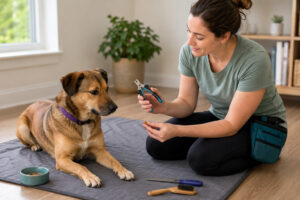
Brushing should be approached in the same way. The dog may first investigate the brush, then accept it touching the shoulder, followed by one gentle stroke. Gradually, the owner can increase the number of strokes and work towards more sensitive areas.
Ear cleaning may be separated into lifting the ear, touching the outside, showing the cleaning product, placing a hand near the opening and eventually completing the procedure. A dog who struggles with eye drops may first learn to remain calm while a hand approaches the face and lightly supports the chin.
This gradual process is known as desensitisation when exposure is carefully controlled so the dog remains below an overwhelming level of fear. Positive associations can also be created by pairing each manageable step with something the dog values. The timing matters. Rewards should support calm participation rather than simply appearing after a prolonged struggle.
Professional Hamilton dog training can be especially valuable when owners are unsure how quickly to progress. Moving too slowly may prevent meaningful improvement, while moving too quickly may trigger another fearful response. A skilled trainer can read the dog’s behaviour and design steps that are challenging enough to create progress without creating panic.
Teach Practical Positions and Gentle Restraint Skills
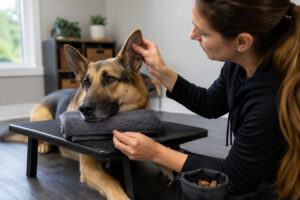
A dog who understands where to stand and what to do is often easier to handle than a dog who is physically placed into position without warning. Cooperative care positions give the dog a clear task and help the handler organise the procedure.
A standing position can be useful for brushing, body examinations and some nail work. Lying on one side may provide access to the paws or coat. Resting the chin on a towel, hand or low surface can create a calm stationary position for examining the face and ears.
A mat can become a powerful visual cue. The dog learns that stepping onto the mat begins a predictable handling exercise and that remaining there earns reinforcement. This foundation can later be transferred to a bathroom, grooming area or veterinary clinic.
Raised platforms may help some dogs understand where their feet should remain. The platform does not need to be high. Even a low, stable surface can create clearer boundaries and encourage the dog to remain in position. Any surface must be secure and appropriate for the dog’s size and physical condition.
Handling training must also include gentle restraint. Many dogs accept touch until they realise they cannot immediately move away. Briefly holding the collar, supporting the body or maintaining a stationary position can create a completely different emotional response.
Restraint should begin in very small increments. Hold the collar lightly for one second, reward and release. Place one hand gently along the body, then remove it before tension develops. Increase duration gradually as the dog demonstrates comfort.
Releasing before the dog struggles teaches them that remaining calm causes the pressure to end. Holding tighter while the dog fights may teach the opposite lesson: that restraint predicts conflict and that stronger resistance is necessary.
There will be situations where a dog must be safely restrained for essential treatment. Cooperative care cannot guarantee that every procedure will always be voluntary. However, a dog with a foundation in calm positions and gentle restraint is generally better prepared than a dog experiencing those sensations for the first time during an emergency.
Use Rewards to Build Cooperation Rather Than Hide Fear
Food can be extremely effective during handling training, but it must be used with purpose. Constantly feeding while forcing a dog through something frightening may distract them temporarily without changing how they feel about the procedure.
The reward should clearly follow a behaviour the owner wants to strengthen. The dog remains still while the ear is lifted, and the reward arrives. The dog offers the paw, and the reward arrives. The dog returns their chin to the towel after a short break, and the reward arrives.
This clear relationship helps the dog understand what behaviour produces reinforcement. It also turns the session into an active learning process instead of a situation where the dog is merely occupied with food.
Owners should choose rewards that are valuable enough for the environment and difficulty of the exercise. Dry kibble may work in the living room but fail inside a busy veterinary clinic. Higher-value food may be needed around new equipment, unfamiliar people or more challenging forms of handling.
Food is not the only reward. Some dogs value movement, praise, play or the opportunity to step away briefly. A short release can become part of the reinforcement when the dog learns that calm participation earns a break.
The dog’s emotional state must still guide the session. A dog who grabs food frantically, cannot settle or immediately attempts to escape may be too stressed to learn effectively. The exercise should be simplified rather than disguised with more treats.
This principle is consistent with effective dog training generally. Rewards are not bribes and they are not random handouts. They are information. They tell the dog which behaviour worked and encourage that behaviour to occur again.
Prepare Your Dog Before the Veterinary Appointment
Veterinary preparation extends beyond touching paws and ears. The complete experience begins before the dog enters the examination room.
For some dogs, the first challenge is the vehicle. A dog who becomes stressed during car travel may arrive at the clinic already overwhelmed. Calm vehicle loading, short practice drives and relaxed exits can reduce some of that pressure.
Unfamiliar buildings may also be difficult. Practising calm entrances, waiting near doorways and walking across different flooring can help the dog adapt more easily. Veterinary clinics may contain smooth floors, narrow hallways, unusual smells and sounds that the dog has never experienced elsewhere.
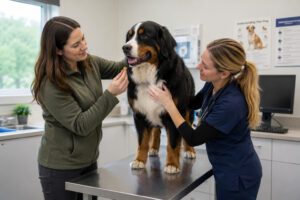
Owners can practise standing on a stable platform to prepare for being weighed. They can teach the dog to remain on a mat while another person approaches. Friends or family members may help by performing brief, simple touches once the dog is comfortable with the owner.
Waiting calmly is another useful skill. A dog who can settle near the owner is less likely to become increasingly agitated while waiting. However, owners should also advocate for distance when needed. A nervous or reactive dog may struggle when unfamiliar dogs are allowed to approach closely.
Some clinics may permit brief positive visits during quiet periods, allowing the dog to enter, receive treats and leave without undergoing a procedure. Owners should contact their veterinary clinic first to ask what is appropriate and available.
The objective is not to recreate every medical procedure at home. It is to build general handling skills, confidence and predictability. The more pieces the dog already understands, the fewer completely new experiences they must process during the actual appointment.
Owners seeking dog training in Hamilton should begin this preparation while their dog is healthy. Pain and illness can change behaviour dramatically. A dog who normally accepts handling may react defensively when an area hurts, which is why even well-trained dogs must always be handled thoughtfully.
Common Mistakes That Turn Handling Into a Battle
Chasing the dog with grooming equipment creates an immediate problem. The dog learns that seeing the tool predicts pursuit and restraint. Instead, equipment should be introduced in controlled sessions where the dog is not cornered.
Trying to finish everything in one sitting is another common mistake. Owners may believe stopping will reward resistance, so they continue despite increasing stress. However, the dog may simply learn that the procedure does not end until they fight with enough intensity.
Punishing growling is particularly dangerous. A growl provides valuable information. It tells you that the dog is uncomfortable and that the situation may escalate. Removing the warning without addressing the emotion can create a dog who bites with less obvious notice.
Moving too quickly often happens because the first few repetitions go well. The owner touches the paw successfully and immediately attempts to hold it, separate the toes and trim a nail. Each additional step increases difficulty. Progress should be based on the dog’s comfort, not the owner’s desire to complete the task.
At the opposite extreme, allowing complete avoidance for months can make the problem larger. The answer is not to abandon all handling. It is to identify an easier starting point and build cooperation systematically.
Owners may also make the mistake of only touching sensitive areas when something unpleasant is about to happen. If ears are only handled before cleaning and paws are only lifted before nail trimming, those movements quickly become predictors. Neutral handling exercises should occur regularly when no procedure follows.
Another problem is involving too many people too soon. A dog may accept handling from a trusted owner but become overwhelmed when a stranger attempts the same exercise. Skills should first become reliable with familiar people and then be transferred gradually.
Finally, owners sometimes wait until the dog is exhausted, highly excited or already stressed before attempting grooming. Training is most productive when the dog can think clearly. Selecting the right environment and emotional state can dramatically improve the outcome.
When Handling Resistance Becomes a Safety Concern
Mild uncertainty and severe fear should not be treated as the same problem. A dog who briefly pulls their paw away may need slower training. A dog who snaps, bites, redirects aggression or enters a state of intense panic requires a more carefully managed plan.
Owners should not repeatedly place themselves at risk in an attempt to prove that the dog must tolerate the procedure. Every serious confrontation can strengthen the dog’s belief that handling is dangerous.
Professional dog training support is especially important when the behaviour is becoming worse, the dog has already made contact with teeth, children are involved or essential care cannot be completed safely. The plan may require cooperation between the owner, trainer, groomer and veterinarian.
Pain must also be considered. A sudden change in handling tolerance can have a physical cause. Behaviour training should not be used to push through suspected pain. A qualified veterinarian should assess any concern involving illness, injury or unexpected sensitivity.
Some dogs may benefit from properly introduced safety equipment, including a basket muzzle. A muzzle should not first appear moments before a frightening procedure whenever preparation is possible. It should be conditioned gradually so the dog can wear it comfortably and safely.
Safety equipment does not replace training, but it can reduce risk while training progresses. The objective is not to label the dog as bad or aggressive. It is to create a responsible plan that protects the dog and the people involved.
How K9 Principles Can Help With Grooming and Veterinary Handling
K9 Principles can help owners develop the practical foundations needed for safer, calmer handling. These may include stationary positions, impulse control, collar handling, body awareness, confidence around equipment and a structured desensitisation plan.
Private in-home training can be especially valuable because the work begins where the dog already feels most secure. Instead of immediately asking the dog to cope inside a busy clinic or grooming facility, the trainer can establish the foundation in a familiar environment and gradually increase difficulty.
Every dog brings a different history to the process. A puppy learning these skills for the first time requires a different plan than an adult dog who has spent years fighting nail trims. A dog who becomes mildly worried around a brush requires a different approach than a dog with a history of biting during restraint.
K9 Principles does not rely on a one-size-fits-all formula. The training plan is built around the behaviour being displayed, the dog’s previous experiences and the care they must learn to accept. Owners also learn how to recognise stress, reward effectively and progress without pushing the dog into unnecessary conflict.
For families searching for experienced dog training in Hamilton and surrounding communities, K9 Principles offers practical support that goes beyond basic obedience. Handling tolerance affects veterinary care, grooming, home maintenance, and emergency safety, making it an important part of living responsibly with a dog.
Hamilton dog training should prepare dogs for real life, not only for performing commands inside a classroom. A dog who can sit on cue but cannot be safely examined is missing a critical life skill. Cooperative care fills that gap by connecting obedience, trust, communication, and practical handling.
Beginning early is always ideal, but owners should not assume it is too late because a problem already exists. With the correct starting point, realistic expectations and consistent dog training, many dogs can make meaningful progress.
Conclusion: The Worst Time to Begin Is When Care Can No Longer Wait
Cooperative care is not simply about making nail trims more convenient. It can affect how safely your dog receives necessary care throughout their entire life.
A dog who understands calm positions, gentle restraint and predictable handling is better prepared for routine grooming, veterinary examinations and unexpected situations. The process may also reduce stress for owners, groomers and veterinary professionals while lowering the risk of defensive behaviour.
The strongest results come from beginning before there is urgency. Practise when your dog is healthy, comfortable and able to learn. Keep sessions short, divide each procedure into manageable steps and pay attention to the early signs of stress.
Do not wait until the nails are badly overgrown, the ears urgently need treatment or an injury makes examination unavoidable. The worst time to teach handling skills is when your dog no longer has the option of learning gradually.
K9 Principles can help you create a structured cooperative care plan built around your dog’s individual behaviour. Through professional dog training in Hamilton and the surrounding region, you can begin replacing avoidance, fear and conflict with clearer communication, practical skills and safer handling.
Contact us for more information:
- Name: K9 Principles
- Address: Haldimand County, Greater Hamilton Area, Burlington, and Most of Norfolk County
- Phone: 289 880-3382
- Email: k9principlesinc@gmail.com
- Website: www.k9principles.ca
FAQs
-
A1. Cooperative care is a form of dog training that teaches dogs to participate more calmly in grooming, body handling and veterinary procedures. It may include standing in a specific position, offering a paw, resting the chin on a surface or remaining on a mat while brief handling occurs. The purpose is to reduce fear, create predictability and make necessary care safer.