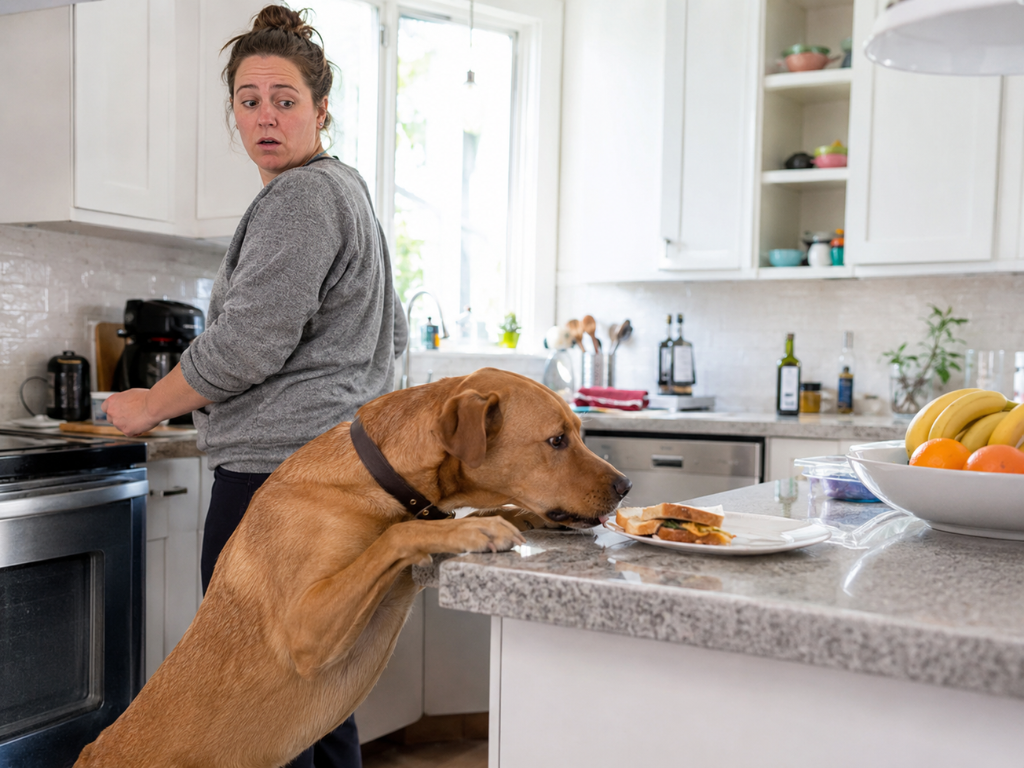





You turn your back for one second, and suddenly the sandwich is gone. The roast chicken has moved. The butter dish is empty. Your dog is standing there looking innocent, or worse, running away with the prize like they just won the lottery. Counter surfing is one of those dog behaviours that can drive owners absolutely mad because it often feels sneaky, deliberate, and impossible to stop. The truth is, your dog is not plotting against you. Your dog has simply learned that counters, tables, kitchen islands, BBQ areas, and coffee tables sometimes pay very well. At K9 Principles, we see this behaviour often in our dog training in Hamilton, Caledonia, and the surrounding areas. Counter surfing is not just about food stealing. It is about impulse control, household structure, management, timing, and teaching your dog what you actually want them to do instead.
What Is Counter Surfing?
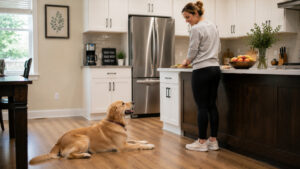
Counter surfing is when a dog jumps up, reaches, climbs, stretches, or checks surfaces looking for food or interesting objects. It may happen at the kitchen counter, dining table, coffee table, kitchen island, desk, outdoor patio table, or near the BBQ. Some dogs are looking for food. Others steal napkins, wrappers, sponges, utensils, toys, or anything that smells interesting. For many owners, it starts small. The dog puts their paws up once or twice. Then one day they grab something. Once that happens, the behaviour can become a regular problem very quickly. In dog training, we always look at what the dog is getting out of the behaviour. With counter surfing, the answer is usually simple: the dog found something valuable, and now they are willing to try again.
Why Dogs Learn To Counter Surf So Quickly
Counter surfing is powerful because it is self-rewarding. Your dog does not need you to hand them a treat, praise them, or throw a toy. The counter does the rewarding all by itself. If your dog jumps up and finds toast, chicken, cheese, a dirty plate, or a child’s snack, the behaviour has paid off. Even one successful grab can keep the habit alive for a long time. From your dog’s point of view, the counter is not just furniture. It is a jackpot machine. Sometimes there is nothing there. Sometimes there is something amazing. That “maybe this time” feeling is exactly why dogs keep checking. This is also why counter surfing can be so hard to stop if the home environment is not managed properly.
Your Dog Is Not Being Spiteful
A lot of owners feel personally offended when their dog steals from the counter, especially when the dog waits until they leave the room. It can feel like the dog knows they are doing something wrong. In reality, most dogs are learning patterns. They learn that when people are close, they may get interrupted. When people leave, the opportunity is better. That does not mean your dog is guilty, stubborn, or disrespectful. It means they have learned when the reward is easiest to get. Good dog training does not rely on taking the behaviour personally. It looks at the pattern, changes the setup, and teaches the dog a more appropriate choice.
Why Yelling “No” Usually Does Not Fix Counter Surfing
Many owners try to stop counter surfing by yelling, clapping, correcting, or scolding after the dog has already jumped up. The problem is that by the time you react, the reward may have already happened. If the dog has already grabbed the food, swallowed it, or enjoyed the chase, the behaviour has still paid off. Some dogs also learn to become faster, sneakier, or more careful about when they do it. They do not necessarily learn, “Never touch the counter.” They learn, “Do it when no one is watching.” This is why proper Hamilton dog training focuses on prevention, timing, structure, and replacement behaviours instead of only reacting after the mistake has happened.
The First Step Is To Stop Letting The Counter Pay Your Dog
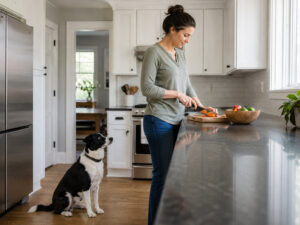
Before we can expect a dog to stop counter surfing, we have to stop allowing the behaviour to be successful. This is not being lazy. This is not avoiding training. This is smart management. Food should be put away, pushed well back, covered, or placed in cupboards, the fridge, the oven, or the microwave when needed. Dirty dishes, meat packaging, bread bags, butter, kids’ snacks, and leftovers should not be left where the dog can reach them. If your dog has already developed a strong counter surfing habit, they may need to be out of the kitchen during meal prep or supervised on leash until better habits are built. The goal is simple: stop the counter from paying your dog while we teach a better behaviour.
Management Gives Training A Fair Chance
Many people think management means they have failed, but management is part of good dog training. If a dog keeps practising the unwanted behaviour, the habit gets stronger. Every stolen item becomes another lesson that says, “Try that again.” Blocking access, using baby gates, closing doors, keeping counters clear, and supervising during busy household moments all help reduce rehearsal. Once the dog is no longer being rewarded by the environment, training becomes much more effective. At K9 Principles, we want owners to understand that structure is not punishment. Structure creates clarity. Dogs do better when the rules are clear, and the environment supports success.
Teach Your Dog What To Do Instead
One of the biggest mistakes owners make is only telling the dog what not to do. Do not jump. Do not steal. Do not touch that. Do not go over there. The problem is that your dog still needs a job. Instead of only stopping counter surfing, we want to teach the dog what to do during those tempting moments. That may be lying on a place bed, relaxing on a mat, sitting away from the counter, staying out of the kitchen, or checking in with the owner. This is where foundation obedience becomes very important. A dog with strong basics is much easier to guide around food, movement, visitors, children, and household distractions.
Why The Place Cue Is So Useful
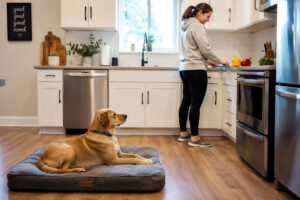
The place cue is one of the best tools for counter surfing because it gives your dog a clear, useful job. Instead of having your dog roaming the kitchen while food is being prepared, they can be sent to place. Instead of hovering under the table while children eat, they can relax on place. Instead of following every grocery bag, cutting board, or dinner plate, they learn to settle in a specific spot. Place work helps build impulse control, calmness, and household manners. This is one reason we use place as a key part of our dog training programmes. It is not just an obedience cue. It is a practical life skill.
Reward The Behaviour You Want To See Again
Owners often notice their dogs when they are doing something wrong, but miss the quiet moments when the dog is making a good choice. If your dog walks past the counter without jumping, reward that. If they lie down while you prepare food, reward that. If they stay on place while groceries come into the house, reward that. If they look at you instead of scanning the counter, reward that. Behaviour that gets rewarded is more likely to happen again. This does not mean you need food in your hand forever. It means that while the dog is learning, we need to make the right choice worth repeating. That is how reliable dog training is built.
Timing Matters More Than Most Owners Realise
With counter surfing, timing is everything. If you wait until your dog has already jumped up, you are late. The better moment to step in is when the dog starts thinking about it. Watch for the early signs. The dog may stare at the counter, lift their nose, move closer, stretch their neck, or start loading their body to jump. That is your chance to redirect, cue place, reward a check-in, or move the dog away. Good timing helps your dog understand the correct choice before the mistake happens. This is one of the biggest areas where professional dog training can help, because many owners are reacting to the final behaviour instead of catching the early decision.
What Not To Do When Your Dog Counter Surfs
Do not turn stolen food into a chase game. If your dog learns that grabbing something gets everyone running, shouting, and reaching, the whole event can become even more exciting. Do not leave food out as a test before the dog is ready. That is not training; that is setting the dog up to fail. Do not assume your dog “knows better” just because they behave when you are standing nearby. Dogs are very good at learning when rules apply and when opportunities are open. Do not rely only on corrections after the fact. The better plan is to prevent access, teach a clear replacement behaviour, reward the right choices, and slowly build reliability with controlled practice.
Practising Around Food The Right Way
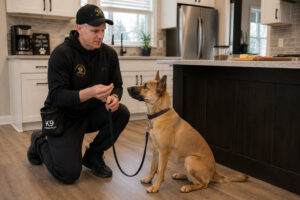
Once management is in place and your dog understands basic cues, you can begin practising around food in a controlled way. Start with low-value distractions, not a steak sitting on the counter. Keep your dog on leash if needed. Reward them for staying on the floor, checking in with you, or going to place. Build slowly. Do not rush to the hardest version of the problem. If your dog cannot ignore a boring item on the counter while you are standing right there, they are not ready to ignore a plate of food when you leave the room. Good dog training moves in steps. The dog needs to learn how to win before we make the challenge harder.
When Counter Surfing Becomes Dangerous
Counter surfing is not just annoying. It can become dangerous. Dogs may steal chocolate, grapes, raisins, cooked chicken bones, medication, sharp objects, wrappers, plastic packaging, hot food, or food that causes stomach upset. Some dogs may swallow things quickly to avoid having them taken away. Others may begin guarding stolen items. If your dog growls, snaps, runs away with dangerous objects, or becomes difficult to approach after stealing, the behaviour needs to be taken seriously. This is no longer just a manners issue. It becomes a safety issue. In those cases, K9 Principles professional dog training is strongly recommended so the plan is safe, fair, and effective. Our In-Home Private training is ideal for situations like this. We come to your home and work with you and your dog to put nuisance behaviours behind you.
How K9 Principles Helps With Counter Surfing
At K9 Principles, we help owners deal with counter surfing by looking at the full picture. We work on structure in the home, impulse control, place cue, leash supervision, reward timing, clear rules, and better communication between dog and owner. For some dogs, group classes are a great way to build stronger foundation skills. For more serious cases, our In-Home Private Training may be the better choice, especially when the dog is stealing dangerous items, guarding food, or the household is struggling to manage the behaviour safely. Our approach to dog training in Hamilton is practical, realistic, and focused on real-life results. We are not just interested in whether your dog can sit in class. We care about whether your dog can make better choices in your kitchen, your living room, your yard, and your daily life.
Conclusion:
Counter surfing can be frustrating, but it is fixable with the right plan. The key is to stop the counter from rewarding your dog, manage the environment, teach a better behaviour, and reward the choices you want repeated. Your dog does not need more confusion, more yelling, or more chances to practise stealing. They need structure, consistency, and clear guidance. With proper training, your dog can learn that calm behaviour pays better than jumping up and stealing food. If counter surfing has become a daily battle in your home, K9 Principles can help you build better household manners through practical Hamilton dog training that fits real life.
Contact us for more information:
- Name: K9 Principles
- Address: Haldimand County, Greater Hamilton Area, Burlington, and Most of Norfolk County
- Phone: 289 880-3382
- Email: k9principlesinc@gmail.com
- Website: www.k9principles.ca
FAQs
-
A1. Your dog keeps stealing food because the behaviour has probably worked before. Even one successful grab can teach a dog that the counter is worth checking again. Counter surfing is self-rewarding, which means the food or object itself rewards the behaviour.