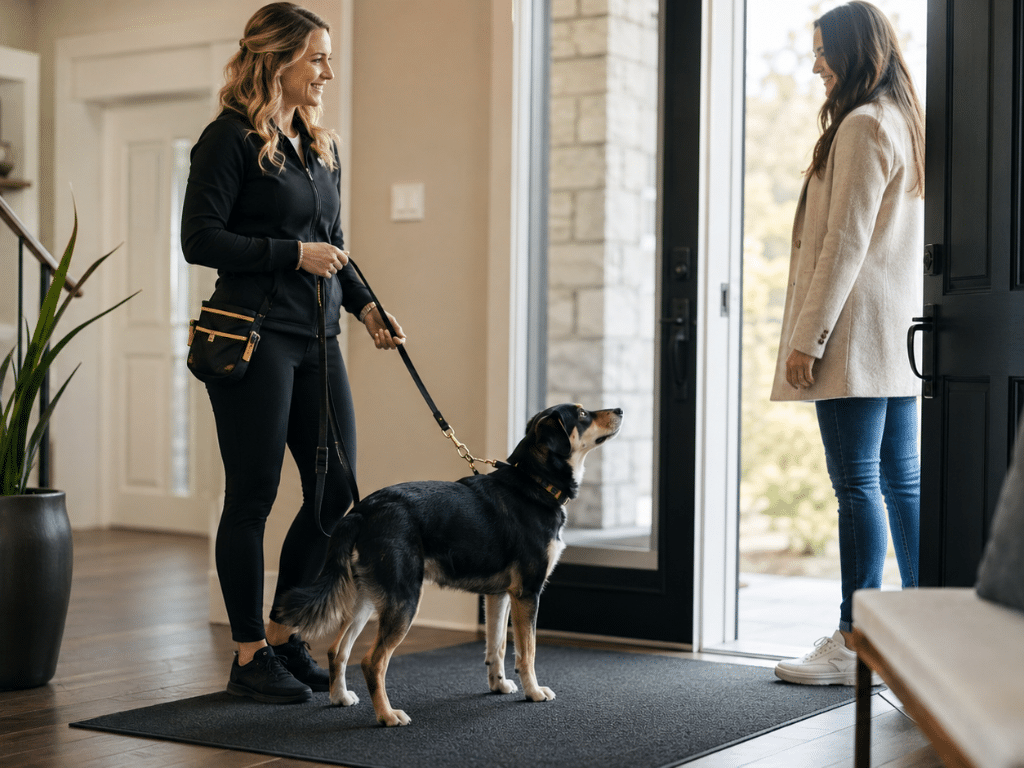





Jumping up is one of those dog behaviours that can go from “kind of cute” to “absolutely not okay” very quickly. When a tiny puppy puts two paws on your leg, most people smile, laugh, pet the puppy, or pick them up. The problem is that dogs grow, habits strengthen, and the behaviour that once seemed harmless can become embarrassing, frustrating, and even unsafe. A dog who jumps on guests can scratch skin, knock over children, overwhelm seniors, ruin clothing, scare visitors, or turn every front-door greeting into chaos.
At K9 Principles, we see this problem all the time in our dog training in Hamilton programs. Owners often come to us after trying everything they can think of. They have said “off” hundreds of times. They have turned their back. They have pushed the dog down. They have told guests to ignore the dog. They have tried rewarding a sit. They have tried getting louder. Yet the dog still jumps, because the dog has learned that jumping works.
That is the part many owners miss. Jumping up is not usually a dog trying to be rude, dominant, stubborn, or disrespectful. In most cases, jumping is a behaviour that has been rewarded in some way. The reward might be attention. It might be touch. It might be excitement. It might be access to a person. It might even be the simple thrill of getting a reaction. Once we understand what the dog is getting from the behaviour, we can start building a better training plan.
This is exactly why our Jump Free Workshop, held exclusively at the Hamilton/Burlington SPCA, is such a valuable option for owners dealing with this issue. It is a focused 1-hour workshop designed specifically to help address jumping up, and it includes a booklet and video to support owners after the workshop is over. Registration is done through the HBSPCA website, making it a simple and accessible first step for local dog owners who want clearer guidance.
Why Jumping Up Is So Common
Jumping up is common because it is natural for many dogs to move toward the face, hands, and upper body of the person they are excited to greet. Dogs are social animals. They notice movement, energy, body language, voices, and emotional changes. When someone enters the home, bends over, talks in a high-pitched voice, reaches toward the dog, or creates excitement, many dogs respond by launching upward.
The behaviour often starts early. Puppies jump because they are small, excited, and trying to get closer to people. Unfortunately, owners and guests often reward it without meaning to. A puppy jumps, and someone says, “Oh, hello!” while petting them. The puppy jumps, and someone picks them up. The puppy jumps, and everyone laughs. From the dog’s point of view, jumping created connection.
Over time, that behaviour becomes stronger. The dog does not understand that jumping was acceptable at 12 pounds but unacceptable at 70 pounds. Dogs do not automatically adjust their manners because their body size changed. They repeat what has been reinforced. This is why puppy training matters so much, and it is also why older dogs can still learn when the training becomes clear and consistent.
In our Hamilton dog training programs, we often remind owners that dogs are not born understanding human rules. A dog may not naturally understand that four paws on the floor is polite, that guests need space, or that jumping on a child is dangerous. Those expectations have to be taught, practised, reinforced, and protected from constant rehearsal.
Jumping Up Is Not the Dog Being “Bad”
One of the most important mindset shifts in dog training is learning to look at behaviour honestly instead of emotionally. When a dog jumps up, it is easy for the owner to feel embarrassed or annoyed and label the dog as rude, defiant, pushy, or out of control. While those feelings are understandable, they do not help us train the dog better.
A better question is, “What is the dog getting from this?” Dogs repeat behaviour that improves their situation in some way. If jumping gets attention, the dog may jump again. If jumping gets hands on them, the dog may jump again. If jumping makes the guest squeal, laugh, talk, move, or engage, the dog may jump again. If jumping gets the dog closer to food, toys, faces, or excitement, the dog may jump again.
This is why dog training has to look beyond the surface behaviour. The jumping is only what we see. Underneath it, there is motivation. The dog may be seeking attention, struggling with impulse control, feeling overwhelmed, trying to access a person, or simply repeating a well-practised habit. If we only correct the jump without addressing the reason behind it, we may suppress the behaviour temporarily, but we do not always create a reliable long-term solution.
At K9 Principles, we want owners to understand the dog in front of them. That does not mean excusing the behaviour. It means training it properly. A dog who jumps on people still needs rules, structure, and consequences for choices. But those rules need to be fair, understandable, and paired with a clear alternative behaviour.
The Biggest Mistake Owners Make When Trying to Stop Jumping
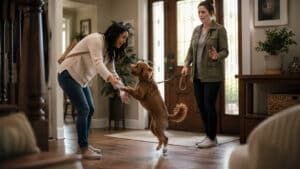
The biggest mistake owners make is reacting after the dog is already in the air and then accidentally rewarding the behaviour with attention. This is where jumping becomes messy. The owner says “off,” pushes the dog down, grabs the collar, repeats the dog’s name, laughs nervously, apologises to the guest, or physically wrestles the dog away. The owner feels like they are correcting the behaviour, but the dog may experience the entire event as interaction.
For many dogs, attention is attention. It does not always matter whether the owner sounds happy or frustrated. If jumping creates eye contact, touch, movement, voice, or excitement, the dog may still find it rewarding. This is especially true for social dogs who crave engagement.
Another common mistake is rewarding too late. For example, the dog jumps on the guest, the owner says “sit,” the dog sits, and then the dog gets a treat. That can be useful in some situations, but if the dog repeatedly learns the pattern of jump first, sit second, reward third, the owner may accidentally build a behaviour chain. The dog learns that jumping starts the process that leads to reward.
This is why timing matters so much in dog training. We want the dog to learn that four paws on the floor, calm behaviour, handler focus, or going to place is what creates access. We do not want the dog to think jumping is part of the routine.
Why “Just Ignore the Dog” Often Fails
Many owners have been told to simply ignore the dog when they jump. In theory, this can make sense. If the dog is jumping for attention and attention is removed, the behaviour may eventually decrease. The problem is that real life is rarely that clean.
Ignoring only works if everyone is consistent. That means every person in the home, every guest, every child, every visitor, and every person the dog meets must respond the same way. Most households cannot maintain that level of consistency without a better structure in place. One guest pets the dog while they jump, and the behaviour gets paid again. One family member laughs and talks to the dog, and the behaviour stays alive. One visitor says, “It’s okay, I love dogs,” and the dog learns that jumping still works on some people.
Ignoring can also cause frustration. Some dogs jump harder, mouth clothing, bark, paw, or escalate because the behaviour used to work and now suddenly does not. This does not mean ignoring can never be part of a plan, but it should not be the entire plan.
Better dog training gives the dog information before the mistake happens. Instead of waiting for the dog to launch and then trying to ignore the chaos, we set the dog up to succeed. We use management, lead control, place work, calm reinforcement, clear markers, and structured greetings. That gives the dog a job instead of leaving them to guess.
The Real Goal Is to Teach an Alternative Behaviour
Stopping jumping is only half the job. The real goal is teaching the dog what to do instead. A dog cannot make a better choice if the only behaviour they know is launching at people. This is where proper dog training becomes much more effective than simply correcting the dog after the fact.
For some dogs, the alternative behaviour may be sitting calmly before greeting. For others, it may be keeping four paws on the floor while the person approaches. For higher-energy dogs, it may be going to a place bed when guests enter. For dogs who struggle at the door, it may be staying on lead and learning that calm behaviour creates controlled access to visitors.
The best alternative behaviour depends on the dog, the household, and the situation, but the principle stays the same. The dog needs a clear, repeatable pattern that replaces the old one. Instead of “guest arrives, dog jumps, owner panics,” the pattern becomes “guest arrives, dog is managed, dog performs a trained behaviour, dog is rewarded for calm choices.”
This is one of the reasons our Jump Free Workshop at the Hamilton/Burlington SPCA is so useful. In a focused 1-hour format, owners can learn how to look at jumping as a trainable behaviour rather than a daily battle. The included booklet and video also help owners continue practising at home, which is where the real change has to happen.
The Four Paws Rule
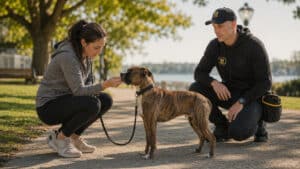
One of the simplest foundations for stopping jumping is the four paws rule. The dog only gets access to people when all four paws are on the floor. This rule is simple enough for owners to remember and clear enough for dogs to learn, but it only works when it is applied consistently.
If the dog jumps and gets touched, jumping was rewarded. If the dog jumps and gets talked to, jumping may have been rewarded. If the dog jumps and the person keeps moving closer, jumping may have been rewarded. But if the dog keeps four paws on the floor and that is when attention, food, praise, or access happens, the dog starts learning a different pattern.
This does not mean owners should stand there hoping the dog figures it out. At first, the dog may need help. That may mean using a lead in the house when guests arrive. It may mean keeping the dog behind a baby gate until the first wave of excitement passes. It may mean rewarding the dog before they jump, not after. It may mean teaching the dog to settle on a mat or place bed while people come in.
The four paws rule is not magic by itself. It becomes powerful when it is paired with timing, structure, and repetition. Dogs learn through patterns. If four paws consistently creates good things and jumping consistently does not, the dog can start to change.
Why Guests Make Jumping Worse
Guests are one of the biggest reasons jumping problems continue. Owners may be committed to training, but visitors often undo the work in seconds. They may say, “I don’t mind,” while petting the dog as it jumps. They may use a high-pitched voice that sends the dog into a frenzy. They may wave their hands around, bend over the dog, or encourage excitement without realising it.
The problem is that the dog does not understand that one person “doesn’t mind” while another person does. The dog only learns that jumping sometimes works. Behaviour that is rewarded sometimes can become very persistent because the dog keeps trying. This is the same reason dogs keep checking counters after finding food there once. If the behaviour has paid before, it may be worth trying again.
Owners also feel pressure when guests arrive. They may be embarrassed, rushed, or worried about seeming rude. Instead of giving the dog clear direction, they let the greeting happen too soon. The dog is already over-aroused, the guest is already excited, and the owner is trying to train in the middle of chaos.
A better approach is to train the humans first. Guests need simple instructions before they enter. They should know not to pet the dog if the dog jumps. They should avoid building excitement. They should wait until the dog is calmer. Most importantly, owners should not put training in the hands of the guest. The owner controls the setup.
Door Greetings Need Structure
The front door is one of the hardest places to train jumping because everything happens fast. The doorbell rings, the dog barks, the owner rushes, the guest enters, and excitement explodes. If this pattern happens over and over, the dog becomes conditioned to lose control at the door.
Good dog training slows the picture down. Before the guest enters, the dog should be managed. That may mean the dog is on lead, behind a gate, in a crate, or on a place bed. The point is not to avoid training. The point is to prevent the dog from rehearsing the behaviour while the owner teaches a better routine.
Once the guest enters, the dog should not immediately be given full access if they are already over the top. The owner can reward calm behaviour at a distance, ask for known skills, or wait for the first burst of excitement to pass. When the dog is calmer, a controlled greeting may happen. If the dog jumps, access ends. If the dog stays grounded, access continues.
This kind of structure is especially helpful for families with children, seniors, or nervous visitors. It also helps dogs who are friendly but intense. A dog can be sweet and still need boundaries. Excitement does not excuse unsafe behaviour.

In our Hamilton dog training programs, we often explain that the first two minutes of a greeting matter most. If owners can control those first two minutes, the dog has a much better chance of settling. If the dog is allowed to explode through those first two minutes, the owner spends the rest of the visit trying to recover.
Jumping Up During Adolescence
Many owners notice that jumping gets worse during adolescence. The puppy who was improving suddenly becomes bigger, faster, stronger, and more excitable. This can feel discouraging, especially when owners thought the dog had already learned better manners.
Adolescence is a normal developmental stage, but it can be challenging. Dogs may become more impulsive, more distracted, and more likely to test behaviours that have worked in the past. This does not mean the training failed. It means the training needs to be strengthened and made more consistent in real-life situations.
This is where many owners accidentally lower their standards. They assume the dog is just going through a phase, so they allow more jumping, more chaos, and more uncontrolled greetings. Unfortunately, the dog is still learning during that phase. Every rehearsal makes the behaviour stronger.
Dog training during adolescence should focus heavily on impulse control, engagement, calm behaviour around distractions, and consistent rules. The dog needs to learn that excitement does not remove expectations. Guests, family members, walks, parks, and public places all become opportunities to practise better choices.
Why Jumping Is a Safety Issue, Not Just a Manners Issue
Some people dismiss jumping as harmless because the dog is “just excited.” That may be true emotionally, but it does not remove the safety risk. A friendly dog can still knock someone down. A happy dog can still scratch a child’s face. A social dog can still scare a visitor who is nervous around dogs. A large dog can injure someone without any bad intention at all.
This matters even more when children or seniors are involved. A dog jumping on a toddler, an elderly family member, or someone with mobility challenges can create a serious problem. Owners have a responsibility to teach the dog safe greeting behaviour, even if the dog’s intent is friendly.
Jumping can also create problems in public. A dog who jumps on strangers during walks, at the vet clinic, outside a pet store, or in a training class may cause stress for everyone involved. Not every person wants to interact with your dog. Not every dog nearby is comfortable with sudden movement. Good manners protect your dog as much as they protect other people.
This is one of the reasons we treat jumping as a real dog training issue, not a silly habit. When owners address it properly, they are not being strict for the sake of being strict. They are creating safety, clarity, and better freedom for the dog.
Why Correction Alone Does Not Fix the Problem
Correction may interrupt jumping, but interruption is not the same as training. If a dog is corrected for jumping but never taught what to do instead, the dog may become confused, frustrated, or inconsistent. The owner may stop the behaviour in one moment, but the pattern returns the next time excitement rises.
This is why we do not want owners relying only on reaction. A complete training plan includes prevention, teaching, reinforcement, consistency, and fair consequences. The dog needs to understand both sides of the rule. Jumping does not work, but calm behaviour does. Launching at the guest ends access, but four paws on the floor creates access. Chaos gets managed, but self-control gets rewarded.
Correction without teaching can also create conflict around greetings. Some dogs become more frantic because they do not understand how to succeed. Others may suppress the jump in one context but still jump when the owner is not ready. That is not reliable training. Reliable training creates a dog who understands the expected behaviour even when life is exciting.
At K9 Principles, our approach to dog training focuses on clarity. Dogs need to know what behaviour is expected, when it is expected, and why it is worth choosing. Owners need to know how to manage the situation before the dog fails, not just how to react after the dog has already made the mistake.
How Professional Dog Training Helps
Professional dog training helps because jumping is rarely just about jumping. It is often connected to impulse control, excitement, household structure, guest routines, reinforcement timing, and owner consistency. A professional trainer can see the full picture and help owners build a plan that actually fits their dog and their home.
For some dogs, the solution may be simple changes to greeting routines. For others, the dog may need stronger foundation skills, better leash control, place training, calmness work, or more structure around visitors. Some dogs need help learning how to think when excited. Others need the family to stop accidentally rewarding the behaviour.
This is where K9 Principles can help owners looking for dog training in Hamilton. We work with real dogs in real households, which means we understand that training has to function beyond a perfect classroom setup. Your dog has to learn around guests, doorbells, family routines, distractions, and daily life.
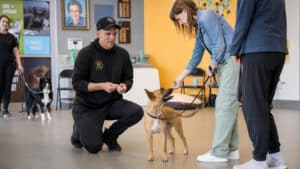
The Jump Free Workshop at the Hamilton/Burlington SPCA is also a great targeted option for this specific issue. Because it is a 1-hour workshop focused on jumping up, it gives owners direct help with one of the most common and frustrating behaviours. The booklet and video give owners something to refer back to, which is important because the real progress happens through repetition at home. Owners interested in this workshop can sign up through the HBSPCA website.
Dog Training in Hamilton for Jumping Up
If your dog is jumping on guests, family members, children, or strangers, the best time to address it is now. The longer the behaviour is practised, the stronger it becomes. That does not mean older dogs cannot learn. They absolutely can. But the plan needs to be clear, consistent, and realistic.
At K9 Principles, we help owners understand why the behaviour is happening, what is reinforcing it, and how to change the pattern. We do not want owners trapped in the endless cycle of yelling “off” while the dog keeps repeating the same behaviour. We want owners to feel confident, prepared, and in control when guests arrive.
Good Hamilton dog training should not just teach obedience words in isolation. It should help owners build behaviour that works in everyday life. A dog who can sit in an empty room but cannot control themselves when Grandma walks through the door still needs training in the real picture. That is where structure, proofing, and consistency matter.
Jumping up can improve when the dog learns that calm behaviour works better than chaos. It can improve when owners stop accidentally rewarding the wrong thing. It can improve when guests are managed properly. It can improve when the dog is given a clear job. Most importantly, it improves when the entire household commits to the same rules.
Conclusion: Your Dog Is Not Trying to Be Rude
Jumping up is frustrating, but it is also understandable. Your dog is not trying to embarrass you, disrespect you, or ruin every visit. In most cases, your dog has simply learned that jumping creates access, attention, excitement, or interaction. Once that pattern is established, the behaviour will continue until a better pattern is taught.
The good news is that jumping up can be improved with proper dog training. The dog needs to learn that four paws on the floor, calm greetings, place work, handler focus, and self-control are what create the reward. Owners need to learn how to prevent rehearsal, manage guests, reward at the right time, and stay consistent long enough for the new behaviour to become the dog’s normal response.
If you are looking for dog training in Hamilton, K9 Principles can help you build a practical plan that makes sense for your dog, your home, and your life. If jumping up is your main concern, our Jump Free Workshop held exclusively at the Hamilton/Burlington SPCA is a fantastic place to start. It is a focused 1-hour workshop that includes a booklet and video, and registration is available through the HBSPCA website.
Your dog does not need more confusion. They need better information. Once they understand what works, they can start making better choices.
Contact us for more information:
- Name: K9 Principles
- Address: Haldimand County, Greater Hamilton Area, Burlington, and Most of Norfolk County
- Phone: 289 880-3382
- Email: k9principlesinc@gmail.com
- Website: www.k9principles.ca
FAQs
-
A1. Your dog likely jumps because it has learned that jumping creates attention, excitement, touch, or access to people. Even if you are telling the dog “off,” the dog may still be getting interaction from the behaviour. Proper dog training teaches the dog that calm behaviour, not jumping, is what creates greetings.