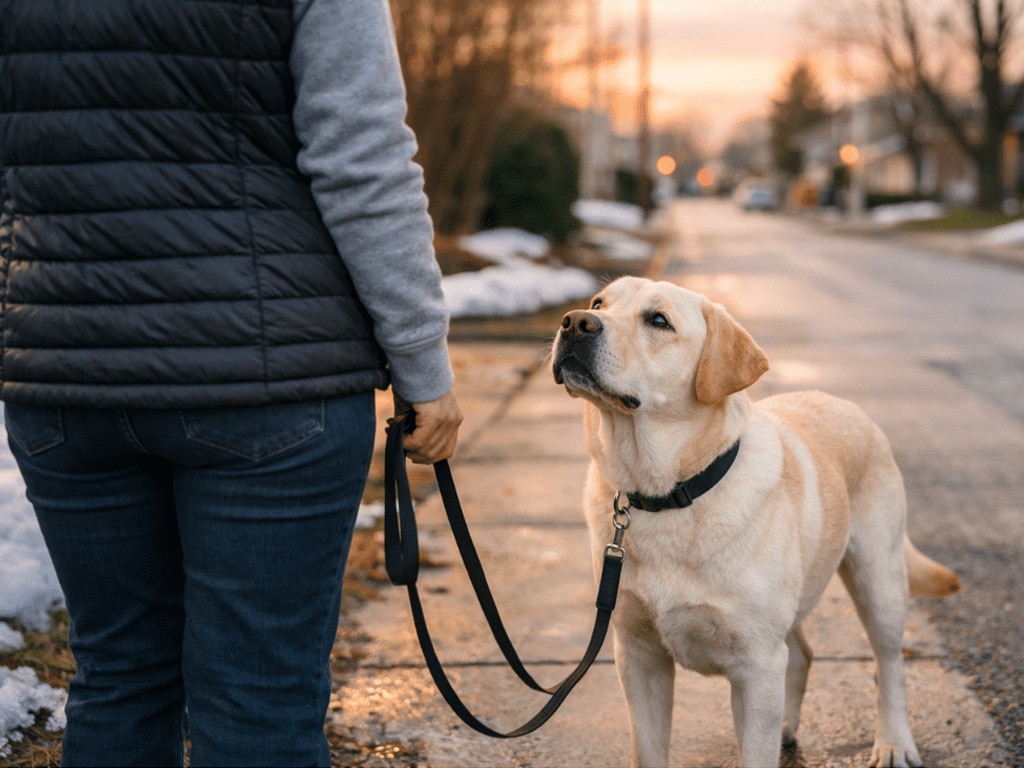





If you’ve landed here because your rescue dog is scared of “normal life,” you’re not alone, and you’re not doing anything wrong. Fear is one of the most common reasons people reach out for dog training in Hamilton help, because it can show up in a hundred small ways that feel confusing, exhausting, and sometimes even scary. One day your dog is sweet at home, and the next day the world seems to be too much.
At K9 Principles, we build confidence without flooding, forcing, or “letting them figure it out.” Real confidence is not your dog being dragged closer until they stop reacting. Real confidence is your dog learning, at their pace, that they are safe, they have choices, and good things happen when they engage with the world. This is the heart of calm, effective Hamilton dog training for fearful rescue dogs, and it is absolutely doable with the right plan.
How Fear Actually Shows Up (And Why It’s Not Always Obvious)
Fear does not always look like shaking in a corner. Some dogs freeze and get small, but plenty of fearful dogs look “busy,” loud, or even pushy. Fear can show up as barking, lunging, growling, snapping, hiding, bolting, refusing food outdoors, panting when it is not hot, scanning the environment, refusing to move, or clinging to you like glue.
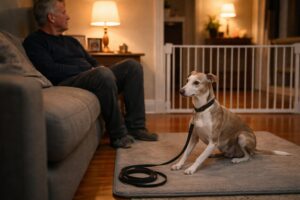
A lot of first-time owners get thrown off because their dog’s fear looks like stubbornness. “He won’t go for walks.” “She won’t let strangers touch her.” “He loses his mind when he sees another dog.” That is not a dog being difficult. That is a dog trying to feel safe. Once you see it that way, the path forward gets clearer, and dog training becomes less about control and more about building capacity.
Why Pushing ‘Socialisation’ Too Fast Backfires Hard
Rushed socialisation is one of the quickest ways to make fear worse. If your dog is scared, and we push them into the scary thing, their brain does not learn, “Oh, I’m fine.” Their brain learns, “That was terrifying and I had no way out.” That is how you get bigger reactions, longer recovery times, and a dog who starts reacting sooner because they expect it to go badly.
People often mean well here. They want their dog to meet people, meet dogs, go to busy places, get “exposed.” The problem is that exposure is not the same as learning. Flooding is exposure without choice, without safety, and without staying under threshold. It is like throwing someone who cannot swim into deep water and calling it confidence building. They might survive the moment, but they do not come out loving the pool.
Fear, Threshold, and the ‘Point of No Return’
Your dog has a threshold, and it is basically the line where thinking brain turns off and survival brain takes over. Under threshold, your dog can notice something and still eat, sniff, respond to a cue, and recover quickly. Over threshold, your dog is no longer choosing behaviour, they are reacting.
This is why the same dog can look “fine” at home and fall apart on a walk. The environment is louder, closer, faster, and less predictable. In smart dog training, we stop measuring progress by “did they react” and start measuring progress by “how quickly did they recover” and “how close could we get while staying calm.” That is where confidence actually grows.
What Confidence Really Is (And What It Is Not)
Confidence is not boldness. Confidence is not your dog charging up to everything. Confidence is your dog feeling safe enough to explore, safe enough to say “no thanks,” and safe enough to come back to you when they are unsure.
At K9 Principles, we aim for a dog who can move through life with options. Sometimes that means choosing to approach. Sometimes it means choosing to create distance. Either way, your dog stays in a learning state. That is the difference between a dog who is “managed” and a dog who is genuinely improving through Hamilton dog training done properly.
Predictable Routines: The Fastest Way to Reduce Fear at Home
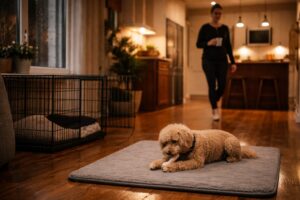
Fearful dogs relax when life becomes predictable. When routines are messy, random, and constantly changing, your dog stays on alert because they cannot guess what is coming next. When routines are clear, your dog stops wasting energy on vigilance and starts building trust in the environment.
We like simple structure: regular potty breaks, consistent meal times, calm rest time, and short training moments that end before your dog gets tired or overwhelmed. A predictable routine does not mean boring. It means your dog has a steady floor under their feet. From that floor, we can build real confidence using dog training that fits your actual life.
Reinforcement Done Right: Not Bribing, Not Begging, Just Clear Feedback
If you have ever wondered, “Am I just luring my dog around with treats?” you are asking the right question. Reinforcement is not bribery when it is used to mark and pay for brave choices, calm behaviour, and recovery. The goal is not to wave food in front of your dog’s face. The goal is to change what the scary thing predicts.
When your dog sees something that worries them and good stuff happens at a safe distance, the world starts feeling less threatening. Over time, your dog learns a new emotional response, and the behaviour changes along with it. This is why reinforcement is a foundation piece in fear-based behaviour with our dog training in Hamilton, especially for rescue dogs who are still learning what your home and neighbourhood mean.
Gradual Exposure That Works: Choice, Distance, and Tiny Wins
The safest exposure is gradual, planned, and under threshold. We want your dog to notice the trigger and still be able to think. That might mean the trigger is far away, quiet, predictable, or only present for a short time. It might mean you practise in the parking lot instead of inside the store. It might mean you watch the world from your car with the windows cracked while you feed calmly.
Here is the mindset shift that changes everything: we do not train bravery by forcing contact. We train bravery by creating successful repetitions where your dog stays regulated. If your dog can look at the world and then choose you, that is a win. If your dog can sniff the grass and decompress while the world exists at a safe distance, that is a win. Those wins stack, and they turn into confidence.
Confidence Exercises You Can Start Today (Without Overwhelming Your Dog)
A fearful dog needs games that build a sense of control and safety. One of our favourites is the “find it” scatter, where you calmly toss a few treats on the ground and let your dog sniff to find them. Sniffing lowers arousal, gives your dog something predictable to do, and helps them reset. It is not a distraction trick. It is a nervous system tool.
Another powerful exercise is a simple hand target cue, like “touch,” where your dog boops your hand and gets reinforced. This becomes a clean way for your dog to re-orient to you when they are unsure. It also builds confidence because the dog can succeed quickly and often. Success is fuel.
We also love pattern games that create predictability, like a calm “one-two-three” rhythm where you say the pattern the same way each time and deliver reinforcement on the third beat as you move. Fearful dogs relax when the script is consistent. When the world feels messy, you become the steady metronome.
Walks for Fearful Dogs: Stop Trying to ‘Tire Them Out’ and Start Helping Them Feel Safe
A common trap is thinking your dog needs “more exposure” on walks. If your dog is fearful, long, intense walks can actually make things worse because your dog spends more time over threshold. Instead of building confidence, you build rehearsal of panic.
We prefer shorter, calmer walks that prioritise decompression and distance. Sometimes the best walk is ten minutes in a quiet area with lots of sniffing, then home for rest. Sometimes the best walk is stepping outside, doing a quick confidence loop, and coming back in before the stress builds. This is not “giving in.” This is smart dog training that keeps your dog in the learning zone.
As your dog improves, we expand the map. We add slightly busier streets at quieter times. We practise near the edge of a park instead of walking through the middle. We do the same route until it is boring, because boring is safety for a fearful dog.
Strangers, Guests, and ‘Don’t Let Them Pet Him Yet’
Most fearful dogs do not need more petting from strangers. They need less pressure and more choice. A dog who is unsure may approach, then freeze, then get touched, then learn that approaching equals being trapped in contact. That is how you get dogs who start barking or snapping “out of nowhere.” It is not out of nowhere. It is built from repeated moments where the dog felt they had no escape.
We coach owners to advocate clearly. Your dog is allowed to observe. Your dog is allowed to stay behind you. Your dog is allowed to move away. When guests come over, we set the environment up so your dog can succeed. That might mean a gate, a leash with slack, a settle spot, and reinforcement for calm behaviour while the guest ignores the dog completely. Weirdly enough, ignoring is often the kindest thing someone can do for a fearful rescue dog.
When your dog is ready, we build controlled interactions that are on your dog’s terms. That is the difference between “socialisation” that scares them and socialisation that actually creates confidence through safe, gradual Hamilton dog training.
Common Confidence-Killers Owners Don’t Realise They’re Doing
One of the biggest confidence-killers is accidentally rewarding avoidance patterns that increase fear. That does not mean you ignore your dog when they are scared. It means you avoid frantic soothing that adds emotional pressure, like hovering, begging, or repeating their name while they spiral. Calm, steady support is the goal.
Another common issue is inconsistent boundaries. If your dog is fearful, they often feel safer when the rules are predictable. That might mean consistent management around windows, doors, visitors, and walk routines. When the structure changes daily, your dog has to stay alert.
The final one is pushing too soon after a “good day.” Fear is not linear. A good day does not mean your dog is cured. It often means the environment was easier, the dog slept better, or the triggers were lighter. Progress is built by repeating easy wins, not by cashing in one good day for a huge challenge.
When Professional Support Is the Safest Option (And Not a ‘Last Resort’)
If your dog is growling, snapping, biting, redirecting onto the leash, or cannot recover after being scared, it is time for professional support. If your dog is terrified of handling, terrified of strangers, panics in the car, or shuts down to the point they will not eat, those are not “wait it out” situations. If there are children in the home, frequent visitors, or unavoidable close-contact environments like condo hallways, getting help early is simply safer.
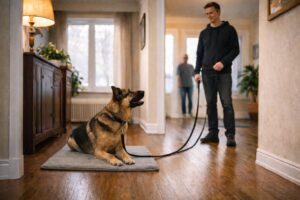
At K9 Principles, we take safety and emotional welfare seriously. Fear can turn into defensive aggression when dogs feel trapped, and owners often get hurt trying to “comfort” or physically move a scared dog. The safest option is a plan that reduces risk while building confidence. That is exactly what high-quality dog training in Hamilton should do: protect the dog, protect the people, and create steady improvement without drama.
Sometimes we also recommend a conversation with your vet, especially if anxiety is intense, sleep is poor, recovery is slow, or your dog seems constantly on edge. Training and veterinary support can work together, and when they do, progress is often faster and kinder.
Why In-Home Private Training Works So Well for Fearful Rescue Dogs
Fear is context-dependent. Your dog might be fine in the kitchen and terrified on your front step. That is why cookie-cutter plans fail so often. In our In-Home Private training, we build an individual plan for you and your dog, and we work in the exact environments that are causing the concerns. We are right by your side while we coach timing, distance, body language, and reinforcement, so you are not guessing or hoping you are doing it right.
We also help you set up your home and daily routine so your dog can actually decompress. When a dog feels safer at home, progress outside gets easier. When your dog learns predictable patterns, your cues land better. When you know how to spot threshold early, you stop accidental flooding before it happens. This is where dog training becomes a system instead of a scramble.
If your dog is ready for it later, our Level 1 group classes can be a great next step to build a tremendous foundation and practise around real-life distractions in a structured way. If your schedule is packed or you want a done-for-you option, our Home School Academy is also available, where we do the training for you and hand you back a dog with real skills and a clear maintenance plan.
Conclusion
If your rescue dog is fearful, you do not need tougher love, more pressure, or faster socialisation. You need a plan that protects your dog’s nervous system while building real confidence through gradual exposure, predictable routines, and reinforcement that makes the world feel safe again. At K9 Principles, we make this practical, step-by-step, and tailored to your actual life, because that is what effective Hamilton dog training looks like when fear is the real issue. When you are ready, reach out for our In-Home Private training so we can build an individual confidence plan with you, in the places your dog actually struggles, and help you turn those “hard moments” into steady wins.
Contact us for more information:
- Name: K9 Principles
- Address: Haldimand County, Greater Hamilton Area, Burlington, and Most of Norfolk County
- Phone: 289 880-3382
- Email: k9principlesinc@gmail.com
- Website: www.k9principles.ca
FAQs
-
A1. If your dog struggles most when something changes, when the environment is busy, or when people or dogs get closer, fear is likely part of it. “Untrained” dogs are often simply excited or distracted, but fearful dogs show stress signals like freezing, scanning, refusing food, panting, bolting, or reacting strongly and then taking a long time to recover.