




Why Rescue Dogs Struggle Alone More Often Than Other Dogs
If you have a rescue dog who melts down the second you grab your keys, you are not imagining things, and you are not “creating a clingy dog.” Separation anxiety is genuinely more common in rescue dogs because their history is often full of stress, unpredictability, and loss, even when they seem “fine” on the surface.
A lot of rescue dogs have been rehomed, surrendered, transported, fostered, kenneled, or bounced through multiple environments where nothing stayed the same for long. Their nervous system learns one big lesson: people disappear, and safety disappears with them. When you leave, the dog is not being stubborn, dramatic, or spiteful. They are panicking because their brain is screaming, “This is how I get abandoned again.”
This is also why dog training for separation anxiety is not just “teach the dog to be alone.” It is rebuild-the-dog’s sense of safety, predictability, and confidence, and it has to be done in a way that prevents panic from rehearsing.
Separation Anxiety Versus Boredom: Why the Difference Matters
Before you try to “fix it,” you need to know what you are actually looking at. Boredom problems usually look messy, but they are often calmer underneath. A bored dog chews because they have energy and no plan. A separation-anxious dog destroys things because they are trying to escape distress.
Separation anxiety usually includes panic behaviours like frantic vocalising, drooling, trembling, relentless pacing, desperate scratching at doors, and attempts to break out of crates or windows. Some dogs injure teeth, nails, or gums trying to get free. That is not a training issue in the simple sense. That is a nervous system in overload.
Getting this distinction right is one reason Hamilton dog training should not be a one-size-fits-all recipe pulled from the internet. The plan changes depending on whether you are dealing with panic, confinement anxiety, isolation distress, or a dog who simply needs a better routine.
The Real Reasons It Happens in Rescue Dogs
Most owners assume separation anxiety is “attachment,” like the dog loves you too much. The truth is more practical and more fixable. It is usually a cocktail of learned fear, incomplete coping skills, and stress stacking.
Rescue dogs often arrive already running hot, even if they look calm. Stress hormones can linger, sleep can be poor, and their baseline arousal is higher than you realise. Then normal life hits, and the dog has not yet learned how to self-settle, how to switch off, or how to feel safe when nothing is happening.
Some dogs also have a history where being alone predicted something scary, like crate confinement, rough handling, a noisy kennel, or chaotic rehoming. Other dogs are simply under-prepared for solitude because they have never had to practise it properly. In that case, your dog is not “bad at being alone.” They are untrained in a life skill.
Early Warning Signs Owners Miss in the First Two Weeks
A lot of separation anxiety builds quietly before it explodes. If you catch it early, you can often improve it faster because you stop the panic reps before they become the dog’s default routine.
You might notice your dog follows you room to room like a shadow and cannot settle unless they are physically touching you. You might see them suddenly wake when you stand up, or track your movements like they are on duty. You might notice they struggle to chew a chew, eat a meal, or relax if you are not close.
You might also see “pre-departure panic,” where the dog starts to escalate the moment you put shoes on, touch your coat, or pick up keys. That tells you it is not the time alone that is the only trigger. The leaving routine has become the cue for distress.
What It Looks Like When It Is Getting Serious
If your dog is vocalising for long periods, attempting escapes, or destroying exit points, that is a bigger deal than “a little whining.” The longer it goes on, the more your dog practises panic as a habit, and the harder it becomes to unwind.
A serious case often includes a dog who cannot settle even after you leave, who escalates rather than calms down, and who seems relieved but still frantic when you return. Some dogs also show “aftershocks,” where they remain unsettled for hours after a short absence because the nervous system stays activated.
If your dog is hurting themselves, breaking teeth on a crate, or smashing windows, that is not the time to test tougher crates or “let them cry it out.” That is the time for a proper plan, and sometimes veterinary support, because safety comes first.
The Fastest Way to Improve It Starts With One Big Rule: Stop the Panic Reps
The fastest improvements happen when you stop giving the brain “practice runs” at distress. Every full panic episode is like your dog doing a workout for anxiety. The body gets better at what it practises, even when that thing is unhelpful.
Management is not failure. Management is how you buy your dog time to learn. If your dog panics when left alone, you need a short-term plan to prevent that while you rebuild skills. That can mean arranging sitters, family help, daycare, bringing the dog with you when appropriate, or working from home strategically while you train.
At K9 Principles, we treat management like scaffolding on a house. You do not keep scaffolding forever, but you absolutely use it while you build something solid.
Set Up Your Home So Alone Time Feels Predictable, Not Like a Trap
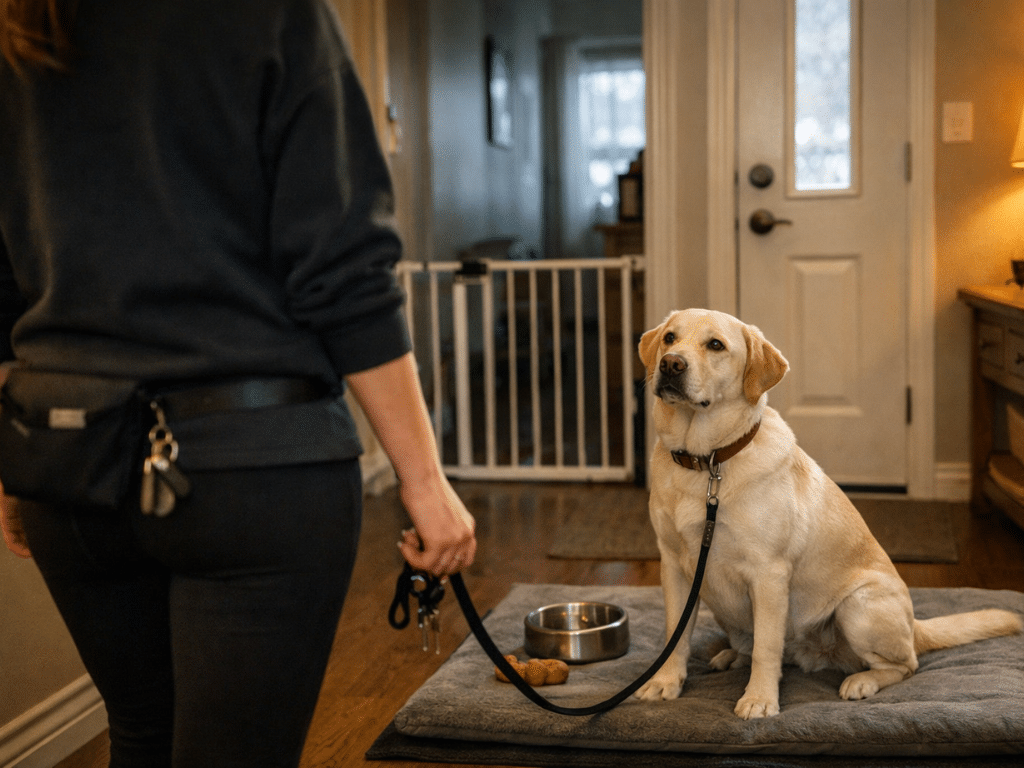
Your environment can either calm your dog or wind them up. Start by choosing one “safe zone” where your dog regularly relaxes when you are home. That might be a dog bed in the living room, a mat near your desk, or a quiet corner where the dog can watch life without being in the middle of it.
If your dog panics in a crate, do not force crate time as your “solution.” For some dogs, crates help. For other dogs, crates become the panic trigger. The goal is calm, not containment. If you need a boundary, a gated area or a puppy-proofed room can be safer while you retrain the emotional response.
Sound can help too, but it is not magic. A steady fan, white noise, or calm music can take the edge off outside triggers. The real win is making the leaving routine boring and predictable instead of dramatic and emotionally charged.
Confidence-Building Routines That Make Alone Time Easier
Separation anxiety is often a confidence problem hiding inside a leaving problem. Your dog needs a daily routine that builds stability, teaches switching off, and rewards calm independence, even when you are home.
Start with a predictable rhythm for sleep, meals, walks, and calm time. Rescue dogs do better when life is readable. Add short, simple training sessions that teach your dog how to succeed, because success builds confidence fast. A mat settle, relaxed down time, and calm place routines create a dog who can breathe instead of scanning for danger.

We also want your dog practising “not always being involved.” That means you can move around the house without the dog needing to shadow you, and your dog can stay settled on their mat while you do normal tasks. This is not about ignoring your dog. It is about teaching them, kindly, that they can be safe without constant contact.
How to Start Alone-Time Training Without Triggering a Meltdown
Here is the core idea: you do not train “being alone” by leaving for long periods and hoping your dog adapts. You train it like you train any skill, in tiny reps your dog can handle, and you build tolerance gradually.

Start below threshold. That means you practise micro-departures that do not cause panic. For some dogs, that might be stepping to the other side of a baby gate for one second and returning before any distress. For other dogs, it might be walking to the door, touching the handle, and sitting back down. Yes, it can be that small, and yes, it works, because you are changing the emotional prediction.
You also want to break the pattern of your leaving cues. If keys, shoes, and coats set your dog off, you practise those things at random times when you are not leaving. You pick up keys and put them down. You put shoes on and make a coffee. You grab your jacket and then sit on the couch. You are teaching your dog, “Those cues do not always mean abandonment.”
What to Do Immediately When You Have to Leave Today
Sometimes you have training goals, and sometimes you have real life. If you have to leave today and your dog struggles, your priority is preventing panic and keeping everyone safe.
Keep departures calm and low-key. Do not do big emotional goodbyes, and do not “rev” your dog up with hype right before you go. Set up the safe zone, give a calm activity your dog can handle, and leave without turning it into an event. When you return, keep greetings calm too, because we want coming and going to feel normal.
If your dog will not eat when distressed, do not treat that like stubbornness. It is information. It tells you the dog is already above threshold. In those cases, management support matters even more, because a dog who cannot eat cannot learn.
When Professional Help Is Needed and Why In-Home Matters
If your dog is injuring themselves, escaping, breaking out of confinement, or showing sustained panic, you should get help now, not later. If your dog is vocalising for long periods, your neighbours are complaining, or you feel trapped because you cannot leave the house, that is also a strong sign you need a plan built for your exact dog and schedule.
This is where in-home private training is not a luxury, it is the fastest path. Separation anxiety happens in your home, with your doors, your triggers, your routine, and your dog’s specific patterns. At K9 Principles, our In-Home Private Training is built for this because we work in the environment causing the concern, and we build an individual plan that fits your real life, not a fantasy schedule.
How Proper Dog Training in Hamilton Changes the Outcome Long-Term
Separation anxiety can feel like a life sentence, but it is not. The dogs who improve the fastest are the dogs whose owners stop the panic reps, build a daily confidence routine, and train alone time gradually and consistently.
The big mistake is trying to skip steps because you want the dog to “just be okay.” Your dog is not choosing to be difficult. Their brain is trying to survive. When you treat it like a skill and an emotional response, rather than a behaviour to punish, you finally get traction.
If you are looking for dog training in Hamilton that treats separation anxiety like the real thing it is, which is a nervous-system and routine problem that needs a practical plan, we are exactly built for that. This is also why Hamilton dog training for separation anxiety works best when it is personalised, because the details matter, and the details are different for every dog.
MoreConclusion
If your rescue dog panics when you leave, you do not need to feel guilty, and you do not need to feel stuck. You need clarity, a calm plan, and a way to stop rehearsing distress while you build your dog’s confidence from the ground up. Start by managing absences to prevent panic, build a predictable routine that rewards calm independence, and train alone time in tiny reps your dog can actually succeed at. If you want the fastest progress with the least guesswork, reach out to us at K9 Principles for In-Home Private Training, because we will work with you right inside the environments triggering the anxiety and build an individual plan that gets your life back while helping your dog feel safe again.
Contact us for more information:
- Name: K9 Principles
- Address: Haldimand County, Greater Hamilton Area, Burlington, and Most of Norfolk County
- Phone: 289 880-3382
- Email: k9principlesinc@gmail.com
- Website: www.k9principles.ca
FAQs
-
A1. The timeline depends on how intense the panic is and how long it has been rehearsed, but most owners see early changes faster when they stop full panic episodes and train below threshold. The goal is steady progress, not giant leaps, because confidence builds best through repeatable wins.