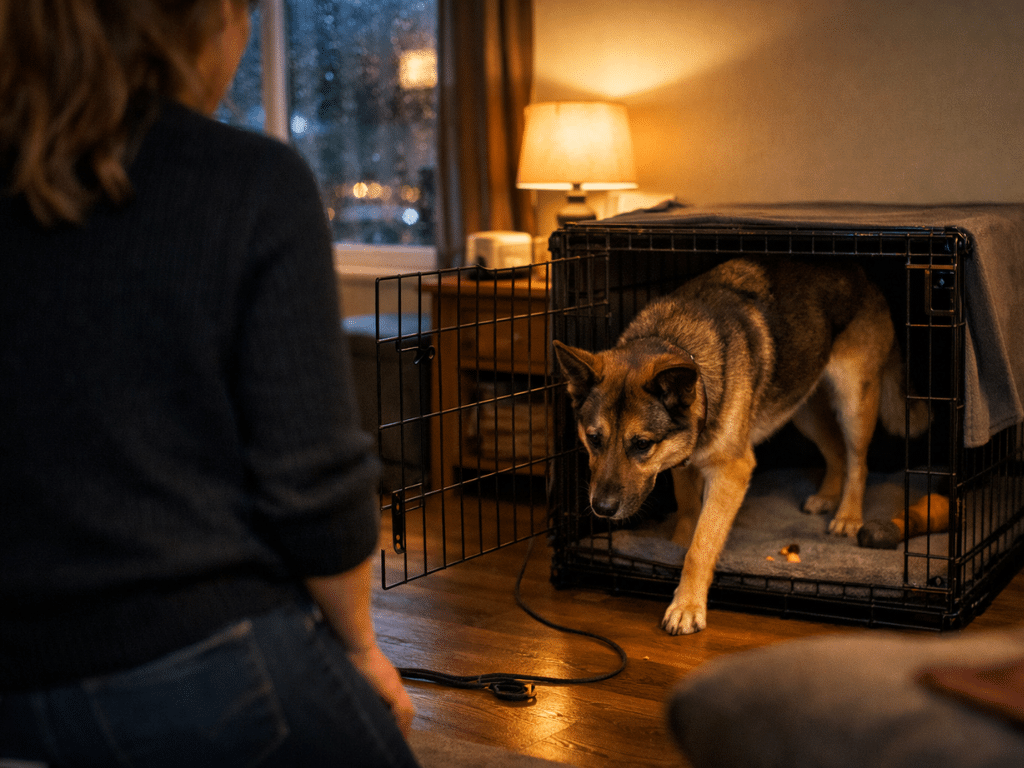





If you’re new to rescue dogs, crate training can feel like one of those “simple” topics that turns messy fast. You set up the crate, you pop in a comfy bed, you toss a treat… and suddenly your dog is screaming like you’ve betrayed them. If that’s where you’re at, take a breath. Crate training is not about forcing your dog to “get used to it”. It’s about teaching safety, predictability, and calm. That’s why, at K9 Principles, we treat the crate like a skill, not a shortcut.
Because in real life, the crate isn’t just a place to “put the dog”. It’s a management tool. It can protect your home, keep your dog safe by prevent rehearsal of bad habits, and give your dog structured rest. But if you push it too fast, or you use it like a time-out box, you can accidentally create panic, frustration, and separation struggles that make everything harder. And if you’re searching for dog training in Hamilton, you’re probably looking for a plan that actually fits real homes, real rescue dogs, and real schedules. That’s what this is.
This article will walk you through how to introduce the crate safely, build positive associations, use it without over-relying on it, and prevent panic. We’ll also give you a step-by-step progression, the mistakes we see most often, and solid alternatives for dogs who genuinely struggle with confinement.
What the Crate Is Really For (And What It’s Not For)
A crate is meant to be a predictable, safe “off switch” space. Think of it like a bedroom, not a jail cell. When it’s introduced properly, the crate becomes a place your dog can settle because it makes sense to them. It’s quiet, it’s consistent, and good things happen there.
What the crate is not for is punishment, isolation, or “shut up” containment when you’re frustrated. Dogs don’t reflect in a crate and decide to behave better next time. They either learn that the crate predicts calm and relief, or they learn it predicts frustration, separation, and loss of control.
At K9 Principles, we also don’t treat crate training as a badge of honour. Some dogs love crates. Some tolerate them. Some panic in them. Our goal with Hamilton dog training is always the same: choose what helps the dog succeed while keeping everyone safe and sane.
Why Rescue Dogs Often Struggle With Crates
A lot of rescue dogs have a history you don’t fully know, even if you have a great adoption story. Some have been crated for long hours with no enrichment. Some were confined in stressful kennel environments. Some learned that barriers mean they can’t escape scary things. Others simply never had the skill taught properly.
There’s also the “loss of control” piece. Rescue dogs often arrive already overloaded. New smells, new rules, new humans, new neighbourhood, new routine. When a dog’s nervous system is already running hot, confinement can feel like the final straw. The crate becomes the place where they can’t follow you, can’t explore, can’t check what’s happening, and can’t regulate the situation.
And then there’s separation. If your dog is already uneasy about being alone, a crate can amplify it. Not because crates are bad, but because the combination of being alone plus being confined can be too much too soon. That’s why our approach in Hamilton dog training is to build the emotional “yes” first, and the door-closed time second.
Before You Start: Set Up the Crate for Success
Start by making the crate physically inviting and emotionally neutral. Put it in a low-traffic area where your dog can still feel part of the household, especially in the early stages. A corner of the living room is often better than a basement or a closed laundry room. “Out of sight, out of mind” sounds nice, but for many rescue dogs, it becomes “out of sight, I’m abandoned.”
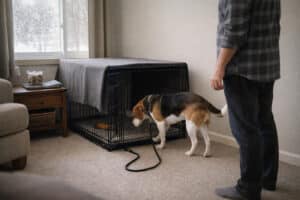
Choose the right size. Your dog should be able to stand up, turn around, and lie down comfortably. Too small feels tight. Too big can encourage toileting in one corner for dogs who haven’t learned house habits yet. If you’re using a wire crate, consider covering three sides to reduce visual stimulation, but keep airflow and temperature in mind.
Be careful with bedding. A stressed dog might shred and ingest bedding, which becomes a safety issue. If your dog is a chewer, start with a safer surface and add plush comfort later once they’re calm in the space. The goal is not “Pinterest crate goals”. The goal is calm, safe, and repeatable.
The Golden Rule: The Crate Must Predict Good Things
If you only crate your dog when you leave, or only crate them when you’re annoyed, the crate becomes a predictor of bad outcomes. Dogs are brilliant at pattern recognition. They learn sequences fast. Shoes on, keys grabbed, crate door closes, human disappears. That’s not crate training. That’s a countdown to stress.
Instead, we want the crate to predict comfort and reward even when nothing “needs” to happen. That means food, chews, and calm downtime happen in or near the crate at random times during the day, with you still home. It means your dog can wander in, check it out, get paid, and wander out again without pressure.
This is the piece most people skip because they want the crate to work immediately. But this is the foundation that makes the rest easy. If you want crate training without the battlefield, you build the emotional association before you build duration.
Step-by-Step Progression: From “Door Open” to Real-Life Crating
Step 1 is simple: the crate exists with the door open, and your dog gets to discover it. We like to start with a trail of treats leading to the entrance, then one treat just inside, then one slightly deeper. If your dog won’t step in, that’s information, not stubbornness. Reward any curiosity at the edge and keep sessions short.
Step 2 is meals near the crate, then at the entrance, then just inside. For some dogs, feeding fully inside the crate with the door still open is the magic switch that turns the crate into a good idea. For others, that’s too much pressure at first. The rule is: we don’t bribe the dog into panic. We shape comfort.
Step 3 is building a “go in” cue that feels like an invitation, not a shove. You can toss a treat in, let the dog go get it, then toss a treat out so they come back out. This teaches that going in doesn’t trap them. It also creates repetition without pressure. When the dog is choosing to go in easily, you start delaying the “treat out” by a second or two so they linger.
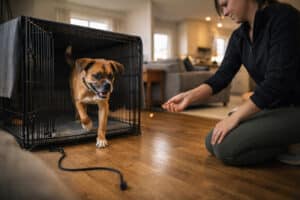
Step 4 is door movement without commitment. Touch the door. Wiggle it. Move it an inch. Reward calm. Open it again. If your dog startles, you went too fast. A lot of crate battles come from dogs being fine until the moment the door starts moving, because that’s the moment the brain goes, “Oh. This is confinement.”
Step 5 is closing the door for one second, then opening it before your dog feels the need to protest. This matters. If your dog learns that they have to escalate to be released, you’ve just trained noise and panic. We want your dog to learn that calm keeps the world predictable.
Step 6 is very short closed-door sessions with you sitting nearby, then standing up, then taking one step away, then returning. This is where many people accidentally rush because the dog looks “fine” until they’re suddenly not. Use a camera if you can. A dog can look quiet while still stressed. We want relaxed body language, not just silence.
Step 7 is adding real life: you go make a tea, you put laundry in, you answer the door, you take a shower. You keep sessions short enough that your dog stays successful, and you build up in tiny layers. This is where crate training becomes practical management rather than a dramatic daily event.
Step 8 is gentle independence. That might mean you leave the room for five seconds and come back, then ten seconds, then thirty. If your dog starts to worry, you drop the difficulty. This part is not about “teaching a lesson”. It’s about building tolerance and trust.
Step 9 is longer rests. This is where the crate becomes what most people actually want: a place your dog can nap while you work, cook, or handle life. We like to pair this stage with a long-lasting chew or a stuffed food toy so the crate becomes a calm routine, not an emotional cliff.
If this progression sounds detailed, good. Rescue dogs often need detailed. And the good news is that the better you build the early stages, the faster the later stages go.
How to Prevent Panic (And What Panic Actually Looks Like)
Panic isn’t just barking. Panic can look like frantic circling, digging, biting bars, drooling, panting, wide eyes, not taking food, or suddenly freezing and “shutting down”. Some dogs scream. Some go quiet and tremble. Both can be stress.
The single biggest panic trigger is too much time, too soon, with the door shut. The second biggest is pairing the crate with abandonment. If every crate session equals you leaving, your dog doesn’t learn the crate is safe. They learn the crate is the place where they lose you.

At K9 Principles, we prevent panic by keeping early sessions short, staying under threshold, and building a predictable routine. If your dog shows signs of panic, the best move is not to tough it out. The best move is to step back, lower the difficulty, and rebuild the association. That’s how you keep the crate from becoming a battlefield.
Using the Crate for Management Without Over-Relying on It
Crates are a tool, not a lifestyle. Yes, management matters. It prevents chewing, house soiling, door-dashing, and rehearsing behaviours that become habits. But if the crate becomes your main solution to everything, you can end up with a dog who never learns how to settle in the home, never learns household routines, and never learns what to do with freedom.
We like to balance crate time with structured freedom. That can mean short supervised time in the house, then a crate rest, then a training session, then a chew on a mat, then a walk. This rhythm teaches your dog, “I can handle life, and I can also rest.”

For first-time dog owners, this is where dog training becomes less overwhelming. You’re not trying to manage chaos all day. You’re building a predictable cycle that helps your dog’s nervous system settle and helps you feel in control without feeling harsh.
The Mistakes That Turn Crate Training Into a War
One common mistake is only using the crate when you leave. This creates a powerful negative association even if your dog doesn’t “act” upset right away. Over time, you can see more resistance, more vocalising, or more frantic behaviour as soon as you reach for the crate.
Another common mistake is moving too fast because the dog is quiet. Quiet does not always equal calm. A shut-down dog can be silent while still struggling. Look for loose muscles, soft eyes, settled breathing, and a dog who can eat and then relax.
We also see people inadvertently rewarding protest. If the dog screams and the door opens, the dog learns that screaming works. If the dog paws and you talk to them, the dog learns that pawing gets attention. That doesn’t mean you ignore distress. It means you build sessions so the dog stays below distress, then you reward calm behaviour instead of accidental escalation.
Another mistake is using the crate as punishment. If the crate is where the dog goes after “being bad”, the dog won’t feel safe there. You’re basically turning their bedroom into the place where the bad feelings happen.
Finally, a big one in rescue dogs is doing too much too soon overall. Crate training doesn’t exist in isolation. If your dog is overwhelmed by visitors, walks, new routines, and new expectations, the crate can become one more stressor. Sometimes the best crate training plan starts with reducing the rest of life first.
When a Crate Isn’t the Right Starting Point: Alternatives That Still Create Structure
Some dogs genuinely struggle with confinement, especially early on. That doesn’t mean they’re untrainable. It means you need a different entry point. Structure can exist without a closed crate door.
A gated safe room can be a great option, especially if your dog does better with a little more space. A laundry room, a kitchen area, or a hallway zone can work if it’s dog-proofed and calm. The key is still the same: positive association, gradual duration, and predictable routines.
An exercise pen can be another helpful middle ground. It gives more movement than a crate, which can reduce panic for dogs who feel trapped, while still preventing full access to the house. For some dogs, we’ll even start with the crate inside the pen with the crate door open, so the dog can choose the crate voluntarily while still being safely managed.
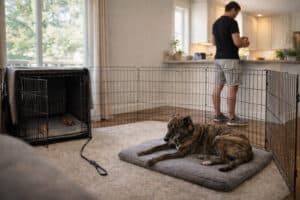
Tethering can work in specific situations, especially when you’re home and supervising. A short lead clipped to a sturdy piece of furniture can prevent wandering and sneaky chewing while your dog practises settling near you. This is not something we use casually, because safety matters, but in the right set-up it can be a practical stepping stone.
If your dog has true separation anxiety or confinement panic, the best plan is often to work the underlying emotional response first instead of trying to “crate train harder”. That’s where tailored coaching matters, because the wrong approach can make the problem bigger fast.
How Long Should a Rescue Dog Be Crated? A Practical, Humane Answer
There’s no magic number that fits every dog, but there is a common-sense rule: the crate should support rest and management, not replace training and enrichment. A dog who is crated for long hours every day without enough exercise, mental work, and social connection is going to struggle, crate or no crate.
For many rescue dogs, short crate rests during the day actually help them settle, especially in the first few weeks when everything is new. They don’t always know how to switch off. The crate can teach that off switch, but only if the dog is comfortable and only if they get enough healthy outlets outside of it.
If your dog is crated while you work, you’ll want a plan that includes breaks, walks, enrichment, and gradually increasing freedom as skills improve. This is one of the areas where our Hamilton dog training support can save you months of frustration, because the plan has to match your actual schedule and your actual dog, not an idealised routine you found online.
How We Build Crate Success Faster in Real Homes (And Why It Matters)
At K9 Principles, we don’t just hand you generic crate tips. We build a plan around your dog’s behaviour, your home layout, and the moments you’re actually struggling with. If your dog panics when you leave the room, we work on that. If your dog barks at every sound and can’t settle, we work on that. If your dog is fine in the crate but turns into a tornado the second they’re out, we work on the structure and routines so you’re not relying on the crate as the only calm button.
This is exactly why our In-Home Private training is such a strong fit for crate issues. We can coach you right where the problem happens, with your crate, your hallway, your front door, your neighbours, and your real daily flow. That’s how you get solutions that stick. If you’re looking for dog training in Hamilton that feels practical and personal instead of cookie-cutter, this is one of those topics where the right help changes everything.
And if your dog needs the fundamentals first, our Level 1 group classes can be a brilliant way to build the foundation that makes crate routines easier, including calm behaviours, engagement, and “settle” skills that transfer into the crate. If you’re slammed and you want the results without doing all the reps yourself, our Home School Academy is also an option, because sometimes the best answer is letting us do the heavy lifting while you get a dog who fits your life.
Conclusion: Calm Crating Isn’t About Tough Love, It’s About Skill
Crate training a rescue dog doesn’t have to be a showdown. When you treat the crate like a skill and not a shortcut, you get a dog who can actually rest, a home that feels calmer, and a routine that doesn’t rely on constant supervision. The goal is never to “win” against your dog. The goal is to build comfort, predictability, and trust so the crate becomes a tool that supports your life instead of a daily battle. If you want help turning your crate routine into something calm and reliable, reach out to us at K9 Principles. Our In-Home Private training is built for exactly this kind of real-life problem, and we’ll walk you through a plan that fits your dog and your home so you can finally breathe again.
Contact us for more information:
- Name: K9 Principles
- Address: Haldimand County, Greater Hamilton Area, Burlington, and Most of Norfolk County
- Phone: 289 880-3382
- Email: k9principlesinc@gmail.com
- Website: www.k9principles.ca
FAQs
-
A1. It depends on the dog’s starting point, but most rescue dogs do best when you think in stages instead of days. Some dogs feel comfortable within a week because the crate immediately feels safe. Others need a longer, slower build if confinement is stressful. The fastest route is usually the slow, steady one where you prevent panic and build true comfort first.