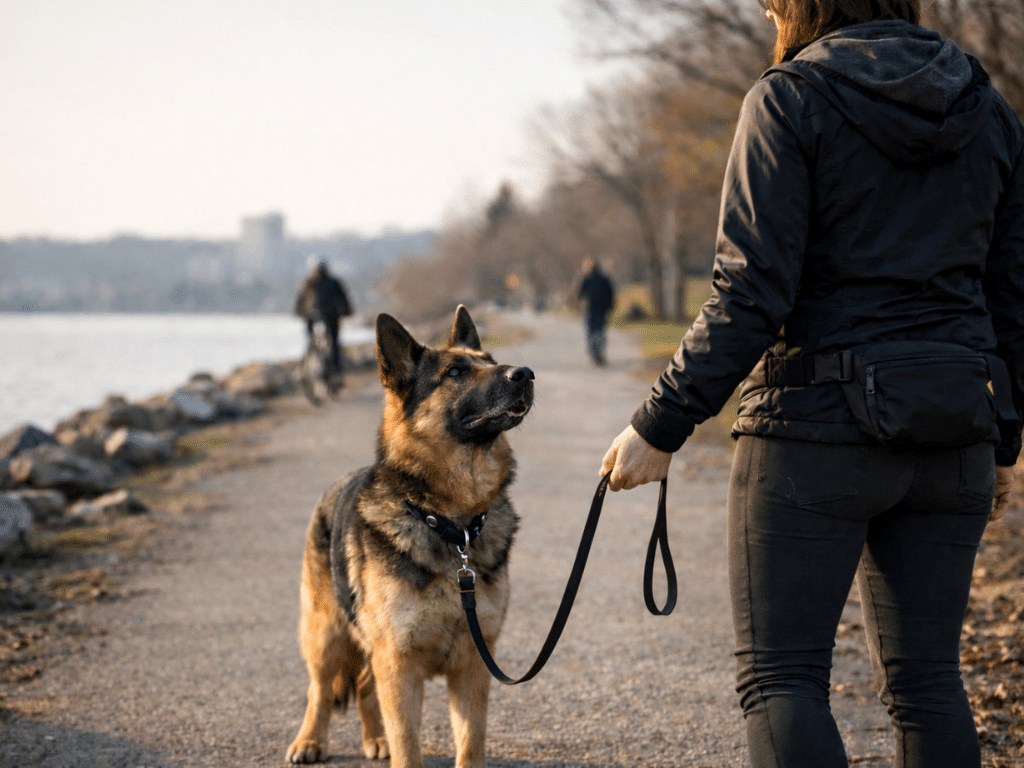




If you’ve just brought home a rescue dog, you’re probably asking a very normal question: “How do I get this dog to trust me?” And then, ten minutes later, you’re asking another one: “Why does he listen one moment… and completely ignore me the next?” That confusing flip-flop is exactly why trust is the real foundation of dog training. Not tricks. Not treats. Trust.
At K9 Principles, we see this every day with our dog training in Hamilton. The good news is trust isn’t mysterious, and it isn’t something you “earn” by being overly soft or constantly feeding your dog. Trust is built through consistency, predictability, fair boundaries, and positive experiences that make sense to the dog. Let’s break it down in a way you can actually use at home starting today.
Trust Isn’t Affection, It’s Safety and Predictability
A lot of first-time owners think trust means the dog wants cuddles, follows them everywhere, or acts excited when they come into the room. Sometimes that happens, but it’s not the core of trust. Trust is the dog believing, “This person is safe, and life makes sense around them.”
When a dog doesn’t trust yet, you’ll often see behaviours that look like stubbornness but are actually uncertainty. They might ignore cues, wander off mentally, cling to you, avoid you, freeze, or explode with big emotions over small things. That’s not your dog “being bad.” That’s your dog saying, “I don’t know what’s expected here, so I’m making my own choices.”
Here’s the shift we want: instead of trying to be more exciting than the environment, we become more reliable than the environment. That’s the heart of great Hamilton dog training for rescue dogs.
The Trust Formula: Consistency + Fair Boundaries + Good Outcomes
Trust builds when your dog can accurately predict what you’ll do. Not perfectly, not robotically, but consistently enough that your dog stops scanning for danger and starts leaning into you for direction.
Consistency means the same cue means the same thing today as it did yesterday. It also means the rules don’t change based on your mood. Fair boundaries mean your dog has clarity, not chaos. A boundary is not punishment. A boundary is information.
Good outcomes matter because dogs repeat what works. If ignoring you works, they’ll ignore you more. If choosing you works, they’ll choose you more. That’s not “dominance.” That’s learning. And it’s why trust and dog training are inseparable.
Your First Job: Build a Simple Routine Your Dog Can Memorise
Rescue dogs settle faster when the day has a predictable rhythm. You’re basically giving the dog a map. Without it, they’re guessing, and guessing creates stress.

A simple routine doesn’t need to be strict, but it should be repeatable. Meals at roughly the same times. Walks that start and end calmly. A predictable potty routine. A set rest place. A short daily training moment that feels easy, not intense.
At K9 Principles, we often tell clients to picture routine like a handrail on stairs. You can still move forward at your pace, but the handrail makes it safer. With dog training in Hamilton, the dogs that improve fastest are almost always the dogs whose owners become calmly consistent at home.
Why Bribing Backfires: The “Treat Magnet” Problem
Treats are useful, but bribing is a trap. Bribing is when the dog only responds because they see the treat first. Then the treat isn’t a reward, it’s a negotiator. The dog learns, “I’ll decide after I see what you’re offering.”
This is one of the most common ways owners accidentally teach their dog to ignore them. The dog looks at you, you repeat the cue, you show the treat, the dog responds, and you think, “Great, he listened.” What the dog learned was, “Wait them out until they pay.”
The fix is simple: cues happen once, rewards happen after. We can still use food, but we use it as feedback, not as a flashing sign that says “please.” That approach builds both reliability and trust, which is what good Hamilton dog training is supposed to do.
Fair Boundaries That Build Trust (Not Fear)
Boundaries sound harsh until you realise what the alternative is: confusion. Rescue dogs don’t relax in chaos. They relax when the world becomes understandable.
Fair boundaries look like gates, pens, leashes indoors when needed, and clear “this is your spot” routines. They look like preventing rehearsals of stealing, counter surfing, door-dashing, or pacing the house all evening. Not because you’re trying to control your dog, but because you’re trying to remove decision-fatigue from a nervous brain.
When your dog keeps practising self-directed behaviour, they start trusting themselves more than you. When you gently prevent the chaos and guide the dog into success, they start trusting your leadership. That’s the kind of trust we build through dog training every day.
Consent-Based Handling: How to Touch a Dog Who Isn’t Sure Yet
Handling is where a lot of trust is won or lost. If your dog dodges your hand, flinches, or stiffens, that’s not “attitude.” That’s information. Your dog is telling you they’re not ready for that level of closeness.
Consent-based handling means you invite, you don’t impose. You approach calmly, pause, and let the dog choose to lean in. You keep touch brief and neutral at first. You avoid reaching over the head, hugging, pinning, or grabbing collars unless it’s truly necessary for safety.

If you need to do grooming, harnessing, or collar grabs, you can teach it as a skill instead of making it a surprise. At K9 Principles, we coach owners through this with our dog training in Hamilton sessions because handling confidence is a massive trust-builder when it’s done properly.
The Collar-Grab and Leash Routine That Stops “Catch Me If You Can”
Many rescue dogs learn one very annoying game fast: you reach for them, they dodge, and suddenly you’re chasing a dog around your own living room. That game destroys trust and creates avoidance around you.
Instead, teach a predictable “gear up” routine. You come to the same spot. You present the collar or harness calmly. You do a quick collar-grab practice where your hand touches the collar, then you reward after. You clip the lead smoothly and then you release the dog forward.
The goal is for your dog to think, “That hand reaching for my collar means good things happen, and life stays calm.” That one change can transform your day-to-day life and is a staple in effective Hamilton dog training for rescue dogs.
Engagement Games That Build Trust Without Turning You Into a Vending Machine
Engagement is your dog choosing to notice you even when something else is happening. It’s not constant eye contact. It’s the ability to check in and take direction.
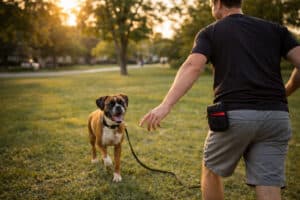
Simple engagement games done correctly build trust fast because they create a pattern: your dog chooses you, and good things happen. That “good thing” can be food, but it can also be movement, permission to sniff, a short game, or getting to go through a doorway.
Two powerful ideas we use at K9 Principles are predictability and permission. Predictability means your dog knows how to win. Permission means your dog learns that listening doesn’t end fun, it unlocks fun. That’s how we build real-world reliability through dog training without bribery.
The “Under-Threshold” Rule: Trust Dies When Your Dog Is Overwhelmed
If your dog is barking, lunging, freezing, or scrambling to escape, they are not learning trust in that moment. They are surviving. Trust-building happens under threshold, when your dog is aware but still capable of thinking.
This matters because well-meaning owners accidentally flood their rescue dog. They take them to busy places, introduce too many people, allow dogs to rush up, or push greetings because they want the dog to “get used to it.” The dog doesn’t get used to it. The dog learns the world is unpredictable and the owner doesn’t protect them.

With our dog training in Hamilton work, we prioritise calm exposure at distances your dog can handle. That’s how confidence grows without forcing it.
Common Trust-Breaking Mistakes That Teach Your Dog to Ignore You
If you want one section to read twice, make it this one, because these are the sneaky habits that create a dog who tunes you out.
Repeating cues teaches your dog that the first cue doesn’t matter. Pulling on the lead teaches your dog that you will do the work for them. Randomly calling your dog for “not fun stuff” teaches them your cue is a trap. Letting your dog drag you to sniff spots teaches them the environment pays better than you do. Petting a worried dog when they’re trying to move away can teach them that you don’t listen to their signals.
None of these make you a bad owner. They just show why coaching matters. At K9 Principles, we don’t only train the dog. We build the whole system so your dog learns that choosing you is the most logical, rewarding decision. That’s what high-quality Hamilton dog training actually looks like.
When You Should Get Help: The Shortcut Is Coaching in Your Real Environment
If your rescue dog’s issues show up at the front door, on walks, around guests, near other dogs, or in specific rooms of your house, the fastest way forward is training in those exact environments. Reading tips is helpful, but it can’t replace hands-on timing, set-ups, and real-life proofing.
That’s why our primary recommendation is our In-Home Private Training. At K9 Principles, we come to you, we build an individual plan right where the problem happens, with you beside us the whole time. That’s how you get clarity fast and stop second-guessing yourself.
If your dog is ready for a structured social learning environment after that foundation is built, our Level 1 group classes are the next step to create a rock-solid base you can expand on. And if life is slammed and you want the results without doing the daily reps yourself, our Home School Academy is the option where we do the training for you while still keeping you in the loop on the rules that maintain it.
What Trust Looks Like After It Starts Working
Trust isn’t dramatic. It’s quiet. It looks like your dog exhaling on their mat. It looks like your dog glancing back at you on a walk instead of scanning the world for threats. It looks like your dog accepting handling without dodging. It looks like your dog being able to say “no thanks” without needing to panic.
Most importantly, trust looks like choice. Your dog starts choosing you because your guidance has become predictable, fair, and worth following. That’s when dog training stops feeling like a battle and starts feeling like a relationship with structure.
If you’re sitting there thinking, “I want that, but I’m not sure I’m doing this right,” you’re exactly the kind of owner we love working with at K9 Principles.
Conclusion:
Building trust with a rescue dog is not about being the most exciting thing in the room, and it’s definitely not about babying your dog into a fragile routine. Trust is built when your dog learns that life with you is consistent, understandable, and fair, and that good outcomes happen when they follow your lead. If you want a clear plan that fits your dog’s personality and your real life, our In-Home Private Training is the best next step because we work with you in the exact environments causing the concerns and show you how to build trust through practical reps that actually stick. When you’re ready to expand that foundation, our Level 1 group classes help you build the skills that make everything else easier, from leash walking to calm greetings to reliable recall.
Contact us for more information:
- Name: K9 Principles
- Address: Haldimand County, Greater Hamilton Area, Burlington, and Most of Norfolk County
- Phone: 289 880-3382
- Email: k9principlesinc@gmail.com
- Website: www.k9principles.ca
FAQs
-
A1. Trust usually builds in layers, not all at once. You might see small signs within days, like your dog settling faster or checking in more, but deeper trust can take weeks or months depending on the dog’s history and how consistent the routine is. With our daily dog training in Hamilton, we see the biggest jumps when owners stop guessing and start running the same predictable system daily.