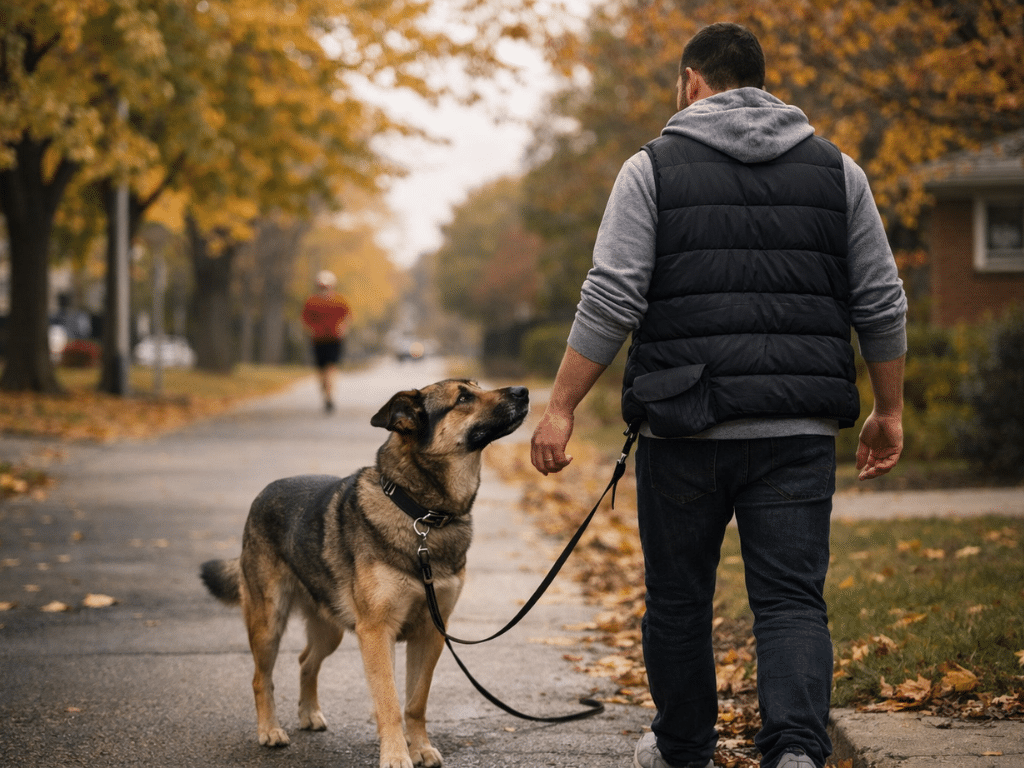





Bringing home a rescue dog is exciting, emotional, and sometimes a little bit “What have we done?” all at the same time. If your new dog is pacing, shadowing you, whining, barking at every noise, or acting like rest is illegal, you are not failing. You are watching a nervous system try to make sense of a brand-new world. This is exactly where decompression comes in, and it is one of the most important pieces of dog training you will ever do.
At K9 Principles, we see this constantly with our dog training in Hamilton. A dog arrives in a new home and the family wants to “do everything right,” so they give tons of freedom, tons of affection, tons of stimulation, and tons of reassurance. It feels loving, but it often backfires because it accidentally teaches the dog that unsettled behaviour is the way to get safety, attention, and control.
This article will show you what decompression really means, how to build a calm environment, and how to balance rest with gentle structure so your dog settles in without learning anxious or demanding habits. You will still be kind. You will still be supportive. You will just be clear, predictable, and steady, which is what rescue dogs actually need.
What Decompression Really Means (And What It’s Not)
Decompression is not “doing nothing.” It is not ignoring your dog. It is not letting them roam the house to “get used to it.” Decompression is the process of reducing stress, lowering arousal, and helping your dog’s brain and body return to a baseline where learning and bonding can happen.
Think of it like moving to a new city where you do not know the rules, the streets, or the people. You would not want someone to drag you to five parties, introduce you to twenty strangers, and then wonder why you cannot sleep. You would want quiet, routine, and someone calmly saying, “You’re safe. Here’s what happens next.”
Decompression is the foundation under all good Hamilton dog training. If your dog cannot settle, they cannot learn. If their nervous system is constantly “on,” every little thing becomes a big deal, and that is when you see reactive behaviour, separation stress, demand barking, and meltdowns.
Why Rescue Dogs Struggle to Settle in a New Home
Rescue dogs often arrive with a history you do not fully know. Even when their past is “fine,” the transition itself is stressful. New smells, new sounds, new routines, new expectations, and new people can feel like a lot.
Many rescue dogs also come from environments where their choices did not matter much. Suddenly they have freedom, couches, toys, attention, and space. That sounds amazing, but it can also create hypervigilance because the dog does not yet understand what is expected or what is safe.
This is why we focus on structure early in dog training. Structure is not harsh. Structure is a relief. It makes the day predictable, and predictable is calming. When your dog can predict the pattern, they stop trying to control everything.
The Biggest Myth: “Just Give Them Love and Time”
Love matters, but love without structure often teaches the wrong lesson. If your dog whines and you instantly cuddle, your dog learns that whining is the cue that produces closeness. If your dog paws you for attention and you respond every time, your dog learns that pawing is an effective strategy. That is not “spoiling” in a moral sense. It is just learning.
Time matters too, but time does not fix rehearsed habits. The behaviours your dog practises in week one become the behaviours your dog defaults to in week four. That is why decompression has to include gentle boundaries right away.
At K9 Principles, our approach to dog training in Hamilton is simple: we keep the dog’s world small enough that they can succeed, then we expand it as their nervous system settles and their skills grow.
Your First Goal: Calm Beats Confidence (At First)
A lot of people aim for confidence immediately. They want their rescue dog to be social, brave, playful, and “normal” right away. That is understandable, but it is backwards.
Calm comes first. Calm is the soil. Confidence grows out of calm. When your dog can settle on a mat, nap, chew, and exist without scanning the world, that is the sign you are winning decompression.
So your first goal is not more experiences. Your first goal is fewer surprises, fewer choices, and more predictable calm. That is not boring. That is therapeutic.
Set Up the Home Like a Calm “Landing Zone”
Your home environment can either help your dog settle or keep them wound tight. For decompression, we want the home to feel like a quiet routine machine.

Start by creating one main area where your dog spends most of their time. This can be a living room area with a baby gate, an exercise pen, or a crate setup with a comfortable bed nearby. The goal is not confinement for punishment. The goal is reducing the number of decisions your dog has to make.
Keep traffic low. Keep voices normal. Avoid hovering. If your dog is following you everywhere, do not treat that as “bonding.” Treat it as stress. We want your dog learning, “Humans move around and I can still relax.”
This is a core piece of Hamilton dog training that people underestimate. The environment is part of the training plan, whether you meant it to be or not.
Routines That Help a Rescue Dog Exhale
A routine is not a schedule that must be perfect to the minute. A routine is a predictable rhythm. Your dog starts to relax when they know what usually happens next.
In early decompression, keep days simple. Start with a toilet break, a small bit of movement, a calm enrichment moment, and then rest. Repeat that pattern through the day. You are teaching a cycle: activity happens, then calm happens, and calm is safe.
Try to keep feeding, rest, and outings roughly consistent. Even small consistency builds safety. Unpredictable days create scanning, and scanning creates over-arousal.
If you want the simplest rule for early dog training, it is this: do fewer things, more consistently.
Boundaries Without Being Cold: Structured Freedom Done Right
Boundaries are where most first-time owners get stuck. They worry boundaries mean their dog will feel rejected. In reality, boundaries reduce anxiety because the dog does not have to manage the whole house.
Structured freedom means your dog earns access to more space as they demonstrate calm behaviour. If they cannot settle in the living room, giving them the entire house is not kind. It is overwhelming.
Use gates, tethers, or closed doors strategically. Give your dog a place to succeed, then slowly expand. When you expand, do it on your terms, not because your dog is demanding it. That one detail prevents a lot of bad habits.
This is one of the most effective, humane strategies we use with our dog training in Hamilton because it gives the dog clarity without intimidation.
Rest Is Not Optional: Teaching an “Off Switch” During Decompression
A rescue dog that cannot rest is not being stubborn. They are dysregulated. They might look busy, needy, or “on edge,” but what you are really seeing is a body that does not know how to downshift.
Build rest into the day like it is an appointment. After a short walk or enrichment moment, guide your dog to their mat, bed, or crate area. Keep it boring. Keep it calm. Give a chew if it helps. Then ignore the small protests, as long as your dog is safe.
If your dog whines, paws, or stares, you do not need to correct them harshly. You simply do not pay that behaviour. When they take a breath, soften, or lie down, that is when calm attention can happen.
This is decompression as dog training: not punishment, not coddling, just teaching calmness as the default.
Enrichment That Calms Instead of Hypes
Not all enrichment is equal. Some enrichment makes dogs more frantic. During decompression, we want enrichment that slows the brain down.
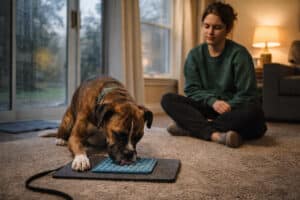
Food-based enrichment can be great when it is low-arousal. Think scatter feeding in a small area, stuffed Kongs, lick mats, and simple puzzle feeders that do not create frustration. Sniffing is also calming, which is why calm sniff walks can be part of the plan.
Avoid high-intensity games early on, especially if your dog already struggles to settle. Tug, chase, and frantic fetch can be fun later, but early decompression is about lowering the baseline.
At K9 Principles, we build enrichment into our Hamilton dog training plans based on the dog in front of us, because the same activity that calms one dog can wind up another.
Walks During Decompression: Less Distance, More Quality
A mistake we see all the time is owners doing long walks to “tire the dog out.” Tired and calm are not the same thing. A dog can be physically tired and mentally buzzing.
During decompression, think short, quiet, and controlled. Choose calmer routes. Avoid busy parks and pet stores. Keep the lead loose. Let your dog sniff. End the walk before your dog gets fried.
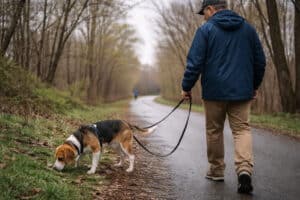
If your dog is reactive or over-stimulated, your decompression walk might look like five minutes outside, a sniff in one area, and then back in. That still counts. Your goal is not mileage. Your goal is recovery.
This is a big shift in mindset for new owners, but it is a game-changer with dog training in Hamilton where sidewalks, trails, and busy neighbourhoods can overwhelm a fresh rescue quickly.
How to Avoid Reinforcing Anxious or Demanding Behaviour (While Still Being Kind)
This is the part people fear, so let’s make it simple. Kindness is not the same as reinforcement. You can be kind, calm, and supportive without paying for behaviour you do not want repeated.
If your dog is demanding attention by barking, pawing, mouthing, or climbing on you, do not negotiate. Do not lecture. Do not push them away in a way that turns it into a game. Instead, calmly remove access to you for a moment, or stand up and disengage. When your dog offers a calmer choice, that is when you re-engage.
If your dog is anxious, your job is to provide safety through predictability. That might mean guiding them to a rest space, offering a chew, and continuing your routine. It might mean quietly sitting nearby without fussing. What we avoid is the pattern where anxious behaviour becomes the cue that produces constant soothing and constant attention.
In dog training, the behaviours that get results are the behaviours that repeat. Your dog is not trying to be manipulative. They are trying to learn what works. We want calm behaviours to work best.
Visitors, Sounds, and “Triggers”: Protect the Nervous System Early
Early decompression is not the time for meet-and-greets. Your dog does not need to be introduced to everyone in the first week. They need to learn that your home is safe and predictable.

If you have visitors, keep them low-key. No leaning over the dog. No reaching. No excited voices. Give your dog space behind a gate or on their mat, and pay for calm behaviour. If your dog cannot settle, the visit is too much, and that is not a failure. That is information.
Noise management matters too. If your dog is startled by sounds, use white noise, close curtains, and reduce chaos. Every time your dog goes over threshold, it takes time to come back down. The fastest way to build confidence is to prevent repeated overwhelm.
This is why our In-Home Private Training is so effective for Hamilton dog training. We work inside your actual home, with your actual noises, your actual routines, and your actual challenges, so your plan matches real life.
When Decompression Isn’t Enough: The Signs You Need a Real Plan
Decompression is a starting point, not a magic reset button. If your dog is escalating, not improving, it is time to stop guessing and start following a plan built for your dog.
If your dog cannot settle at all, panics when alone, shows aggressive behaviour, or has intense reactivity, you do not need more time and hope. You need clear structure, skill-building, and coaching in the environments where it is happening. That is exactly what we do at K9 Principles through In-Home Private Training. We create an individual plan, we coach you step-by-step, and we help you build calm routines and reliable cues without turning your home into a battlefield.
If your dog is ready for the next layer after decompression, our Level 1 group classes are a strong foundation builder. They give you clear skills, clear progression, and the kind of structure that makes future dog training easier instead of harder.
And if life is full and you want the results without being the one holding every rep, our Home School Academy is there. We do the training for you, then transfer the skills back to you so your dog can live well in your home and in Hamilton’s real-world environments.
Conclusion:
Decompression Done Right Becomes the Dog You Were Hoping For
Here is the truth most people do not hear early enough: decompression is not about “fixing” your rescue dog. It is about giving their nervous system a fair shot. When you create calm routines, structured freedom, and clear boundaries, you are not being strict. You are being stabilising. You are teaching your dog that they do not need to manage everything, because you have it handled.
If you want help turning decompression into a plan you can actually follow, reach out to us at K9 Principles. Our In-Home Private Training is designed for exactly this stage, because we come to you and build the plan in the environments causing the concerns with your dog.
Contact us for more information:
- Name: K9 Principles
- Address: Haldimand County, Greater Hamilton Area, Burlington, and Most of Norfolk County
- Phone: 289 880-3382
- Email: k9principlesinc@gmail.com
- Website: www.k9principles.ca
FAQs
-
A1. No, because dogs are not robots and rescues come with different histories, temperaments, and stress levels. The timeline is a general pattern, not a promise. The useful part is understanding that behaviour changes as stress changes, so you should plan for progress in stages instead of expecting instant stability.