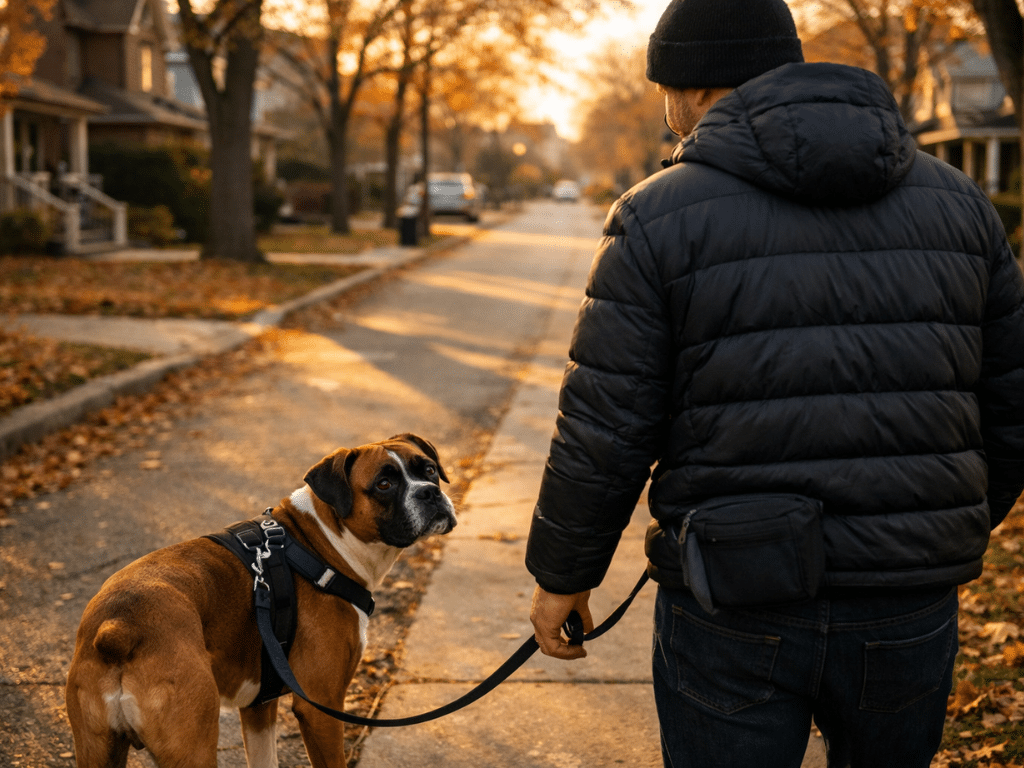





You’ve done the paperwork, you’ve got the leash, and now you’re standing at your front door thinking, “Okay… now what?” If you’re a first-time rescue dog owner, the first 72 hours can feel like trying to land a plane in fog. You want to do everything right, your dog is overwhelmed, and everyone online is yelling different advice at you.
Here’s the truth we want you to breathe: the first 72 hours are not about “showing your dog their new life”. They’re about helping your dog feel safe enough to start learning. That’s why this is a dog training article, not a “cute welcome home” checklist. Around here, good dog training in Hamilton starts with calm structure, not big excitement, and that’s exactly what this guide gives you.
As the dog trainers for the Hamilton/Burlington SPCA and Hamilton Animal Services, here at K9 Principles, we help rescue dogs and first-time owners in Hamilton every week through Hamilton dog training that’s practical, real-world, and designed to stop problems before they become your normal. Let’s walk through the first 72 hours the way we do it with clients, step by step.
What The First 72 Hours Are Really For
The first 72 hours are your dog’s decompression window. Your dog has lost their old routine, their old smells, their old people, and sometimes even their confidence. Even the friendliest dog can act “off” because their nervous system is running the show.
So your job is not to test them, entertain them, or introduce them to the neighbourhood like it’s a parade. Your job is to create predictability. Think of it like moving into a new house yourself. If someone dragged you to a surprise party on night one, you wouldn’t feel “welcomed”. You’d feel trapped.
When we do dog training, we’re always watching one thing first: is the dog under threshold? In plain terms, can they still think? The first 72 hours are about keeping your dog in the “I can think” zone as much as possible.
Before You Bring Them Home: Build A Calm Landing Zone
Set your home up like you’re hosting someone who’s exhausted, not like you’re hosting a celebration. Pick one main area where your dog can eat, drink, rest, and decompress without being followed, stared at, or constantly approached.
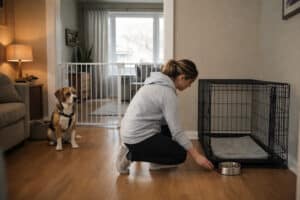
If you’re using a crate, set it up ahead of time with the door open and a comfy bed or mat inside. If you’re not using a crate, use a pen or baby gate to create a boundary. Boundaries are not mean. They’re relief. They tell your dog, “Nothing is expected from you right now.”
Keep the environment quiet. Lower the noise, dim the chaos, and keep high-energy greetings on hold. You’re trying to reduce the number of brand-new things your dog has to process in the first few hours.
Hour 0–6: The Arrival Plan That Prevents Day-One Chaos
When you walk in, go straight into calm mode. Take your dog out to toilet first, then bring them inside and let them explore one small area at a time. You do not need to “tour the house” on day one. You need your dog to settle, not rehearse a full-speed scavenger hunt.
Talk less than you think you should. People love to narrate, coax, and hype. Most rescue dogs do better with quiet presence. Sit down, let them sniff, and let the pressure drop. If they approach, you can softly invite contact. If they don’t, that’s not rejection. That’s stress.
The biggest win in hour 0–6 is a dog that eats, drinks, toileting happens outside, and your dog rests. If you get that, you’re already doing better than most people.
What Not To Do In The First Night (Even If It Feels “Nice”)
Do not introduce a bunch of visitors. Not neighbours, not family, not your friend who “is great with dogs”. Your dog does not need more faces on day one. Your dog needs fewer variables.
Do not let your dog free-roam the house because you feel bad restricting them. Too much freedom too soon is how dogs find things to chew, places to pee, and corners to worry about. Freedom is earned through predictability, and predictability takes a bit of time.
Do not start testing cues because you want to see what your dog “knows”. Your dog might know things. They also might be too stressed to show you. Testing creates pressure. In the first night, we want the opposite.
Day 1: Routine Beats Love-Bombing Every Single Time
If you want your rescue dog to trust you, give them a routine they can predict. Feed at consistent times. Toilet at consistent times. Rest at consistent times. Calm walks at consistent times.
This is where first-time owners get thrown. People assume bonding comes from constant affection. For many rescue dogs, bonding comes from relief. Relief comes from knowing what happens next.
At K9 Principles, we treat day one like the foundation pour. You don’t decorate the living room while the concrete is wet. You build the base first, then everything else becomes easier. That’s not just nice philosophy. That’s practical dog training.
Food, Water, Toileting: Keep It Simple And Avoid Accidental Bad Habits
Feed somewhere quiet. Put the bowl down, step back, and let your dog eat without being watched like a reality show. If your dog doesn’t eat right away, don’t panic. Stress kills appetite. Keep offering meals on schedule, then pick the bowl up after a reasonable time.
For toileting, take your dog out more often than you think you need to. New homes create new mistakes. Your goal is to prevent rehearsals, not react after the fact. If your dog toilets inside, clean it calmly and move on. No lectures. No rubbing noses. No drama. Your dog is not being “spiteful”. Your dog is confused.
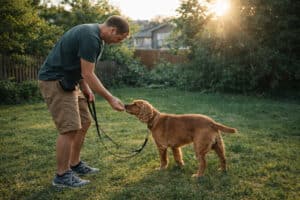
If you want fast progress, reward toileting outside like it’s the greatest idea your dog has ever had. Not with a party, but with a calm “yes” and a high-value reward. That one habit alone can save you weeks.
Handling, Touch, And Kids: Respect First, Confidence Later
Rescue dogs often have unknown histories. Even when they seem friendly, you do not know what they’ve learned about hands, hugs, or being cornered. So your rule in the first 72 hours is consent.
Let your dog choose contact. Avoid leaning over them, hugging, or grabbing collars. If you need to clip a leash, do it slowly and smoothly, then reward. If you need to check something like paws or ears, wait until your dog is calmer and you’ve built a reinforcement history for touch.
If you have kids, the boundaries matter even more. Kids should not be practising “love” by climbing into a dog’s space. Set up safe separation and coach calm. This is how you prevent fear, avoidance, and the kind of defensive behaviour that breaks hearts later.
The First Walks: Why “More Exercise” Is Usually The Wrong Answer
A lot of people think the first day should include a big walk to “tire the dog out”. That sounds logical until you remember your dog’s nervous system is already lit up. More stimulation can push your dog over threshold and start habits like pulling, scanning, barking, or freezing.
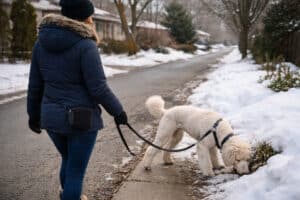
Your first walks should be short, boring, and confidence-building. Think sniffy, quiet, and low pressure. You’re collecting information, not doing kilometres. If your dog startles easily, chooses to avoid things, or can’t take food outside, you’re seeing stress, not stubbornness.
This is a huge part of Hamilton dog training done properly. Hamilton has busy paths, parks, cyclists, and tons of normal life. You do not need to expose your dog to all of it in the first 72 hours. You need to protect your dog’s confidence so we can expand it later.
Confinement, Sleep, And The “Off Switch” In The First 72 Hours
Rest is training in disguise. A dog that isn’t sleeping is a dog that can’t learn. Many rescue dogs will fight sleep because they don’t feel safe enough to fully power down. Your job is to make rest easy.
Use a crate, pen, or gated area to create a predictable rest space. Put it somewhere calm. If your dog paces, whines, or struggles, don’t take it personally. That behaviour is information. It tells us what skills are missing, and we can train those skills.

Night-time is where people accidentally create chaos. If your dog cries and you immediately release them, you teach that vocalising opens doors. If you ignore genuine panic, you risk making confinement worse. This is where a tailored plan matters, because the right choice depends on what the dog is actually feeling. This is exactly why our In-Home Private Training exists. We come to you, we read what’s happening in your real space, and we coach you through it in real time.
Early “Problem Behaviours” That Show Up Fast And What Not To Do About Them
You might see barking at windows, growling near food, fear of men, panic when alone, leash reactivity, or a dog who follows you like a shadow. None of that automatically means you adopted a “bad dog”. It usually means your dog is overwhelmed and trying to control what they can.
What not to do is punish the warning signs. Growling is communication. Avoidance is communication. Barking is communication. If you shut down the warning without changing the feeling underneath, you don’t fix the problem, you hide it until it gets bigger.
The smarter move is to reduce pressure, prevent rehearsals, and build new patterns. This is where dog training in Hamilton becomes more than YouTube tips. You need someone to look at your dog’s triggers, your home setup, and your timing, then build a plan that fits your actual life.
Your Simple 72-Hour Training Focus Without Turning Your Home Into Boot Camp
In the first 72 hours, we keep training tiny, clear, and confidence-based. We are not drilling. We are building communication. Start with your dog learning that good things happen near you without pressure. Reward check-ins. Reward calm. Reward choosing you.
Use one simple “marker” word like “yes” and pair it with rewards so your dog starts to understand the game. If your dog can eat in the house but not outside, that’s normal. Start indoors, then slowly move the skill outward as your dog settles.
If you want one early cue to prioritise, make it a calm “come” inside the house for tiny distances, then reward like you mean it. Not because you want a perfect recall on day two, but because you’re building a history of “when I move toward my human, good things happen”. That is the seed of reliable real-world dog training.
Why Early Support From K9 Principles Changes Everything
Most people wait until the problem is loud. By then, the dog has practised the behaviour, the owner is stressed, and the house feels tense. The better move is getting ahead of it in the first week, when the patterns are still wet cement.
Our In-Home Private Training is the fastest path when you want a plan that fits your dog, your home, and your actual challenges. We do not guess. We work in the environments causing the concerns, we coach you through what to do in the moment, and we build skills that hold up in real life. That is the kind of dog training in Hamilton that saves relationships, not just weekends.
If your dog is already fairly stable and you want to build a serious foundation with guidance and accountability, our Level 1 group classes are a powerful next step. And if your life is full and you want the results without carrying the whole training load yourself, our Home School Academy is built for exactly that. You do not have to figure this out alone, and you definitely do not have to rely on random advice that doesn’t match your dog.
Conclusion:
The first 72 hours with a rescue dog are not a test of whether you’re “good at dogs”. They’re a reset for your dog’s nervous system and a setup for the habits you’ll live with next month. When you keep things calm, predictable, and intentionally boring at first, you give your dog the one thing they actually need to become their best self: safety. If you want a clear plan that fits your dog and your home, reach out to us at K9 Principles for In-Home Private Training, and let’s turn those first 72 hours into the beginning of a stable, confident life together.
Contact us for more information:
- Name: K9 Principles
- Address: Haldimand County, Greater Hamilton Area, Burlington, and Most of Norfolk County
- Phone: 289 880-3382
- Email: k9principlesinc@gmail.com
- Website: www.k9principles.ca
FAQs
-
A1. Many dogs start to relax after a few days, but true settling often takes weeks, not hours. The first 72 hours are a decompression phase, and it is normal if your dog seems shut down, extra clingy, or easily startled. With consistent routine and good support, you will usually see confidence build in layers.