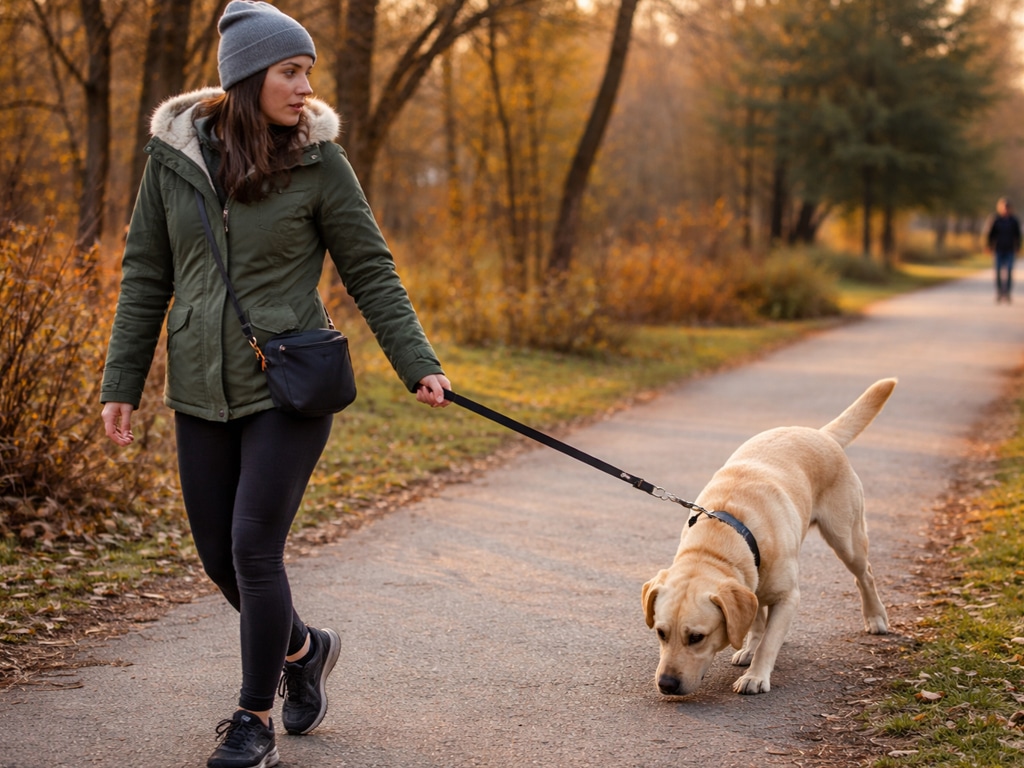




If you’re a first-time dog owner, you’ve probably had this moment: your dog is brilliant in the kitchen, then you step outside and suddenly it’s like you don’t exist. Or you reach for the treats and your dog snaps into “angel mode”, but the second your hand is empty… they vanish. We are going to show you how to fade treats properly without losing reliability, without creating confusion, and without accidentally teaching your dog that listening is optional. This is real-life dog training in Hamilton, the kind that holds up at Bayfront Park, on a busy street in Dundas, or when a squirrel rockets across the path at Gage Park.
Bribery vs Reinforcement: The One Difference That Changes Everything
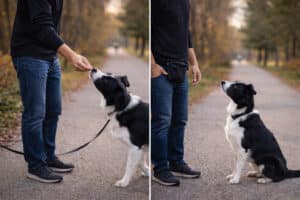
Bribery is when your dog sees the payment first and then decides if the behaviour is worth it. Reinforcement is when your dog does the behaviour, and then the payment arrives afterwards, which strengthens that behaviour for the future. That sounds simple, but it’s the entire reason people get stuck with “he only listens when I have treats”. If you flash the treat like a billboard, you’re not building behaviour, you’re negotiating. In the early stages, we absolutely use food to teach skills, but the order matters: behaviour first, reward second. Even if you’re luring in the beginning, the goal is to very quickly move from “follow the cookie” to “do the cue, then get paid”. When owners tell us their dog is treat-dependent, nine times out of ten they’ve accidentally trained their dog to wait for proof of payment before responding.
How Behaviour Value Is Built (And Why Your Dog Ignores You Outside)
Your dog’s behaviour is always doing something for them. If pulling gets them to smells, jumping gets attention, and ignoring you gets freedom, those behaviours already have value. Your job is to make listening more valuable than the alternatives. This is why “fading treats” is not about removing food; it’s about building value in the behaviour itself, then expanding that value into real life. Inside the house, your dog has fewer competing rewards, so your reinforcement stands out. Outside, the environment is a slot machine of smells, movement, people, dogs, and random excitement. If you haven’t taught your dog that your cues still matter out there, the environment wins because it pays better. Real dog training in Hamilton means you treat the outside world like a different classroom, not a harder version of the living room. You build value by paying well for success, keeping reps doable, and proving to your dog that choosing you unlocks everything they want.
The Rule That Speeds Up Progress: Harder Reps = Better Pay
One of the biggest mistakes we see is owners paying the same reward for everything. If your dog sits in your kitchen and gets the same pay as sitting calmly while another dog walks past on the trail, you’re telling your dog those reps are equal. They’re not. In proper Hamilton dog training, we pay according to difficulty. Easy reps can get easy pay. Hard reps deserve premium pay. This rule does two things: it keeps your dog motivated when the work gets harder, and it teaches your dog that staying connected in challenging moments is massively worth it. Better pay can mean better food, more food, faster delivery, or a bigger life reward. When you start thinking like this, fading treats becomes natural because you stop paying constantly and start paying strategically.
Stage One: Lure to Teach, Not to Live There
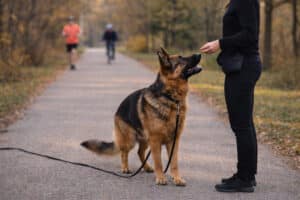
Luring is a teaching tool, not the finished product. It’s like training wheels: useful at first, dangerous if you keep them on too long. If you’re luring, your dog is following your hand, not responding to a cue. So the goal is to use lures briefly, then fade the lure fast. We like to think of luring as “show them the picture”, then we quickly move to “say the word”. You start with the lure to create the motion, then you add the cue right before the dog does it, then you stop showing the lure and reward after the behaviour. If you skip this transition, you get the classic problem where the dog only responds when they see the cookie. With dog training in Hamilton, we’d rather you lure for two sessions and then transition, than lure for two weeks and wonder why your dog needs to see food to function.
Stage Two: Reward After the Behaviour (And How to Hide Treats Without “Lying”)
Once your dog understands the movement, treats should live out of sight. Not because treats are bad, but because hidden treats stop you from bribing and start you reinforcing. The trick is to prepare properly so you’re not fumbling and you’re not accidentally delaying the reward so long your dog disconnects. Keep treats in a pocket, pouch, or on a counter, and practise reaching for them smoothly after the behaviour happens. If you’re worried you’re “lying” because you don’t show food, remember this: in real life, rewards are rarely shown in advance. Your dog doesn’t need to see payment to learn that payment is coming. This is how we build trust in the process, and trust is what keeps behaviour strong when you’re out doing Hamilton dog training in the real world. Also, stop repeating cues. If you say “sit, sit, sit,” your dog learns that the first cue is optional. Say it once, help them succeed, then pay.
Stage Three: Intermittent Reinforcement Without Creating Confusion
This is where most people mess it up, not because they’re careless, but because no one explains the rules. Intermittent reinforcement does not mean randomly stop rewarding and hope your dog stays good. Intermittent reinforcement means your dog already understands the behaviour, can do it reliably in that context, and now you start varying the pay while keeping the behaviour consistent. The behaviour stays the same. Your criteria stay the same. Only the payment schedule changes. We like to start with a simple pattern that prevents accidental “ghosting”, such as rewarding most reps but not all, while still using praise and engagement every rep. Then we gradually thin it out. If your dog’s reliability dips, you didn’t “ruin” them. You thinned too fast for that environment, or your reps got too hard without better pay. With dog training in Hamilton, the environment changes constantly, so your reinforcement schedule must flex with it. Harder reps still get paid, even if you’re generally on variable reinforcement.

Stage Four: Real-Life Rewards That Make Your Dog Choose You Anywhere
Real-life rewards are the secret sauce because they make listening directly useful to your dog. Food is fantastic for learning, but life rewards are what make behaviour stick in the wild. Sniffing is a reward. Access is a reward. Play is a reward. Freedom is a reward. Movement is a reward. If your dog wants to sniff a lamp post, you can turn that into reinforcement by asking for a simple behaviour first, then releasing them to sniff. If your dog wants to greet someone, you can reinforce calmness by making calm behaviour the ticket that earns access. If your dog wants to run, you can reinforce recall by calling them, paying, and then releasing them back to run again. This is how we blend dog training with life so it doesn’t feel like a separate activity. In Hamilton dog training, this is what turns a “treat trained dog” into a “real world dog”.
How to Fade Treats Without Regression: A Mistake-Proof Progression
Here’s the clean progression we want you following, and if you stick to it, fading treats stops being scary. First you use a lure briefly to teach the movement. Then you reward after the behaviour with treats hidden so you’re reinforcing, not bribing. Then you move to intermittent reinforcement only once the behaviour is reliable in that specific context. Then you blend in real-life rewards so food becomes one tool, not the whole system. The mistake-proof part is this: when you change one thing, you keep everything else stable. If you’re fading treats, don’t also raise distractions, add distance, and expect longer duration in the same session. That’s how confusion and regression happen. With dog training in Hamilton, we treat change like a budget: you can spend difficulty in one category at a time, and when you spend it, you pay well.
Proofing and Generalisation: Keeping Reliability When Life Gets Real
Proofing is teaching your dog that the cue still means the same thing when something changes. Generalisation is teaching your dog that the cue means the same thing in different places. Dogs do not automatically generalise. A “sit” in your family room is not the same as a “sit” outside a busy café on Locke Street. If you want reliability, you must train it. That means practising the same behaviour in many locations, at many times, with many different distractions, and paying according to difficulty. It also means you stop blaming the dog for failing reps they’ve never truly been trained to do. The way we run Hamilton dog training is simple: we build skills indoors, then we take them into controlled outdoor spaces, then we gradually add real-life chaos. If you jump straight to the hardest environment and then try to fade treats, you’re basically asking your dog to do advanced work for entry-level pay.
Troubleshooting: “He Only Listens When I Have Treats”
This one is almost always a training order problem, not a dog problem. If your dog has learned to check for food before responding, you need to flip the script. Put treats away, ask for easy behaviours your dog already knows well, and reward after the behaviour with food appearing like magic. If your dog stalls because they’re waiting to see food, help them succeed with a bit of guidance, mark the moment they get it right, then pay. Also, start using life rewards daily. Ask for a sit before you open the door. Ask for eye contact before you clip the lead. Ask for a calm pause before you toss the toy. Your dog should start realising that compliance doesn’t just earn food; it earns access to everything. If you’re doing dog training in Hamilton and you only practise “obedience” in a treat-heavy session, your dog will label it as a treat game. If you weave reinforcement into real life, your dog learns listening is a lifestyle.
Troubleshooting: “He Spits Treats Outside”
If your dog is spitting treats outside, that’s information, not disrespect. It usually means one of three things: the environment is too intense, the treat isn’t valuable enough for that environment, or the dog is over-threshold and can’t eat properly. First, don’t keep stuffing treats at them like you’re trying to bribe them back into reality. Create distance from the distraction until they can eat comfortably, then work there. Second, upgrade your reinforcement. In a quiet room, kibble might work. On a busy trail, kibble can feel like pennies. Third, use life rewards strategically. If your dog is more interested in sniffing, use sniffing as the reward. Ask for a check-in, then release them to sniff. If they’re too aroused to eat, movement and access often work better than food, and calm reinforcement like gentle praise plus controlled freedom can stabilise them. This is exactly why Hamilton dog training must be flexible: you pay in the currency your dog can actually spend in that moment.
Troubleshooting: “He Ignores Me When Distracted” and “Treats Make Him Too Excited”
If your dog ignores you when distracted, the answer is not repeating cues louder. The answer is adjusting difficulty so your dog can succeed, then building up gradually while paying properly for hard reps. Start in lower-distraction zones, keep your sessions short, and treat engagement like the main skill. Reward check-ins, reward orientation to you, reward choosing you over the environment. Then slowly layer distractions. If treats make your dog too excited, you’re not doomed, you just need better delivery and better criteria. Use smaller treats, deliver calmly, avoid whipping your hands around, and reinforce relaxation as a behaviour, not just “doing stuff”. You can also use food scatters for decompression between reps, or switch to lower-arousal reinforcers like sniff breaks, permission to explore, or calm praise paired with movement. Excitement isn’t always bad, but if it makes your dog frantic, we need to train clarity and emotional control alongside the skills. In dog training in Hamilton, we want your dog to be motivated, not frantic, and that comes from structure, not from removing reinforcement entirely.
Conclusion: Treats Don’t Create Dependency, Confusion Does
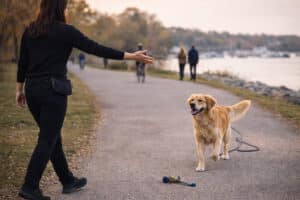
Fading treats is not about proving you can control your dog without food. It’s about building a reinforcement system that makes sense to your dog in every environment, from your living room to a busy Hamilton street. When you stop bribing, build behaviour value, pay harder reps better, and transition through lure to reward to intermittent to life rewards, you don’t lose your dog. You gain a dog that understands the rules, trusts the process, and chooses you because it pays to choose you. If you want this done properly, with a plan that fits your dog and your life, we’ve got you. Start with our Level 1 group class if you want a structured foundation. Choose In-Home Private Training if you want hands-on coaching in your real environment, where your dog actually struggles. Or jump into Home School Academy if you want a guided, done-for-you path that turns daily life into training without stress. This is what we do at K9 Principles, and it’s why our dog training in Hamilton creates results that actually hold up outside the house.
Contact us for more information:
- Name: K9 Principles
- Address: Haldimand County, Greater Hamilton Area, Burlington, and Most of Norfolk County
- Phone: 289 880-3382
- Email: k9principlesinc@gmail.com
- Website: www.k9principles.ca
FAQs
-
A1. You start fading visible treats as soon as your dog understands the behaviour, which is often much sooner than people think. You keep rewarding, but you move the food out of sight and pay after the behaviour so you’re reinforcing instead of bribing.