







If Walks Feel Like a Public Meltdown, You’re Not Alone
If you’ve ever stepped outside feeling hopeful, only to end up wrestling your dog past a driveway while they bark like a megaphone and launch themselves at the end of the lead, you’re in the right place. Leash reactivity can turn a simple walk into a daily stress test. You start timing your walks around “quiet hours”. You scan the street like a security guard. You hold your breath at corners. You dread seeing another dog, a jogger, a kid on a scooter, or that one neighbour who always appears at the exact wrong moment. And the worst part is how personal it feels, like everyone is judging you, or like your dog is “being bad on purpose”. They’re not. This behaviour is common, changeable, and very often misunderstood, especially by well-meaning people who tell you to “just correct it” or “let them say hi so they get used to it”. Most reactive dogs are not trying to be difficult. They’re trying to cope. Your job is to teach them a better way to cope, and that starts with understanding what’s happening on the lead, why it keeps happening, and how to build calm, reliable walking skills that actually transfer to real life.
At K9 Principles, we work with this constantly, and we can tell you this with total confidence: you do not need a “perfect dog”. You need a plan. The goal is a dog that can walk through Hamilton without turning every surprise into a scene, and an owner who feels calm, capable, and in control again. That is exactly what we are building here.
What Leash Reactivity Actually Is (And What It Isn’t)
Leash reactivity is an emotional response that shows up on the lead. It often looks like barking, lunging, growling, snapping, spinning, whining, pulling hard, or locking onto a trigger like your dog has suddenly forgotten you exist. The trigger could be another dog, a person, a bike, a skateboard, a squirrel, a stroller, a loud truck, or even a specific location. The big clue is that the behaviour is intense, fast, and difficult to interrupt once it’s rolling.
Leash reactivity is not the same thing as a dog who is simply excited. It is not the same as a dog who is curious. It is not the same as a dog who “just wants to say hello” in a polite way. And it is not proof that your dog is aggressive by nature. Many reactive dogs are social in the right setting. Many are gentle at home. Many play beautifully off-lead with dogs they know. Reactivity is about the lead and the context, and the lead changes everything because it restricts movement, increases pressure, and removes the dog’s ability to create space in a natural way.
This is why your dog can look “fine” at home, or even in your yard, but fall apart on the sidewalk. Different environment, different stress level, different reinforcers, and a completely different picture in your dog’s brain.
The Real-Life Signs Owners Miss Until It Explodes
Most owners only notice leash reactivity when it becomes obvious. The barking. The lunging. The pulling that feels like it might dislocate your shoulder. But there are usually early signs that show up before the fireworks, and learning to spot them is one of the fastest ways to get progress.
Your dog might freeze and stare. They might slow down and lean forward. Their breathing might change. They might stop sniffing and stop blinking. Their ears might lock forward. Their mouth might close. Their tail might go high and stiff, or tuck and tighten. They might start scanning the environment like they’re on high alert. They might whine. They might do a small hop forward. These are your warning lights. When you catch these moments early, you can create distance, reset your dog’s brain, and prevent the reaction from happening at all. That is not “avoiding the problem”. That is training the correct level of difficulty. That is smart handling.
Why Your Dog Can Be “Amazing at Home” But a Nightmare Outside
Home is controlled. Outside is chaos. At home your dog knows the sounds, the smells, the patterns, and the expectations. Outside, especially in busy areas of Hamilton and along multi-use trails, your dog gets hit with constant information. Dogs are reading scent trails you can’t see, hearing sounds you barely notice, and reacting to movement that triggers instinctive responses. Add a lead that restricts movement and a human who is tense because they are expecting trouble, and you can create a perfect storm without meaning to.
This is also where reinforcement matters. Outside is full of rewards your dog cares about. Squirrels. Rabbits. Other dogs. People. Smells. Windy leaves. Fast movement. If your dog has not been taught how to stay connected to you around those things, they will default to whatever behaviour has worked before. If lunging makes the scary dog go away, your dog learns lunging works. If barking makes a person give you space, your dog learns barking works. If pulling gets them closer to the exciting thing, your dog learns pulling works. Your dog is not being stubborn. They’re being practical.
Why Dogs Become Reactive on Lead
There is no single reason for leash reactivity, but there are a few main patterns. Once you know which one you are dealing with, your training becomes clearer, faster, and far less frustrating.
Fear-Based Reactivity
Fear-based reactivity is often the dog who looks intense, but the goal underneath is distance. They may be worried about the other dog, unsure about strangers, sensitive to sudden movement, or lacking confidence in unpredictable situations. These dogs might have had a scary experience, but they also might simply be genetically more cautious, or they might have missed key early socialisation experiences. The reaction is a strategy. “If I look big and loud, that thing will go away.” And when it goes away, the dog feels relief, which reinforces the behaviour. Relief is powerful learning.
Frustration and Lead Restriction
Frustration-based reactivity is common in social, enthusiastic dogs who want access. They see another dog and they want to greet. The lead blocks them. That pressure builds. They explode. It can look aggressive, but the emotional engine is often frustration and over-excitement. The problem is that the more this happens, the more the dog practises launching into that state, and the easier it becomes to trigger. Also, even if your dog wants to say hi, it doesn’t mean they should. A dog who learns that they can drag you to people and dogs is learning a habit that makes walks harder and harder.
Over-Arousal and Poor Recovery
Some dogs go from calm to chaotic very quickly, and once they’re up there, they struggle to come back down. They might be young, high drive, under-exercised, over-stimulated, lacking sleep, or living with too much freedom and not enough structure. They might have a busy home routine where they are constantly revved up. If a dog cannot recover emotionally after stimulation, reactivity becomes more likely because the dog’s brain is already loaded. Then one more trigger tips them over.
Habit and Accidental Reinforcement
This one is uncomfortable, but important. A lot of leash reactivity becomes a rehearsed habit. If your dog has barked and lunged for months, the behaviour is not just emotional, it is practised. Dogs get good at what they practise. If the reaction causes the trigger to move away, it is reinforced. If the reaction causes you to speak, touch the lead, turn your body, or change direction, it is reinforced in some dogs. If the reaction gets them closer to the trigger sometimes, it is reinforced. Even inconsistency can strengthen behaviour, because intermittent reinforcement is sticky. That is why “sometimes it works” behaviours are the hardest to break.
The Two Words That Change Everything: Threshold and Distance
If there is one concept that can change your entire progress with leash reactivity, it is threshold. Threshold is the point where your dog’s brain flips from “I can think” to “I am reacting”. Under threshold, your dog can take food, respond to cues, and stay connected. Over threshold, your dog is running on emotion and instinct. Training does not work over threshold. It turns into survival mode.
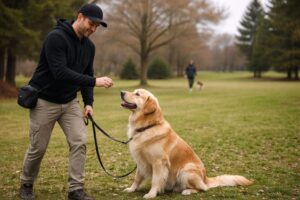
Distance is your best friend because distance lowers intensity. The farther you are from the trigger, the more your dog can think. This is why “getting closer to train” often backfires. People think they need to expose their dog to the scary thing until the dog stops reacting. That approach, called flooding, can create shutdown or escalation, and it often makes the fear deeper. The better approach is controlled exposure under threshold, where your dog learns, “I can see that thing and still feel safe.”
Trigger Stacking: Why Some Days Are Just Worse
Have you ever had a day where your dog reacts to everything, even things they normally handle? That’s trigger stacking. Stress piles up. A loud truck. A dog barking behind a fence. A new smell. A kid shouting. A short lead because the pavement is icy. Less sleep. Less decompression. It stacks. Then the final trigger that would normally be manageable becomes the spark that sets everything off.
When you understand trigger stacking, you stop taking “bad days” personally. You stop thinking the dog is being spiteful. Instead, you adjust the plan. You pick calmer routes. You keep sessions short. You focus on recovery. You protect the dog’s nervous system, because that is what creates long-term change.
What To Do In The Moment When Your Dog Reacts
Let’s be real. Even with a plan, reactions will happen sometimes, especially early on. The key is to stop rehearsing the full meltdown and start building a pattern that keeps you safe and keeps the reaction from becoming the dog’s default response.
First, your goal in the moment is not to “win”. Your goal is to exit. The reaction is not the time to teach. The reaction is the time to manage. If your dog is already exploding, you are late. That’s not shame. That’s information.
Your Emergency U-Turn That Doesn’t Feel Like Failure
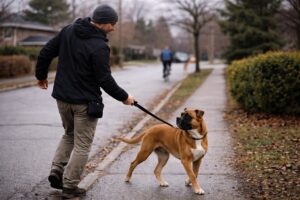
A simple emergency U-turn can save your walks. The secret is how you do it. You don’t yank. You don’t panic. You don’t run away like you’re being chased. You calmly turn, move away, and keep your dog moving with you. Movement helps dogs regulate. Distance helps dogs think. Your body language matters, because your dog is reading you.
You can even teach a cue for it, something like “this way”, practised at home first, then on quiet walks, so it becomes a confident pattern. The goal is for your dog to learn, “When I hear that cue, we move away and I get reinforcement.” That turns escape into a predictable skill, not a chaotic scramble.
How To Use Food Properly Without Creating a Treat Addict
Food is not bribery when it is used correctly. Food is communication. It tells your dog what you like, and it helps shift emotional state. The mistake is waiting until your dog is already exploding, then shoving food in their face. Over threshold, many dogs cannot eat. Or they might snatch food while still reacting, which doesn’t actually change the emotional pattern.
The best use of food is early, under threshold, when your dog can notice a trigger and then choose you. That is where learning happens. Reward the glance, reward the calm choice, reward the check-in, reward the decision to move with you. Over time, you’re building a new habit: “Triggers predict good things and I stay connected.”
What Not To Do, Even If Everyone Tells You To
Do not yank your dog back and shout. That adds pressure and emotion to a dog who is already overloaded. Do not force greetings. Do not march closer to “show them there’s nothing to be afraid of”. Do not punish growling, because growling is communication. If you suppress the warning, you can create a dog who skips warnings. Do not rely on quick fixes that create pain or conflict and call it “leadership”. Real leadership is clarity, consistency, and teaching your dog skills that replace panic.
The Foundation You Build At Home So Walks Stop Falling Apart
Here’s a truth that owners either love or hate, but it changes everything: the walk is the test, not the classroom. If your dog cannot focus around distractions, you need to build focus in easier environments first, then gradually take it outside. The dog that melts down on a walk is not a “bad dog”. They are a dog without the right foundation for that level of difficulty. 
Engagement: Teaching Your Dog That You Matter Outside
Engagement is not your dog staring at you the entire walk like a robot. Engagement is your dog choosing you when it matters. It is check-ins. It is a quick glance back. It is responding to their name. It is staying within a reasonable range without constant correction. Engagement is built through repetition, reinforcement, and clarity.
At K9 Principles, we build engagement in low-distraction settings first, because it is a skill. Then we increase distractions gradually. That is how you get a dog who can walk past a trigger and still remember you exist.
Impulse Control That Transfers to Real Life
Impulse control is not just “sit and stay”. It is your dog learning how to pause, think, and make a better choice when they feel an impulse. It is the dog who sees a dog and can choose to stay with you. It is the dog who can step off the path and wait calmly while a cyclist passes. It is the dog who can move away from something exciting because you asked, not because you dragged them.
Impulse control is built through small daily moments, with structure and consistency. The dog learns that calm choices pay well, and impulsive choices do not lead to the reward.
Calmness Isn’t a Mood, It’s a Behaviour You Teach
Calmness is trainable. Some dogs are naturally more chill, but every dog can learn to settle. We teach calmness through routines, reinforcement of relaxation, and clear boundaries around arousal. If your dog spends most of their day practising chaos, they will be chaotic outside. If they practise settling, they will settle more easily when life gets busy.
This is also why “too much freedom too soon” can make reactivity worse. A dog who has learned to self-entertain through frantic behaviour, or who is constantly practising chasing and scanning, often walks into the world already wound up. Calm starts at home.
A Training Plan That Actually Works (Without Guesswork)
Most owners don’t fail because they don’t care. They fail because they are guessing. They try random tips from the internet. They switch tools. They walk more. They walk less. They avoid everything. Then they test the dog again and get another meltdown. The solution is a clear progression that moves from management to skill-building to proofing.
Week 1: Reduce Reactions and Stop Rehearsing the Habit
In week one, your job is not to “fix” reactivity. Your job is to stop feeding it. That means fewer surprises, more distance, and better routes. If you know your dog loses it on narrow pavements, stop putting them there while you build skills. If you know your dog reacts on a busy trail at peak hours, change the time. This is not quitting. This is stopping daily practice of the wrong behaviour.
You also start building simple engagement and recovery skills at home and on very quiet walks. Your dog needs wins, not constant battles.
Week 2: Pattern Games That Replace Panic With Predictability
Dogs love patterns. Patterns create safety. When a dog knows what’s coming next, their brain relaxes. Pattern games can be as simple as predictable walking routines, structured turns, or repeatable sequences that your dog enjoys. The point is that your dog has something to do when a trigger appears, instead of defaulting to barking and lunging.
This is where owners often notice the first “real shift”, not because the dog is suddenly perfect, but because the dog starts looking to the owner for the next step.
Week 3: Controlled Set-Ups, Not Random Encounters
Random encounters are a terrible training plan. They create inconsistent intensity and unpredictable outcomes. Controlled set-ups allow you to choose distance, angle, duration, and reward timing. You can stage success. That is how learning happens.
This is also where professional coaching like our In-Home Private training becomes a game changer, because we can guide your timing, adjust your spacing, and build the right difficulty without guessing. That’s a big reason people looking for Hamilton dog training often see faster progress when they stop trying to do it alone and call us for help.
Week 4: Proofing in the Real World Without Blowing Your Dog Up
Proofing means taking the skills you built and gradually applying them to real-life environments. The keyword is gradually. You do not jump from your driveway to the busiest trail in town and expect success. You raise difficulty in small steps. You measure progress by how quickly your dog recovers and how often they can stay under threshold, not by whether they are “perfect”.
Over time, your dog learns that triggers are part of life, not emergencies. They also learn that you have a plan, which builds trust. And trust is the foundation of calm behaviour.
Why Tight Leads Create Tight Dogs
This is one of the most overlooked causes of walk problems. Humans tense up. We shorten the lead. We brace. We hold our breath. The dog feels the tension through the lead and through your body. Many dogs interpret that tension as “something is coming”. It becomes a cue. The dog starts scanning, because they have learned that your tension predicts a trigger.
Part of fixing leash reactivity is training the dog, and part of it is training you to move with intention. Calm hands. Smooth movement. Clear exits. Consistent reinforcement. This is exactly why In-Home Private training is so effective. We can see what you’re doing in real time and adjust small things that create big changes.
Common Mistakes That Keep Reactivity Stuck
If you want to speed up progress, stop doing these things.
One common mistake is only training when it’s already going wrong. If your dog practises reactions all week and you only do “training” during the reaction, the dog is getting far more practice at being reactive than they are at being calm.
Another mistake is confusing socialisation with skill. Exposure is not automatically helpful. Bringing your dog close to triggers over and over can increase stress and make the response worse. Real socialisation is about teaching neutrality and confidence, not forcing interaction.
Another big mistake is reward timing. If you reward after the explosion, your dog might learn that the explosion is part of the sequence. The reward needs to happen when the dog is still thinking, still choosing you, still under threshold. This is where guidance matters, because timing is a skill, and once you feel it, everything gets easier.
Real-World Walks in Hamilton: Where Reactivity Shows Up Fast
Hamilton is a brilliant place to have a dog, but it’s also full of the exact scenarios that trigger leash reactivity. Tight pavements in neighbourhoods. Corner dogs that appear suddenly. People stepping out of cars. Busy multi-use trails with bikes and runners. “Friendly” off-lead dogs that rush up and ignore personal space. The environment is not a controlled training hall. It’s real life.
The fix is not to avoid Hamilton forever. The fix is to build a dog who can handle Hamilton because they have the skills, the structure, and the emotional regulation to stay under threshold. This is one of the biggest benefits of proper dog training in Hamilton that focuses on real-world proofing rather than only indoor obedience. You don’t need a dog who can sit in a quiet room. You need a dog who can function politely on a real street.
When You Should Stop DIY-ing and Get Professional Help
There is a point where trying to figure it out alone becomes the slowest route. If you feel unsafe on walks, if your dog is strong enough to pull you over, if your dog’s reactions are escalating, or if you’re stuck in the same cycle month after month, it’s time to get a professional dog trainer involved.
Also, if your dog is practising this daily, it will not “just fade”. Practise creates habits. Habits create defaults. The longer a dog rehearses reactive behaviour, the more efficient their brain becomes at switching into that mode. The good news is that the opposite is also true. If you start rehearsing calm, connected behaviour daily, your dog gets better at that too. But you need the right plan, and you need consistency.
This is where Hamilton dog training that includes hands-on coaching in your real environment like our In-Home Private training can make a massive difference. We can set up training sessions that fit your actual routes, your actual triggers, and your actual lifestyle, not a generic plan that only works in perfect conditions.
How We Fix Leash Reactivity at K9 Principles
When owners come to us, they’re usually exhausted. They’ve tried everything they can think of. They’ve watched videos. They’ve bought gear. They’ve avoided triggers. They’ve been told to “be the boss”. And they’re still stuck. Our job is to remove the chaos and replace it with structure and skill.
We start by identifying what kind of reactivity you’re dealing with, because fear, frustration, and over-arousal do not get fixed with the same approach. Then we build a foundation of engagement and impulse control that fits your dog, not a one-size-fits-all script. We show you exactly how to handle the moments that currently blow up your walks, and we teach your dog what to do instead. We also help you adjust your walking routine so your dog stops rehearsing the problem every single day.
In-Home Private training changes everything because we are working where the problem actually happens. We are not guessing. We are not hoping the skills transfer. We are building the skills on your street, with your triggers, in the real world. That is why our clients often feel relief quickly, even before the dog is “fully fixed”, because they finally have control and a plan that makes sense.
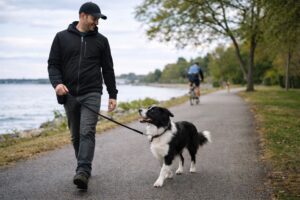
The goal isn’t perfection. The goal is reliable and peaceful. Calm walks. Predictable responses. A dog who can notice a trigger, stay connected, and move on. That’s the win. That is what dog training is supposed to deliver.
Conclusion: Calm Walks Are Built, Not Hoped For
If your dog is reactive on the lead, you are not failing. You are dealing with a behaviour that is emotional, learned, and fuelled by real-life chaos. The fix is not shame. The fix is clarity. You need to keep your dog under threshold, use distance properly, stop rehearsing the meltdown, and build skills that replace panic with patterns. You need to teach engagement, impulse control, and recovery, then proof those skills gradually in the places you actually live.
If you want the fastest path, get professional support. The right coaching turns months of guessing into a clear roadmap, and it can change your daily life in a way that feels almost unreal once you finally experience it. If you’re looking for dog training in Hamilton that focuses on real-world results, this is exactly what we do at K9 Principles.
Contact us for more information:
- Name: K9 Principles
- Address: Haldimand County, Greater Hamilton Area, Burlington, and Most of Norfolk County
- Phone: 289 880-3382
- Email: k9principlesinc@gmail.com
- Website: www.k9principles.ca
FAQs
-
A1. It depends on how long the behaviour has been practised, how intense the triggers are, and how consistent your training is, but most owners feel meaningful improvement once they stop rehearsing reactions daily and start training under threshold. The big milestone is not “never reacting again”. The big milestone is faster recovery, fewer explosions, and a dog who can stay connected more often in real life.
