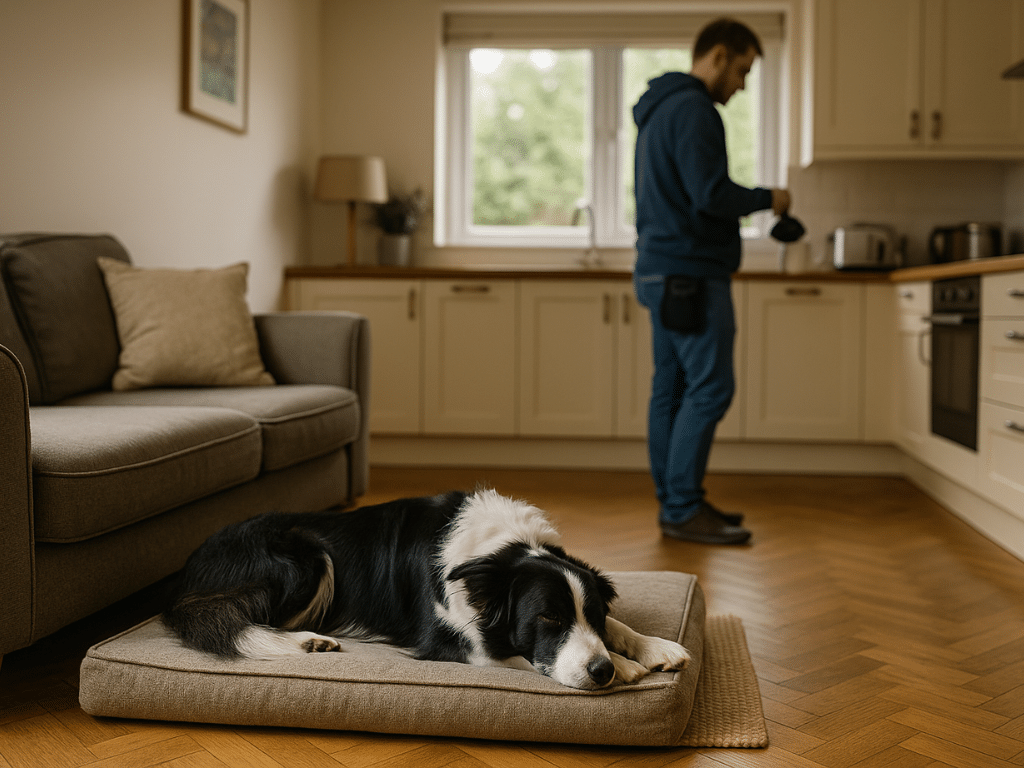





If you’re a first-time Hamilton dog owner, you probably imagined the “calm dog” moment would just show up one day. You’d sit down with a coffee, your dog would curl up, and life would feel… normal. Instead, you’ve got pacing, whining, barking at invisible threats, bouncing off the sofa, stealing socks, and that look that says, “What are we doing next?” Here’s the truth that changes everything: calm isn’t a personality trait. Calm is a skill. And when you teach it properly, your whole home changes.
At K9 Principles, we see this pattern daily with our dog training in Hamilton. Brilliant owners, good intentions, plenty of love, and a dog that simply does not know how to switch off. The goal of this article is to give you a clear, practical path to build an off switch that holds up in real life, not just in your living room for ten seconds.
Why First-Time Owners Think Calm Should Be Automatic
Most people grow up seeing calm adult dogs and assume that’s the default setting. What they don’t see is the training history behind it. A settled dog is usually a dog that has learned three powerful lessons over time: how to handle boredom, how to regulate excitement, and how to succeed by being calm.
Puppies and adolescent dogs are wired to explore. Their brains are designed to notice everything and react quickly. That’s not a flaw. It’s biology. If you’re waiting for calm to arrive naturally while your dog practises chaos every day, you’ll feel like you’re losing your mind. Not because you’re doing a bad job, but because your dog is getting better at the behaviours they repeat.
The Real Problem: Your Dog Has No Skill for Doing Nothing
When we say “off switch,” we don’t mean a dog that’s shut down or bored out of their mind. We mean a dog that can be peaceful when life is quiet. That means your dog can lie on a bed while you answer emails, stay settled while the kettle boils, relax while you watch a movie, and handle a visitor without treating it like a personal emergency.
Most dogs don’t fail because they’re “bad.” They fail because they’ve never been taught what success looks like in calm moments. If your dog only gets interaction when they paw at you, whine, bark, or bounce around, they learn that chaos makes humans come alive. That’s not stubbornness. That’s training.
Over-Tired vs Over-Aroused: The Mistake That Keeps Dogs Wired
One of the biggest myths with Hamilton dog training is that you can exercise a dog into calm. Exercise is important, but it is not a replacement for emotional regulation. Some dogs become fitter, faster, and more frantic when the only strategy is “more stimulation.” You end up with a dog that needs bigger and bigger activity to feel normal, and on days you can’t deliver it, the dog spirals.
Over-tired dogs can look wild. Over-aroused dogs can look wild. The difference is what happens after activity. If your dog comes home from a long walk and still can’t settle, still patrols the house, still reacts to every sound, and still nags for entertainment, you might not be dealing with “not enough exercise.” You might be dealing with a dog who doesn’t know how to come down.
This is where Hamilton dog training work often shifts from “more outlets” to “better outlets and better recovery.” The recovery part is the missing piece for most first-time owners.
How Owners Accidentally Train Chaos (Without Meaning To)
Let’s talk about the most common ways chaos gets trained into the home. It’s never because you’re trying to create a monster. It’s because dogs are experts at discovering what works.
If your dog barks and you talk to them, that can reward barking. If your dog paws at you and you pet them, that can reward pawing. If your dog brings a toy and you play to “shut them up,” that can train demand behaviour. If your dog races the hallway and you laugh or chase them, that can become a daily game. If your dog steals socks and you sprint after them, that can turn theft into a sport.
Add in inconsistent boundaries, like letting them on the sofa sometimes, but scolding them other times, or letting them roam the house when they’re bored, and suddenly your dog is rehearsing every annoying behaviour you didn’t want.
This is the hidden reason why “too much freedom too soon” hits so hard. Freedom isn’t bad. Unstructured freedom is. An off switch is what makes freedom safe.
What an “Off Switch” Actually Looks Like in Real Life
A proper off switch is not your dog lying down because they’re exhausted. It’s your dog choosing calm because calm pays. It’s a dog who can handle your normal household rhythms without needing constant management.
Here’s what that looks like in real life. Your dog can settle while you cook dinner instead of surfing counters or barking for attention. Your dog can relax while you eat instead of staring, whining, or climbing onto you. Your dog can stay grounded when someone enters the home rather than launching a full-body greeting assault. Your dog can rest while you’re on a phone call without trying to pull you into a game.
If this sounds like a dream, good. Dreams are just goals that haven’t been trained yet.
The Calm Foundation: Structure Beats Constant Entertainment
The calm foundation is built from structure, not constant interaction. Structure means your dog has predictable times for activity, predictable times for training, and predictable times for rest. It means your dog doesn’t have to invent their own jobs, like neighbourhood watch, sock inspection, and doorbell security.
At K9 Principles, we teach owners to stop trying to “fill” every moment. Dogs need downtime. They need boundaries that make sense. They need an environment where calm is easy to choose. And they need a human who can reward calm without accidentally hyping them up.
This is one of the most important mindset shifts we teach with our dog training in Hamilton: you don’t create calm by doing more. You create calm by teaching a dog how to succeed in stillness.
Step One: Stop Feeding the Fire (Arousal Reduction Rules)
Before you build calm, you have to stop throwing fuel on the fire. If your dog is practised at launching into excitement, your first job is to reduce the number of times they get to rehearse that pattern.
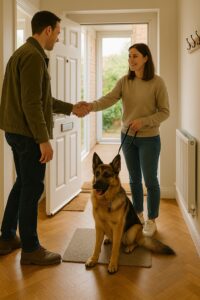
That starts with greetings. If your dog explodes when you come home, keep it boring. Walk in like it’s Tuesday. If your dog jumps, don’t wrestle, don’t scold, and don’t push them off like it’s a game. Create space, be still, and reward four paws on the floor with calm attention. If your dog gets mouthy when excited, remove your attention and redirect to something appropriate, then re-engage when the dog is calmer.
It also starts with your household rhythm. If your dog is constantly following you, nagging, and demanding, you may need planned downtime. That can mean a crate, a pen, a baby gate, or a lead attached to you for short periods so your dog can’t practise pacing and chaos.
The point isn’t to restrict your dog forever. The point is to give them a structured chance to learn a new habit.
Step Two: Teach “Place” as Your Dog’s Home Base
Place training is one of the most powerful tools for building an off switch because it gives your dog a clear job that leads to calm. Your dog isn’t guessing what to do. They know where success lives.
Start with a bed or mat that is easy to identify. Bring your dog to the bed, reward them for stepping onto it, and then reward them for staying there. Early on, you’re paying for tiny wins. You’re building value. You’re teaching the dog that the bed is a great idea.
The biggest mistake owners make is moving too fast. They send the dog to place, then immediately expect minutes of stillness, then get frustrated when the dog gets up. Instead, build duration like you’re stacking bricks. One second becomes two. Two becomes five. Five becomes ten. You release the dog before they break, because you want the dog to learn that staying is what makes freedom happen.
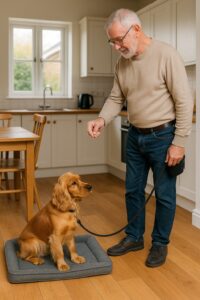
Use a release word that means “you’re done.” That release word protects calm because it teaches your dog that they don’t get to self-release. Calm is a choice, but it’s also a rule.
If you want an off switch that works when life gets busy, Place becomes the anchor skill that holds the house together.
Step Three: Teach a True Settle (Not Just “Lie Down”)
A down is a position. A settle is a state. Your dog can lie down and still be mentally sprinting, eyes wide, ready to pop up at the smallest sound. A true settle looks softer. The body loosens. The breathing slows. The dog stops scanning.
You build a settle by rewarding calm behaviour, not just posture. When your dog lies down and you see that exhale, that head drop, that hip roll, that softened face, that’s the moment you quietly reward. Not with a party. Not with a squeaky voice. With calm delivery that doesn’t trigger another wave of excitement.
This is where many owners sabotage themselves without meaning to. They see the dog finally settle, then they praise like they’ve just won the lottery, and the dog pops up to celebrate. Instead, treat calm like it’s normal. Because that’s what you want it to become.
With time, your dog learns a life-changing lesson: stillness pays.
Step Four: The Freedom Ladder (Earned Freedom, Not Given Freedom)
This is where your previous article, “Too Much Freedom Too Soon,” connects perfectly. Once you start building calm, you must protect it with a freedom ladder. Freedom is earned in small increments based on your dog’s current reliability.
If your dog can’t settle while you make dinner, roaming the kitchen is too much freedom. If your dog steals food, counter surfs, or barks at every movement, giving them full house access is simply setting them up to fail. You temporarily reduce freedom, teach the skill, then slowly give freedom back as the dog proves they can handle it.
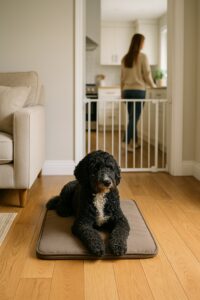
The freedom ladder is what stops the cycle of improvement then regression. It’s what keeps the “off switch” from disappearing the moment you get busy.
In Hamilton dog training sessions, this is often the missing piece. Owners do the training, see progress, then accidentally hand the dog too much freedom too fast and wonder why everything collapsed again. The ladder prevents that.
The Evening Witching Hour: Why Dogs Lose Their Minds at Night
If your dog turns into a maniac between dinner and bedtime, you are not alone. The evening witching hour is one of the most common first-time owner complaints we see at K9 Principles. And it’s not because your dog is plotting against you.
Often it’s a mix of overstimulation, poor nap structure during the day, and a household that becomes chaotic in the evening. Kids are home, routines change, the home is louder, and the dog’s brain can’t handle the surge. Add a dog who hasn’t learned to settle, and you get zoomies, barking, biting at hands, stealing items, and general madness.
The fix is not to fight the dog in that moment. The fix is to build your dog’s ability to recover from stimulation. That means planned downtime earlier in the day, structured calm routines in the evening, and a predictable pattern the dog can follow.
If you know evenings are hard, set your dog up before the storm hits. Use Place while you cook. Use a chew in a controlled space after dinner. Keep interactions calm. Reward stillness. You’re not “ignoring” your dog. You’re teaching them a life skill. 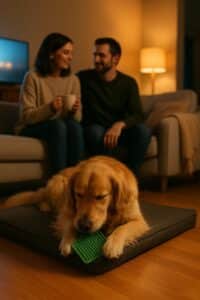
Common Mistakes That Break Calm Training
The most common mistake is expecting calm without teaching calm. The second most common mistake is talking too much. Owners repeat cues, negotiate, plead, and accidentally make the whole thing exciting.
Another major mistake is releasing too early or releasing at the wrong time. If your dog whines on Place and you release them, you just taught whining gets them released. If your dog breaks position and you chase them back, you just made Place a wrestling match. The better approach is to set a duration your dog can win, reward success, and release on calm before the dog feels the need to explode.
Another mistake is using calm tools as punishment. If the crate only appears when the dog is in trouble, the crate becomes a bad place. If the bed becomes a place where the dog gets yelled at, the bed loses value. Calm tools must be associated with success, safety, and reward.
Finally, many owners unknowingly reward arousal. They hype the dog, rev them up, then wonder why the dog can’t switch off. Calm requires a calmer human, too. That’s not a guilt trip. That’s a power move. Your energy is part of the training.
How Long It Takes (And What Progress Actually Looks Like)
If you’re looking for a timeline, here’s the honest answer. You can see early progress in days if you’re consistent, but real reliability takes weeks. Your dog is not just learning a cue. They are rewiring habits.
Progress looks like your dog settling faster after activity. It looks like fewer demand behaviours. It looks like your dog choosing their bed on their own. It looks like the intensity of the evening chaos shrinking. It looks like you being able to breathe in your own home again.
Some days will feel like nothing changed, then you’ll suddenly realise your dog slept through dinner and you didn’t have to manage a single meltdown. That’s when you know the off switch is forming.
When to Get Help: The Line Between “Normal Busy” and “We’re Stuck”
Some dogs need more support than a blog article can provide, and that’s not a failure. If your dog is showing escalating reactivity, intense guarding, severe separation distress, or if your household is constantly on edge, getting help early is the smartest move. The longer a dog practises chaos, the more automatic it becomes.
With our dog training in Hamilton, we often see owners wait until they’re burnt out. We’d rather meet you early, build calm first, then make everything else easier. Calm creates space for learning. It reduces friction. It gives you control without needing to be harsh.
Why We Teach Calm First at K9 Principles
At K9 Principles, we build calm because it’s the foundation that makes every other goal possible. Loose lead walking gets easier when your dog can regulate excitement. Recall improves when your dog isn’t living in constant overdrive. Guest manners improve when your dog has a default behaviour that isn’t jumping and squealing.
This is why Hamilton dog training shouldn’t be a collection of tricks. It should be a system that changes how your dog lives and thinks. Teaching an off switch is one of the fastest ways to improve life for both of you, because it turns your home from a battleground into a place your dog can actually relax.
If you want help installing this properly, we can build it with you through our In-Home private dog training, structured classes, or enrollement into our Home School Academy which will create a clear plan that fits your household. The goal isn’t perfection. The goal is a dog you enjoy living with.
Conclusion: Calm Is Built, Then Protected
Your dog isn’t “too much.” Your dog is simply untrained in the skill of calm. Once you stop expecting calm to appear, and you start teaching it like any other behaviour, everything changes. You reduce rehearsals of chaos. You install Place and a real settle. You follow a freedom ladder. You reward stillness like it matters. Then you protect those habits until they become your dog’s normal.
Calm isn’t a personality trait. Calm is a trained lifestyle. And with the right plan, it becomes your new standard.
Contact us for more information:
- Name: K9 Principles
- Address: Haldimand County, Greater Hamilton Area, Burlington, and Most of Norfolk County
- Phone: 289 880-3382
- Email: k9principlesinc@gmail.com
- Website: www.k9principles.ca
FAQs
-
A1. That’s normal at the start. You’re not failing, you’re simply starting at the right level. Keep duration tiny, reward often, and release before your dog breaks. The win is repetition without frustration, because that’s what builds value.