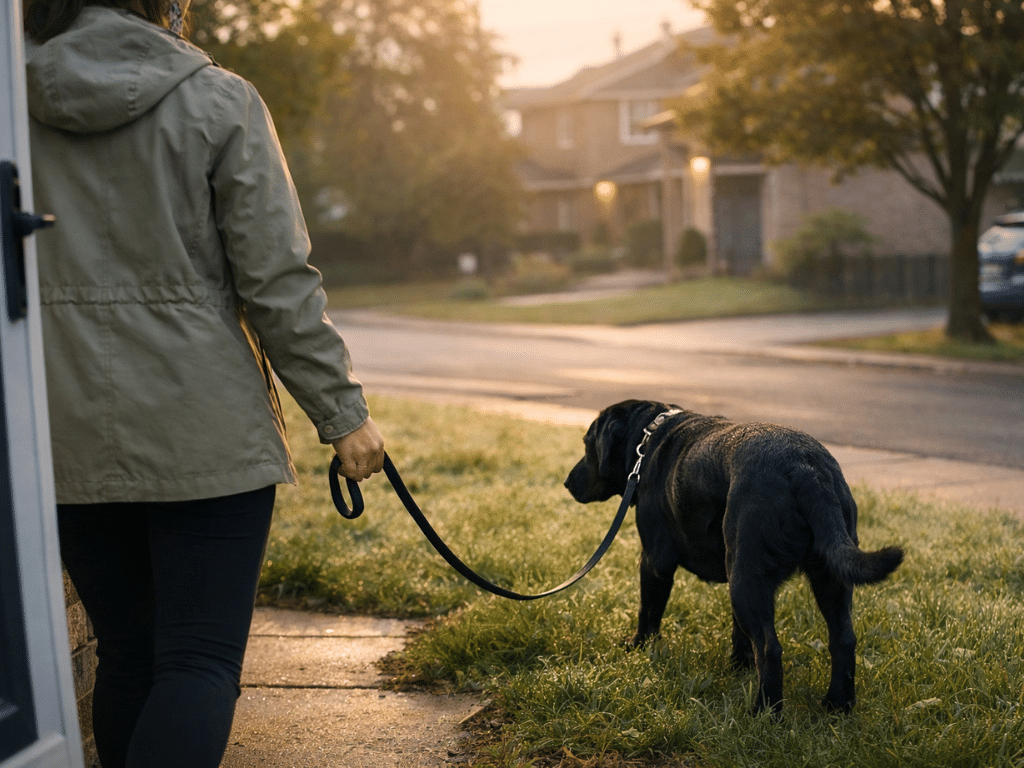



If you just adopted a rescue dog and you’re already feeling that little swirl of, “Why is this so confusing?”, you’re not alone. House training is one of the most common reasons people reach out for dog training in Hamilton, because it’s not just about pee and poop. It’s about trust, routine, stress, and teaching a dog what “home” actually means.
At K9 Principles, we’ve spent decades helping families build calm, predictable routines that make house training finally click. We’re also the exclusive trainers for the Hamilton/Burlington SPCA, so we see rescue dogs at every stage, from “I’m still figuring out where I am” to “I’ve got this, let’s go.” This article gives you a plan you can start today, without harshness, without gimmicks, and without guessing.
Why Rescue Dogs Struggle With House Training (And Why It’s Not “Bad Behaviour”)
A lot of rescue dogs were never properly taught where to toilet. Some were punished for accidents, which can teach them to hide it instead of learning the right place. Others lived in chaotic environments where the rules changed daily, so consistency was never possible.
Even when a rescue dog was house trained before, stress can scramble everything. New home, new smells, new people, new schedule, and sometimes a totally different type of home, like moving from a rural property to a Hamilton apartment with elevators and winter sidewalks. When you see accidents early on, it’s usually information, not attitude.
The win here is that dogs love clarity. When you make the routine predictable and the right choice easy, most rescue dogs improve fast, even if they had a messy start.
The Goal Is Not “No Accidents” Yet. The Goal Is Clarity
Most first-time owners aim at the wrong target. They aim for “zero accidents” immediately, and then feel defeated when reality happens. A better target is “my dog understands the system.” When your dog understands the system, accidents fade out naturally.
Clarity means your dog learns three things. They learn where the toilet area is. They learn how to get there. They learn that using it makes good stuff happen every single time.
That’s the heart of effective dog training, whether you’re working on house training, leash skills, or calm behaviour around guests. Consistency creates confidence.
Set Up Your Home So Success Is the Easy Option
Before you even think about “training”, set up your environment so your dog has fewer chances to make a mistake. If your dog keeps getting accidental practice indoors, you’re accidentally training the wrong habit.
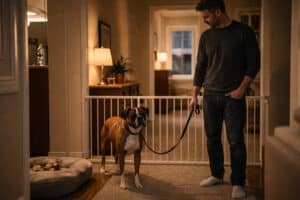
Pick a small “success zone” in your house for the first couple of weeks. A main-floor room is ideal, not the whole house. Use baby gates or closed doors to limit wandering. If your dog can disappear down a hallway, they can toilet down a hallway.
Choose one outdoor toilet spot if possible. Same door, same path, same area. If you do not have a yard, choose the closest realistic spot you can repeat, even if it’s a specific patch near your building. Consistency matters more than perfection.
Have your cleaning supplies ready before the first accident happens. You want an enzymatic cleaner that actually removes the smell at the molecular level, because if your dog can smell it, your dog thinks it’s still a toilet spot.
The Calm Routine That Works: Your Daily Schedule (The “Boring” Secret)
House training is mostly scheduling. When your dog toilets indoors, it usually happens right after a predictable event. Waking up, eating, drinking, playing, getting excited, finishing a nap, or coming back inside from outdoors too soon.
For the first two weeks, assume your rescue dog needs more structure than you think. Take them out first thing in the morning. Take them out after every meal. Take them out after every nap. Take them out after any play that ramps them up. Take them out before bed.
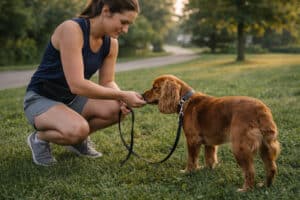
In the beginning, you do not wait for your dog to “tell you.” You build the rhythm first, and the signalling develops because your dog starts to understand the pattern. If you wait for signals too early, you miss them, and then everyone feels frustrated.
If you want a simple rule that covers most dogs, think in terms of “change of state.” If your dog just changed what they were doing, that’s often a toilet moment.
Supervision: The Skill That Prevents 80% of Accidents
Supervision is not staring at your dog like a security camera. It’s being close enough to interrupt the moment your dog starts searching for a spot. A lot of dogs show tiny clues before they toilet, like suddenly sniffing intensely, circling, drifting away from you, or getting oddly quiet.
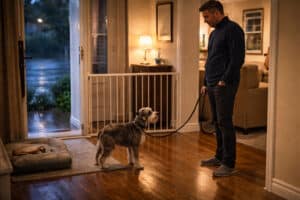
For the first phase, keep your dog with you. This can be as simple as having the lead on indoors while you move around, so your dog doesn’t sneak off to practise accidents. It is not forever. It is just long enough to build a habit you actually want.
If you cannot actively supervise, your dog should be in a safe, controlled setup. That might be a crate if your dog is comfortable with it. It might be an exercise pen. It might be behind a baby gate with a bed and a chew. The point is that “unsupervised freedom” is earned later, not handed out on day one.
Crate Use (If Appropriate): The Right Way, Not the Drama Way
A crate can help house training because most dogs avoid toileting where they sleep, but only if the crate is introduced properly. If your dog panics in a crate, do not force it and call that training. That usually backfires and can create stress toileting, barking, and shutdown.
If your rescue dog is crate-comfortable, use the crate as a short-term management tool. You use it when you cannot supervise, when your dog needs a nap, and when you want to prevent wandering accidents. You do not use it as punishment, and you do not leave your dog in it so long that toileting becomes inevitable.
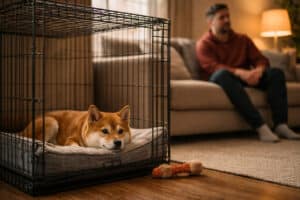
If a crate is not appropriate right now, we often use a pen or a gated area instead. The idea stays the same. You limit accidents by limiting opportunities, and you build freedom gradually as your dog proves they understand the routine.
If you are unsure whether crate work is right for your dog, this is one of the most valuable moments to get support through dog training in Hamilton that happens in your actual home. At K9 Principles, our In-Home Private Training builds a plan around your dog’s stress level, your layout, and your schedule, so you are not forcing a one-size-fits-all method.
How To Teach the Toilet Habit: One Spot, One Cue, One Outcome
When you take your dog out, treat it like a calm mission, not a social event. Put the lead on, go to the spot, stand still, and give your dog time. Too much wandering and chatting can distract a dog that is already unsure.
Use a simple cue you can repeat consistently, like “Go toilet.” Say it once, quietly, and then let your dog do the work. If they do not go within a few minutes, bring them back inside and supervise closely, then try again soon. This prevents the classic problem where the dog learns, “If I wait, I get a longer outdoor adventure.”
The moment your dog finishes toileting in the right place, reinforce it. Timing matters. Reward outside, not once you are back inside. If you wait until you are indoors, your dog can connect the reward to coming inside rather than toileting.
As the habit strengthens, you can reduce food rewards and use life rewards more often, like a sniffy walk, a few minutes of exploring, or breakfast right after. The rule stays the same. Toileting in the right place makes good stuff happen.
Accidents: What To Do In the Moment (Without Making It Worse)
Accidents are not a reason to lecture your dog. Dogs do not feel “guilty” about toileting. They feel weird because humans get intense, and they are trying to make sense of your mood. If you punish an accident, many dogs learn to hide it, which delays house training.
If you catch your dog mid-accident, interrupt gently. A calm “Ah-ah” or even a simple clap can be enough, and then you immediately guide them outside. If they finish outside, you reinforce that finish. You are not rewarding the mistake. You are reinforcing the correct ending in the correct location.
If you find an accident after the fact, you missed the moment. That means your plan needs more supervision or more frequent outdoor trips, not more intensity. Clean it thoroughly with an enzymatic cleaner, then adjust your management so the next one is less likely.
Your job is to treat accidents like data. Where did it happen. When did it happen. What happened right before it. That information tells you exactly what to change.
How To Avoid Confusion (Because Mixed Messages Create “Random” Accidents)
Most house training confusion comes from inconsistency. One day the dog goes out the back door. The next day they go out the front. One person waits for signals, another person does not. One person rewards, another person forgets. The dog is left guessing.
Pick one main route to the toilet spot, and stick to it as much as possible. Use the same cue words. Use the same reinforcement style. If multiple family members are involved, agree on the plan and keep it boringly consistent for two solid weeks.
Also watch for surface confusion. Some dogs will happily toilet on grass but refuse snow. Some will toilet on snow but refuse wet grass. Some dogs think pee pads mean “soft surfaces indoors are toilets,” which can turn rugs into targets. If you need an indoor option for a medical reason, use it intentionally and in a defined location, not as a casual backup.
Clarity is not about being strict. It’s about being predictable. Predictable is kind to a rescue dog.
Troubleshooting: Marking, Leg-Lifting, and “Tiny Pees Everywhere”
Marking is different from full bladder emptying. Marking is often small amounts, sometimes on vertical surfaces, and it can happen when a dog is stressed, excited, insecure, or adjusting to new smells. It is also more common in intact males, but neutered dogs can mark too.
The first step is management. If your dog is marking indoors, freedom is too big right now. Bring your dog back to a smaller success zone, increase outdoor trips, and keep supervision tight. Clean marked areas thoroughly, because lingering scent invites repeat performances.
The second step is routine and reinforcement. Many marking cases improve when the dog’s day becomes predictable and calm, because the dog stops feeling like they have to “announce themselves” to the environment.
If marking is sudden, extreme, or paired with straining, frequent attempts, or discomfort, you need a vet check. Behaviour and health overlap a lot here, and no amount of Hamilton dog training replaces medical care when a urinary issue is present.
If marking is becoming a pattern, this is a perfect situation for In-Home Private Training with us at K9 Principles, because we can see the exact triggers in your home and build a plan around the rooms, the visitors, the schedule, and the stress points that are driving it.
Troubleshooting: Fear of Going Outdoors To Toilet
Some rescue dogs are nervous outdoors. The sounds, the traffic, the wind, the dark, and even the feeling of cold air can be a lot, especially in a Hamilton winter. If your dog is scared outside, they may hold it until they cannot, then toilet indoors where they feel safer.
The fix is not dragging them outside and waiting them out. The fix is making outdoors feel safe enough for toileting to happen. Start with the easiest version of outside, like a quiet time of day, the closest spot possible, and a calm, low-pressure routine. Keep your body loose, keep your voice soft, and do not hover.
If your dog will not toilet, bring them back inside and supervise closely, then try again soon. This prevents the dog from rehearsing indoor toileting while still protecting them from feeling forced outdoors. Over time, as comfort grows, toileting outdoors becomes easier.
If your dog is truly panicking, freezes at the door, or refuses to move outside, professional help is the fastest path forward. At K9 Principles, we work in the real environments causing the concern, which is exactly what fearful outdoor toileting requires. This is hands-on dog training in Hamilton that respects your dog’s threshold and builds confidence without flooding them.
Troubleshooting: Inconsistent Signalling (Or No Signal At All)
A lot of owners say, “My dog doesn’t tell me they need to go,” when the truth is the dog is signalling quietly, and the humans are missing it. Early signals are often subtle, like pacing, sniffing, drifting away, or a sudden focus on the floor.
In the beginning, your routine does the heavy lifting. As the routine becomes reliable, you can start shaping a clearer signal. You can do this by consistently taking your dog out through the same door, and when your dog moves toward that door, you reinforce and immediately take them out. Over time, moving to the door becomes the dog’s way of saying, “I need to go.”
If you want an added signal like a bell, you still need the routine first. Otherwise the bell becomes a toy, or it becomes a way to request outdoor adventures rather than toileting. The goal is that the signal predicts a toilet trip, not a fun free-for-all.
If your dog sometimes signals and sometimes does not, treat that as a management issue. Tighten supervision and increase outdoor frequency for a week, and you’ll often see signalling become more consistent because your dog stops feeling rushed and starts feeling understood.
When House Training Stalls: The Three Things We Check First
When progress stalls, we look at timing, freedom, and emotion. Timing means your outdoor trips are not matched to your dog’s real pattern, so you are consistently late. Freedom means your dog has access to too much space too soon, so accidents are being rehearsed. Emotion means stress is high enough that learning is messy.
We also consider health. Urinary tract infections, digestive issues, parasites, and even pain can change toileting patterns fast. If your dog is suddenly having accidents after doing well, rule out medical causes early.
Finally, we look at the human routine. This is not blame. It is reality. Rescue dogs thrive when the plan fits the household. If your schedule is unpredictable, we build a routine that still works, using management and smart timing rather than unrealistic rules. This is why our In-Home Private Training is such a strong fit for house training problems. We build an individual plan that matches your dog and your life, so you can actually follow it.
Conclusion:
House training a rescue dog is not about being strict, and it is not about “catching” mistakes. It is about building a calm routine your dog can trust, managing freedom so accidents stop being practised, and reinforcing the right choice so your dog stops guessing. If you follow the plan in this article, you will feel the shift from chaos to clarity, and your dog will too.
Contact us for more information:
- Name: K9 Principles
- Address: Haldimand County, Greater Hamilton Area, Burlington, and Most of Norfolk County
- Phone: 289 880-3382
- Email: k9principlesinc@gmail.com
- Website: www.k9principles.ca
FAQs
-
A1. Most rescue dogs improve noticeably within two to three weeks when the routine is consistent and supervision is tight, but the timeline depends on stress, history, and how predictable the household is. In a busy home or an apartment setup with longer travel time to a toilet spot, it can take longer unless management is excellent.