


If you have just brought home a rescue dog from the Hamilton/Burlington SPCA, you have probably heard the 3-3-3 rule and thought, “Perfect. I just need to wait this out.” And honestly, that thought makes total sense, especially when you are tired, overwhelmed, and trying to do right by a dog you do not fully understand yet.
Here is the problem. The 3-3-3 rule can be a helpful lens, but it becomes a trap when it turns into passive waiting. At K9 Principles, we see it all the time in Hamilton dog training consults. Owners are patient, kind, and committed, but they are waiting for day 90 like it is a magical switch. Meanwhile, the dog is practising the exact habits everyone is hoping will disappear.
What the 3-3-3 Rule Actually Means
The 3-3-3 rule is a simple guideline that describes a common adjustment pattern for rescue dogs. The usual version goes like this: the first 3 days are about decompression and stress, the first 3 weeks are about learning the routine and starting to settle, and the first 3 months are about building trust, confidence, and a real bond.
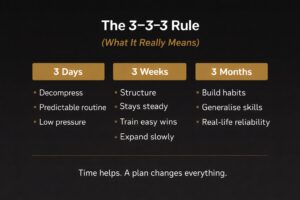
As a big-picture concept, it is trying to say something useful: your dog’s behaviour in week one is not their final form. Stress changes everything, and time matters. That part is true. What the rule does not say loudly enough is that time without structure does not create stability. Time plus the right dog training plan does.
What the Rule Gets Right, and Why It Helps First-Time Owners
The 3-3-3 rule gets one huge thing right: rescue dogs are not “being difficult” for sport. They are often adjusting to a totally new world with unfamiliar smells, sounds, routines, and people. Even a confident dog can act weird when everything changes overnight.
It also helps owners avoid rushing. You do not need to take a brand-new rescue to patios, hardware stores, packed trails, family dinners, and neighbourhood meet-and-greets in the first week. The rule gives you permission to slow down and build the base first, which is exactly what we want for long-term success.
Where the 3-3-3 Rule Goes Sideways for Owners
Most misunderstandings come from one idea: “If I just give it time, things will get better.” Sometimes they do, especially if the dog is simply stressed and shut down. But many of the behaviours owners struggle with are not stress-only behaviours. They are skills and habits. Skills do not download into a dog’s brain because a calendar flipped.
Another common issue is that people treat the timeline as a schedule the dog must follow. When week three arrives and the dog is still scared, or month three arrives and the dog is still barking at visitors, owners feel like something is wrong with their dog. Nothing is “wrong.” The dog is simply telling you what they can handle right now, and that is the only starting point that matters in real dog training.
The Big Truth: Time Does Not Train the Dog
If a dog spends 90 days rehearsing door rushing, leash pulling, barking at passing dogs, or avoiding being touched, that dog is not “waiting to settle.” That dog is learning. And they are learning fast. Dogs repeat what works for them. If barking makes scary things go away, barking becomes the plan. If pulling gets them to the smell faster, pulling becomes the plan.
At K9 Principles, we treat the 3-3-3 rule like a weather forecast. It tells you what conditions are likely, but it does not tell you what to build. You still need the house, the insulation, and the roof. That is what a real plan is for.
Stage One: The First 3 Days Should Feel Boring, and That Is the Point
In the first three days, your job is not to “socialize” your rescue dog. Your job is to make the world smaller, safer, and predictable. Think of it like landing after a turbulent flight. Nobody gets off the plane and immediately wants a surprise party. They want quiet, food, water, and a place to breathe.
So what should you do in real life. You should keep the dog’s world simple and controlled. You should set up a calm resting space, keep interactions low-pressure, and start a gentle routine that repeats daily. You should keep walks short and boring, and you should avoid crowded places and surprise greetings. You should watch your dog’s body language like it is the whole conversation, because early on, it is.

If your dog is shut down, you do not need to “cheer them up.” You need to make safety consistent so they can come out of that shell on their own terms. If your dog is frantic, you do not need to “tire them out.” You need to reduce arousal and teach the off-switch through predictable structure. Both paths lead to the same destination: stability.
What You Should Start Training in the First 3 Days Without Overwhelming Your Dog
Yes, you can start dog training immediately, but it should be the kind that builds clarity, not pressure. You are not drilling flashy cues. You are teaching your dog how to live in your home.
This is where we start with simple wins. We start with routines around meals, rest, and potty breaks. We start rewarding check-ins and calm choices. We start teaching the dog that good things happen when they look to you, move with you, and settle when asked. We also start boundaries right away, because boundaries are not punishment. Boundaries are information, and information lowers anxiety.
If you are thinking, “But I do not want to be strict,” good. We do not want strict either. We want clear. Clear is kind, because it stops your dog from guessing and getting it wrong over and over.
Stage Two: The First 3 Weeks Are About Routines, Not Freedom
Around the three-week mark, a lot of rescue dogs start to “wake up.” Owners often say, “He was so calm the first week, and now he is wild,” or “She was sweet and quiet, and now she is barking.” That is not the dog getting worse. That is the dog feeling safe enough to show you more of themselves.

This is also the stage where many owners accidentally hand over too much freedom too soon. They loosen rules, extend walks, add visitors, start dog park visits, and basically crank the difficulty to hard mode. Then the dog melts down, and everyone feels defeated.
Your best move in these first three weeks is to keep structure steady while gently expanding skills. You should be building leash manners in low-distraction spots. You should be practising calm greetings with you, not with strangers. You should be teaching a reliable recall inside and in the yard before expecting it on a busy trail. You should be creating predictable patterns that tell your dog, “I know what comes next, and I can handle it.”
Stage Three: The First 3 Months Build the Dog You Actually Want to Live With
By three months, many dogs have enough comfort to form real habits, for better or worse. If your dog has been practising calm routines, clear boundaries, and consistent reinforcement, you will often see confidence and stability growing. If your dog has been practising chaos, avoidance, or reactive behaviours, those patterns can be stronger too.
This is where owners sometimes get blindsided. They expected “three months equals fixed.” But three months is often when the real training begins, because now you are working with the dog’s true baseline, not the dog’s initial shock.
This is also where you start generalizing skills into real life. You practise calm behaviour when the doorbell rings, not only when the house is quiet. You practise leash walking on a street with real distractions, not only in the backyard. You practise your dog choosing you over the environment, because that is what creates reliability. That is the difference between a dog who can perform a cue in the kitchen and a dog who can make good choices in Hamilton’s real world.
How to Use the 3-3-3 Rule Properly Without Waiting Passively
Use the 3-3-3 rule as a lens for expectations, not as a reason to delay action. You should assume your dog is stressed early on, and you should plan for that. You should also assume your dog is learning every day, and you should plan for that too.
If you want the simplest “rule” that actually works, it is this. You should make the right behaviour easy, make the wrong behaviour boring or impossible to practise, and reinforce progress like it matters. That means you manage the environment, you build routines, and you train skills in the exact contexts where you need them.
When people ask us, “When should I start training,” our answer at K9 Principles is always the same. You start now, but you start smart. You start with the foundations that reduce stress and increase clarity, because that is what helps rescue dogs settle in a way that lasts.
Common 3-3-3 Moments That Confuse Owners, and What to Do Instead
If your rescue dog will not eat in the first day or two, you do not panic and start offering ten different meals. You keep the environment calm, offer food on a consistent schedule, and use mealtime as a peaceful routine. Appetite often returns when stress drops, and your calm consistency helps that happen faster.
If your dog is glued to you and cannot settle alone, you do not “prove love” by letting them follow you everywhere. You build gentle independence through predictable routines, short separations, and a defined rest space. You teach the dog that being alone is safe, not scary.
If your dog barks at noises, visitors, or passing dogs, you do not assume they just need more time. You treat it like information. You reduce exposure to what is flooding them, and you start teaching calm alternatives. You build distance, you reinforce check-ins, and you practise under threshold. If that sounds technical, do not worry. This is exactly the kind of thing we coach through in our dog training in Hamilton sessions, because it is hard to do alone when you are living it.
Why In-Home Training Changes Everything for Rescue Dogs in Hamilton
Rescue dogs do not struggle in a training facility. They struggle in your home, on your street, at your front door, and on the routes you walk every day. That is why our top recommendation is In-Home Private Training. At K9 Principles, we build an individual plan for your dog and your life, and we coach you right inside the environments that are actually causing the concerns.
If your dog is losing it at the front window, we work at the front window. If your dog panics when you leave, we work on the leaving routine. If your dog is reactive on your neighbourhood loop, we train on that loop. This is not theory. This is practical Hamilton dog training that fits your reality and reduces guesswork fast.

The goal is not a perfect dog in a perfect world. The goal is a stable dog in your world, with a plan you can actually follow on a Tuesday after work.
When Level 1 Group Classes Are the Right Next Step
Some rescue dogs do beautifully once the home routine is stable and the foundations are in place. That is when Level 1 group classes can be an amazing next step. They give you repetition, progression, and real-world practice around distractions in a controlled setting.
At K9 Principles, we like group classes when the dog can stay under threshold and still learn. If your dog is too overwhelmed to take food, too reactive to focus, or too anxious to settle, we would rather start privately first, build stability, and then use Level 1 to expand the foundation. This is how you avoid the “class was a disaster so my dog cannot learn” spiral, because your dog can learn. They just need the right starting point.
Home School Academy: When You Want the Progress Without the Stress
Sometimes the issue is not effort. Sometimes life is simply full. If you want your dog to get trained properly but you do not have the bandwidth to be consistent every day, our Home School Academy is built for that exact situation. We do the training for you, and we create a dog who understands the routines and skills that matter in real life.
This can be a game-changer for first-time owners who want to avoid months of trial and error, especially with a rescue dog whose history is unknown. You still get support, clarity, and handover guidance, but the heavy lifting is on us. That is still dog training, just delivered in a way that fits your season of life.
Conclusion:
The 3-3-3 rule is helpful when it reminds you to slow down, lower pressure, and give your rescue dog room to adjust. It becomes an oversimplified myth when it convinces you to sit back and wait for change instead of building it. Your dog does not need perfect. Your dog needs predictable routines, clear boundaries, and training that matches what they can handle right now. If you want help turning that idea into a plan you can actually follow, reach out to us at K9 Principles. Our In-Home Private Training is designed to meet you exactly where the problems are happening, and our Level 1 group classes give you strong next steps when you want a structured path forward.
Contact us for more information:
- Name: K9 Principles
- Address: Haldimand County, Greater Hamilton Area, Burlington, and Most of Norfolk County
- Phone: 289 880-3382
- Email: k9principlesinc@gmail.com
- Website: www.k9principles.ca
FAQs
-
A1. No, because dogs are not robots and rescues come with different histories, temperaments, and stress levels. The timeline is a general pattern, not a promise. The useful part is understanding that behaviour changes as stress changes, so you should plan for progress in stages instead of expecting instant stability.