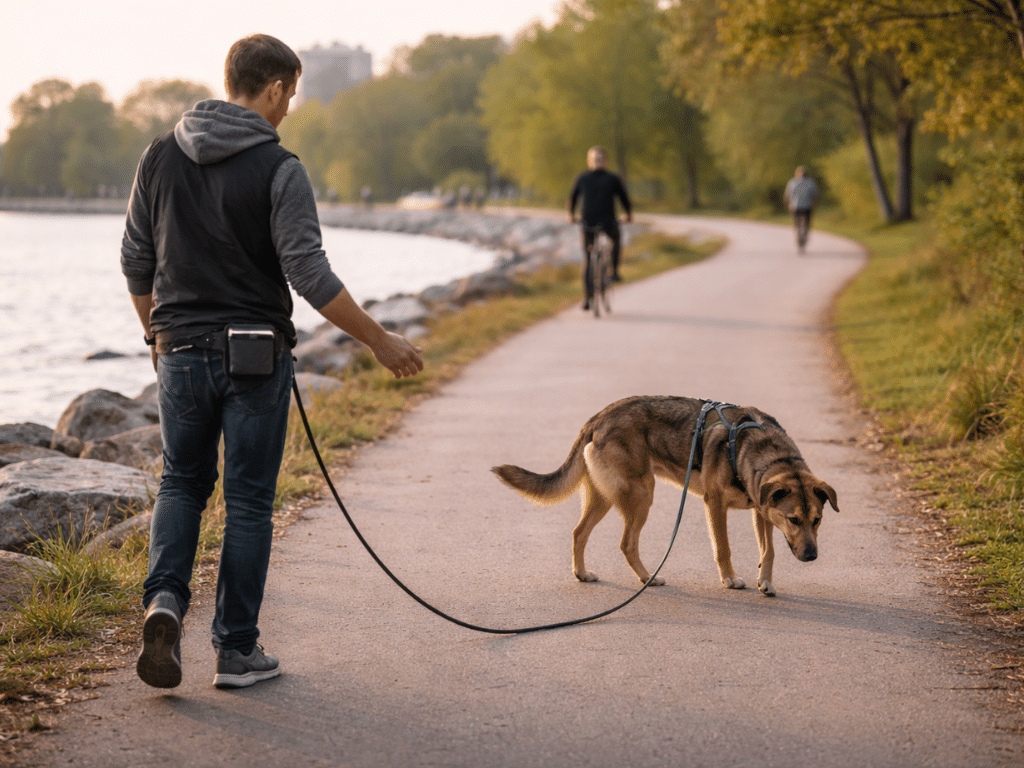



Bringing home a rescue dog is exciting, emotional, and (let’s be honest) a little intimidating. You want to do everything right, but the internet throws a thousand opinions at you and half of them contradict each other. If you’re in that “We’re thrilled… but now what?” stage, you’re in the right place. This guide is designed to give you clarity, not noise, and to help you start strong with dog training in Hamilton, real-world routines, and practical choices that set your new dog up for success.
At K9 Principles, we’ve helped a lot of families through the rescue transition. The pattern is always the same: the people who do best are not the ones who try to control everything. They’re the ones who build structure early, teach the dog how life works, and use dog training to create safety, calm, and trust. That’s what we’re doing here.
Why Rescue Dogs Can Struggle at First (Even When They Seem “Fine”)
A rescue dog is not “starting over” when they arrive at your home. They’re arriving with a history, even if you don’t know what it is. Sometimes that history is rough. Sometimes it’s just confusing. Either way, their nervous system is doing a full reboot in a brand-new environment, with brand-new humans, new smells, new rules, and new expectations. Imagine waking up in a strange house where you don’t know the language, and every door, sound, and routine is unfamiliar. You’d be a bit off too.
Some dogs show stress loudly by pacing, barking, whining, chewing, or pulling hard on leash. Other dogs show stress quietly by shutting down, sleeping constantly, refusing food, avoiding contact, or acting “perfect” because they’re too overwhelmed to do anything else. That quiet version can fool people into thinking, “Wow, this is easy.” Then week two or three hits, the dog relaxes a bit, and suddenly the behaviour shows up. That doesn’t mean you failed. It means the dog finally felt safe enough to be real.
This is exactly why we take a proactive approach with Hamilton dog training. We don’t wait for problems to become patterns. We build the habits you want from day one, so your dog settles into your life instead of inventing their own rules.
Before You Bring Them Home: Choose a Set-Up, Not Just a Dog
Most people choose a dog based on heart, and we love that. But your success comes from choosing the set-up that matches the dog you’re bringing home. You do not need a massive house, endless free time, or a perfect schedule. You do need a plan for management, routine, and training that fits your actual life.
Start by deciding where the dog will sleep, where they will decompress, where they will eat, and where they will be when you cannot supervise. That last one matters more than people realise. “We’ll just keep an eye on them” sounds good until you’re in a work call and they’re chewing baseboards or having an accident behind the sofa. Management is not punishment. It’s prevention. Prevention is kindness.
At K9 Principles, we usually recommend creating a calm “home base” area before the dog arrives. It might be a crate, an exercise pen, a gated room, or a quiet corner with a bed. The goal is not to confine forever. The goal is to give the dog a predictable space where they can exhale. When you combine that with smart dog training, you’ll be shocked how quickly a rescue dog can start to feel secure.
The First 72 Hours: What You Do Now Shapes Everything Later
The first three days should feel boring, and that is a compliment. You are not trying to “show them off,” introduce them to everyone, or test their personality. You are teaching one simple message: “This home is safe, and life is predictable here.”

Keep visitors low or zero. Keep outings simple. Keep your voice calm and your expectations realistic. Yes, you can start training right away, but think of it as confidence-building, not performance. You’re reinforcing tiny wins like responding to their name, following you a few steps, eating calmly, settling on a bed, or choosing to look at you instead of staring at every sound. Those tiny wins stack fast.
This is also the window where routine matters most. Feeding at consistent times, bathroom breaks on a schedule, predictable rest times, and gentle structure on walks can reduce anxiety dramatically. If you’ve ever felt your own stress drop when you know what the day looks like, you already understand the concept. Dogs are the same, and rescue dogs need it even more. This is where dog training in Hamilton becomes less about “fixing” and more about building a lifestyle your dog can succeed in.
Decompression Without Creating Bad Habits: Calm Does Not Mean Chaos
You’ll hear people say, “Let them decompress.” True. You’ll also hear people interpret that as, “Let them do whatever they want because they’ve been through a lot.” That’s where things get messy. Decompression is about lowering stress, not removing structure.
A rescue dog can decompress while still having boundaries. They can rest while still learning that jumping on counters is not an option. They can feel safe while still learning that whining does not open doors, and pulling does not move the walk forward. If you remove structure entirely, the dog doesn’t magically relax. They often become more anxious because the world feels unpredictable and they have to make too many decisions.
At K9 Principles, we use a simple approach: freedom is earned through calm choices. We start with smaller spaces and clear routines, then expand freedom as the dog proves they can handle it. That is how you prevent “decompression” from turning into rehearsed bad habits that later require months of Hamilton dog training to undo.
The Routine That Makes Rescue Dogs Thrive: Predictability, Not Perfection
If you only take one thing from this article, take this: rescue dogs settle faster when the day has a rhythm. You do not need military precision. You need consistency.
Your routine should include predictable bathroom breaks, predictable meals, predictable rest, and predictable movement. Many rescue dogs come from environments where life was random. Random feeding. Random exercise. Random attention. Random stress. When you create predictable patterns, you reduce uncertainty, and uncertainty is a huge trigger for anxiety-based behaviour.
Walks are a big part of this, but they should be structured, not chaotic. Early walks are not about distance or “getting energy out.” They’re about learning how to move through the world calmly with you. That might mean shorter walks with more pauses, more check-ins, and more reinforcement for loose leash and calm body language. When you treat the walk like a training session instead of a cardio session, you’re doing dog training without it feeling like homework.
Building Trust the Right Way: Why “Love” Alone Isn’t Enough
You can absolutely love a dog into a better life. But you cannot love a dog into stability without structure. Trust is built when your dog can predict you. Trust is built when you are consistent, fair, and clear. Trust is built when you notice the small signs of stress and respond early, instead of waiting until the dog explodes.
A common first-time mistake is trying to “prove” you’re safe by constantly talking to the dog, petting the dog, hovering, or offering attention every time they look uncertain. That can accidentally teach the dog that uncertainty earns comfort, which sounds sweet but can build dependence and anxiety. The better move is calm neutrality paired with reinforcement for brave choices. In other words, “You’re safe, and you’re capable.”
This is where engagement games and simple cues become powerful. When your dog learns that looking at you, following you, and checking in earns something good, you become the anchor. That’s the foundation of effective dog training in Hamilton, because real life is full of distractions. We want your dog to choose you because you’ve made that choice worth it.
Name Recognition and Attention: The Fastest Confidence Builder You’ll Ever Teach
Before you chase fancy skills, teach two things: their name means good things, and checking in with you is always a smart choice. This is the start of everything, from recall to loose leash walking to reactivity prevention.
A rescue dog may not know their name, or they may have a history of their name being paired with stress. We treat the name like a brand-new cue. Say the name once in a cheerful tone, and the moment the dog looks at you, mark it with praise and reward. Repeat in calm moments indoors first, then in slightly more distracting moments, then outside. If you say the name and the dog ignores you, do not repeat it ten times. That’s how you teach them the name is background noise. Instead, make it easier and help them win.
When attention becomes a habit, your entire life gets easier. Your dog is less likely to bolt to the end of the leash. They’re less likely to fixate on people, dogs, or squirrels. They’re more likely to pause and ask, “What are we doing?” That is the doorway into reliable freedom, and it’s why Hamilton dog training should start with engagement, not obedience pressure.
House Training a Rescue Dog: Why Accidents Happen and How to Stop Them
Accidents are not spite. They are confusion, stress, timing, or too much freedom too soon. Sometimes they are also a medical issue, so if you’re seeing frequent urination, straining, blood, or sudden changes, a vet check is a smart first step. 
For the average rescue dog, house training becomes simple when you control three things: schedule, supervision, and space. You take the dog out on a predictable routine, especially after sleep, play, meals, and excitement. You reward the correct bathroom behaviour immediately, because dogs learn through outcomes. You supervise indoors so accidents cannot happen unseen. If you cannot supervise, you manage the dog in a crate, pen, or gated space so the dog practises holding it and succeeds.
If an accident happens, you clean it properly and you adjust the plan. You do not scold the dog, because scolding teaches them to hide accidents, not stop having them. The goal is to make the right choice easy and the wrong choice unlikely. That is training in its purest form, and it’s exactly how we approach dog training at K9 Principles: we engineer success.
Crates, Gates, and Boundaries: Structure That Prevents Behaviour Problems
Some people hear “crate” and imagine something harsh. We see it as a tool, and like any tool, it depends how you use it. A crate can be a calm bedroom that helps your dog settle. A gate can prevent your dog from rehearsing chasing cats or stealing socks. A pen can keep the dog close while they learn your routine. Boundaries are not about control. They are about clarity.
If your rescue dog is anxious, the worst thing you can do is give them the full run of the house on day one. That is too much space, too many choices, and too many opportunities to practise unwanted habits. Start smaller, build calm, then expand. It’s the same idea as learning to drive. You do not start on a busy highway at rush hour. You start in a quiet lot until the basics feel safe.
When you pair boundaries with reinforcement for calm behaviour, you get a dog who chooses to settle instead of pacing all evening. You get a dog who can relax while you cook, work, or watch TV, because they’re not constantly scanning for the next thing to do. That settled dog is the real goal of dog training in Hamilton, because a dog who can settle is a dog who can learn.
Walks, Pulling, and Reactivity: How to Prevent the Common Rescue Dog Spiral
Rescue dogs often struggle on walks for two reasons. First, the environment is intense. Second, the leash removes their ability to create distance naturally. When a dog cannot move away from something that worries them, they might bark, lunge, freeze, or spin. When a dog is overexcited and the leash stops them from greeting, they might also bark and lunge. Different emotion, same messy picture.
The solution is not yanking the leash or forcing the dog to “face it.” The solution is teaching skills at a distance where your dog can stay under threshold. We reward check-ins. We use predictable patterns that help the dog understand what’s coming next. We choose routes that confirm safety instead of routes that overwhelm. We make decompression sniffing a reward, not the entire walk.
If you’ve ever walked a rescue dog down a busy path and felt your heart rate climb every time you saw another dog approaching, you already know why early Hamilton dog training matters. Walk stress rehearsed daily becomes a habit. Calm walking rehearsed daily becomes a habit too. We’d rather install the calm habit early.

Introducing New People, Kids, and Other Dogs: Go Slower Than You Think You Need To
A rescue dog can be friendly and still struggle with introductions. Friendly dogs can jump, mouth, overwhelm, or get overly fixated. Nervous dogs can shut down, flee, or bark defensively. In both cases, the mistake is the same: people move too fast because they want things to feel “normal.”
We prefer controlled, low-pressure introductions. We keep greetings short. We avoid face-to-face pressure. We allow the dog to approach and disengage. We create safe zones where the dog is not bothered. With kids, supervision is non-negotiable, and so is teaching the child how to be calm and respectful. A dog does not owe anyone affection, and forcing interaction is how bites happen, even with a “nice dog.”
If you have another dog at home, think in layers. Neutral walks together before free interaction. Separate resources at first, especially food, bones, and toys. Structured rest time. Calm coexistence before play. When we support families through dog training, we focus on preventing conflict, not reacting to it after the fact. Prevention keeps everybody safer, including the dog you just brought home.
When You Should Get Help: The Earlier You Act, the Easier It Gets
Some people wait because they don’t want to “overreact.” They hope the dog will grow out of it. They tell themselves it’s just stress. Sometimes it is, and it still needs guidance. Stress plus rehearsal becomes habit. Habit becomes identity. Then people start saying, “That’s just how he is,” when really it’s just what he practised for months.
You should reach out for professional support if you’re seeing persistent fear, reactivity, guarding, panic when alone, intense mouthing, biting, or behaviour that makes you feel unsafe or overwhelmed. You should also reach out if you’re simply lost. Confusion is a valid reason. You do not need a crisis to deserve help.
At K9 Principles, we make dog training in Hamilton feel practical and doable. We focus on routines you can actually maintain, and we teach you how to read your dog so you can respond early instead of reacting late. The goal is not a robot dog. The goal is a stable dog who understands your home, trusts your guidance, and can handle real life calmly.
How K9 Principles Sets Rescue Dogs Up for Real Success (Not Just “Better Behaviour”)
A rescue dog does not need constant correction. They need clarity, consistency, and the right kind of confidence-building reps. That’s the heart of our approach at K9 Principles. We look at what your dog is doing, why they’re doing it, and what needs to change in the environment and routine so your training actually sticks.
We also keep it real. Most people are not trying to win competitions. They want calm walks. They want guests to come over without chaos. They want the dog to settle at night. They want to stop feeling tense every time they leave the house. That is real-life dog training, and it’s what we build.
If you’re reading this and thinking, “Okay, this makes sense, but I want a plan that’s tailored to my dog,” that’s exactly what we do. Rescue dogs are not one-size-fits-all. Your training should not be either.
Conclusion:
Bringing home a rescue dog is not about getting it perfect. It’s about getting it clear. When you combine calm structure, smart management, and consistent reinforcement, your dog stops guessing and starts relaxing. That’s when trust grows, behaviour improves, and the “What have we done?” panic turns into, “We’ve got this.” If you want your rescue dog to settle in faster and thrive long-term, reach out to us at K9 Principles. We’ll help you build a simple, confident plan that fits your real life and delivers the kind of results people are really looking for when they search dog training in Hamilton.
Contact us for more information:
- Name: K9 Principles
- Address: Haldimand County, Greater Hamilton Area, Burlington, and Most of Norfolk County
- Phone: 289 880-3382
- Email: k9principlesinc@gmail.com
- Website: www.k9principles.ca
FAQs
-
A1. Many dogs show noticeable improvement within a few weeks, but true settling can take months depending on the dog’s history, temperament, and the structure you provide. The fastest progress usually happens when the home has predictable routines and the dog is guided with consistent dog training from day one.