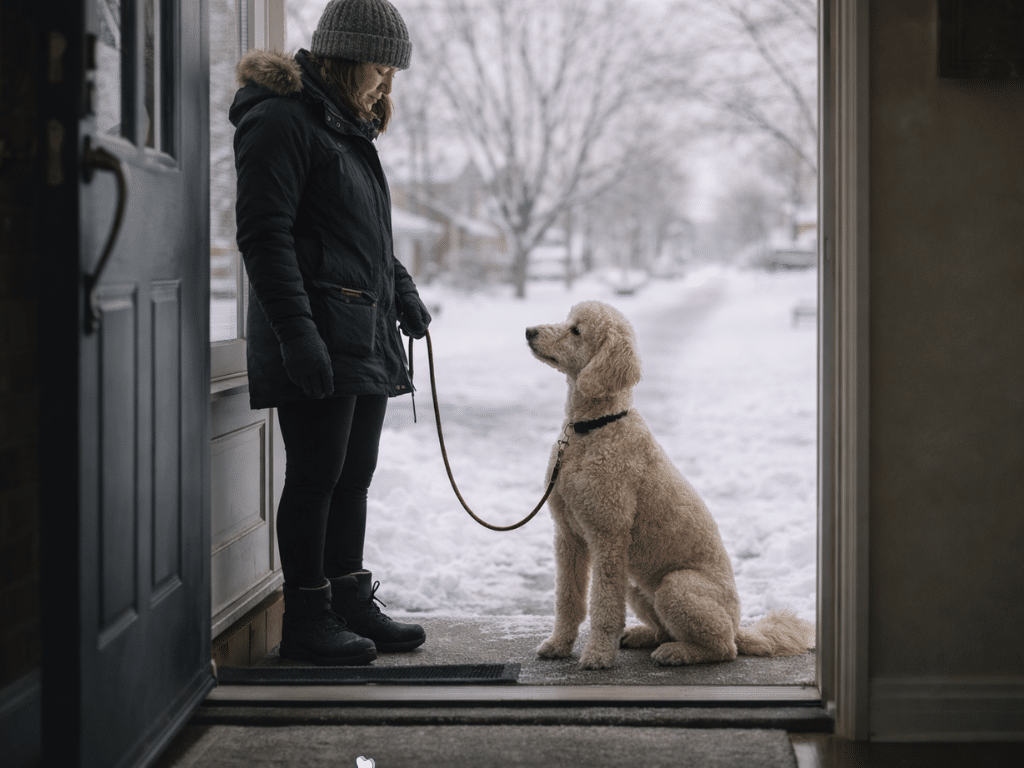


You know the feeling. At home your dog can sit, come, and look at you like a little genius. Then you step outside and it’s like their brain falls out of their ears. The lead goes tight, the sniffing turns frantic, the whining ramps up, and the second a dog appears your “training” might as well be written in invisible ink.
At K9 Principles, this is one of the most common “Wait, what is happening?” moments we see with dog training in Hamilton. It’s also the missing link that ties together everything you’ve been learning in this series: proofing and generalisation, reinforcement, motivation and competing rewards, engagement, and the walk-that-trains. If those topics are the tools, thresholds are the rules of physics. When you understand thresholds, you stop feeling like your dog is ignoring you and start seeing what’s actually going on in their nervous system.
What “Threshold” Actually Means (Plain Language, No Jargon)
A “threshold” is the point where your dog goes from being able to think, learn, and choose… to being in full-body reaction mode. Under threshold, your dog can notice things and still stay connected. Over threshold, they’re not being stubborn. They’re overwhelmed.
Think of it like a volume dial. At a low volume, you can chat, follow directions, and make decisions. As the volume gets louder, you can still function, but it takes effort. Past a certain point, you can’t think straight, you just react. That tipping point is threshold.
This is why with our Hamilton dog training we don’t judge progress by “Can he do a sit?” We judge it by “Can he do a sit when it matters, in the place it falls apart, at the distance that used to set him off?” That’s the real game.
Why Dogs “Forget Everything” Once They Cross It
When a dog crosses threshold, their brain shifts priorities. Learning and problem-solving move to the back seat. Survival and action move to the front. For some dogs, that looks like lunging and barking. For others, it looks like frantic scanning, lead-biting, zooming, or pulling like they’re towing a truck.
This is also why treats suddenly stop working. It’s not because you have the wrong treats. It’s because your dog’s body is saying, “Food is irrelevant right now. Something is happening.”
A big part of effective dog training is accepting this truth: you cannot train your way out of a threshold explosion while you’re inside the explosion. Training happens before. The “fix” is prevention, early detection, and building capacity over time.
What Over-Arousal Looks Like in Everyday Hamilton Life
Over-arousal isn’t always dramatic. In fact, it often starts as “He’s just excited.” Then it snowballs. Here’s what we see constantly with real dog training in Hamilton situations, especially on busy neighbourhood pavements and multi-use trails.
Doorway explosions are a classic. Your dog hears the lead, sees you reach for the door, and their body launches into a different gear before you even leave the house. Then outside, you get lead pulling, zig-zagging, scanning left and right, and that tight, forward-leaning posture that says, “We are hunting for stimulation.”
You might see whining, little barks, or “air snaps” at the lead. You might see jumping, spinning, or grabbing sleeves. Some dogs do the frantic sniffing thing where their nose is on the ground, but it’s not relaxed sniffing. It’s like they’re trying to outrun their own feelings. And when the world gets too much, food becomes a “no thanks,” even if it’s normally their favourite.
On a Saturday morning at Bayfront-style paths, during school drop-off times, or on busy weekends when the parks are packed, all of this gets amplified. That doesn’t mean your dog is “bad in public.” It means the environment is loading pressure faster than your dog can release it.
The Early Warning Signs: Catch It Before the Blow-Up
Most owners miss threshold because they’re waiting for the obvious moment. The lunge. The bark. The meltdown. But threshold is almost always preceded by smaller tells.
Watch your dog’s body like you’re watching a kettle. It doesn’t go from cold to boiling instantly. The first signs are usually faster breathing, tighter mouth, harder eyes, and a head that snaps around more often. You’ll feel the lead start to “buzz” even before it goes tight. You’ll see the sniffing change from curious to frantic. You might see a sudden refusal to check in, even if your engagement has been improving.
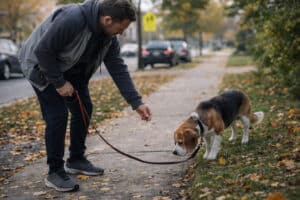
Another big one is speed. Over-aroused dogs move faster. They surge ahead. They rush patterns. They can’t settle into a rhythm. If your walk feels like you’re being dragged from stimulus to stimulus, your dog is likely living right at the edge of threshold.
In Hamilton dog training, this is where we win. Not by waiting for the problem, but by catching the ramp-up and stepping in early.
The Rehearsal Trap: Why It Gets Worse the More It Happens
Over-arousal is self-reinforcing. When a dog pulls hard and reaches the smell, the smell becomes the reward for pulling. When they bark and the dog goes away, they learn barking works. When they lunge and you tighten the lead, the pressure and restriction can add fuel, which creates an even bigger reaction next time.
This is why “letting him get it out of his system” usually backfires. What your dog is practising is what your dog is getting good at. If your dog rehearses frantic walks all week, you don’t wake up on Saturday and magically get a calm dog. You get a dog with strong habits.
That’s not bad news. That’s good news. Because it means your plan doesn’t need to be complicated. It needs to stop the rehearsals and replace them with a repeatable, calmer pattern. That’s what effective dog training looks like.
Your Three-Lever System: Distance, Duration, and Difficulty
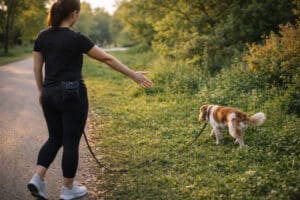
When a dog is over threshold, most people try to increase difficulty. They ask for more cues. They push closer. They stay out longer to “work through it.” That’s like trying to teach a kid math in the middle of a fire alarm.
At K9 Principles, we use a simple three-lever approach that makes dog training in Hamilton feel doable, even in busy environments. You adjust distance, duration, and difficulty. If your dog is struggling, you increase distance from the trigger, shorten the duration of the exposure, and lower the difficulty of what you’re asking.
Distance is the fastest lever. If your dog can’t take food when a dog is across the street, you don’t need a better treat. You need more space. Duration is next. A 10-minute calm session beats a 60-minute spiral. Difficulty is the fine-tuning. Instead of asking for a perfect heel, you ask for one glance, one step with you, one tiny choice.
This is progressive exposure done properly. Not flooding. Not “trial by fire.” Smart, controlled reps that build real capacity.
Pre-Walk Decompression: The 3-Minute Shift That Changes Everything
If your dog launches out the door like a rocket, your walk is starting over threshold. Fix the start and you fix half the walk.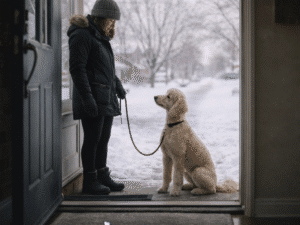
Before you clip the lead on, take three minutes to drop the arousal. Slow movements. Calm hands. No hype voice. If your dog is bouncing, you wait. If they can’t wait, you create a simple pattern: lead on, lead off, reset, repeat until the moment is boring. Boring is the goal. Boring means your dog is thinking.
Then do a tiny decompression ritual before you head into the “real world.” That might mean a few scatter feeds in the yard, a short sniff in one spot, or a simple “find it” game where the pace is slow and the dog is using their nose in a regulated way. Not frantic searching. Regulated searching.
This is Hamilton dog training that fits real life. You don’t need an hour. You need a better first five minutes.
Structured Starts and the Warm-Up Zone (Stop Beginning Walks on Hard Mode)
A warm-up zone is the first stretch of your walk where you protect your dog’s nervous system like it’s the warm-up before a workout. You don’t sprint first. You warm up first.
Pick a route that lets you control space. Neighbourhood pavements where you can cross the road. A quieter side street before you hit the main path. A park loop where you can step off onto grass if you need distance. With dog training in Hamilton, this matters because our busiest places are predictable. Trails get crowded. Weekend parks get intense. School zones spike at the same times every day. Use that predictability to your advantage.
In your warm-up zone, you’re not trying to “train everything.” You’re building rhythm. You reward check-ins. You reinforce walking with you when the environment is still manageable. You keep the lead loose by changing direction early, not by getting into a pulling war. And you watch for the first signs of ramp-up so you can intervene before threshold hits.
Micro-Breaks: How to Keep a Walk From Becoming a Pressure Cooker
One of the biggest reasons dogs “get worse the longer we’re out” is pressure stacking. Every little trigger adds a layer. A bike. A jogger. A squirrel. A dog behind a fence. By minute 35, your dog isn’t reacting to the last thing. They’re reacting to the whole stack.

Micro-breaks empty the stack before it overflows. That could mean stepping onto a driveway and doing a slow scatter feed. It could mean stopping behind a car for a visual break. It could mean turning down a quieter street for two minutes of calm sniffing.
This is not “giving in.” This is strategy. In dog training, breaks are not failures. Breaks are what allow the brain to reset so learning can continue.
Reinforcement That Calms Instead of Hypes (Yes, It Matters)
Not all rewards create the same emotional state. If you reward a highly aroused dog with high-energy play, you might get more intensity, not more control. If you rapid-fire treats while your dog is already buzzing, you can accidentally add fuel.
Calming reinforcement is slower. Lower. Softer. It often uses sniffing as payment. It rewards stillness, slow breathing, and choices that de-escalate. It can be a treat delivered low to the ground, encouraging a head drop and a softer body. It can be permission to sniff a patch of grass after your dog checks in.
This connects directly to the earlier themes in this series, like neutrality and off-switch skills. Neutrality is not your dog ignoring the world. It’s your dog noticing the world and staying regulated anyway. Off-switch skills are not just for the living room. They are the foundation of calm dog training in Hamilton streets and trails.
Troubleshooting the Big Five Owner Statements (What We’d Fix First)
“He won’t take treats outside.”
This is almost always a threshold issue, not a treat issue. At K9 Principles, we would increase distance, lower intensity, and rebuild food-taking as a simple under-threshold skill. We would also use food differently, focusing on calm delivery and predictable patterns rather than trying to “buy” attention in the middle of chaos.
“He gets worse the longer we’re out.”
That’s pressure stacking. Shorten the walk, add micro-breaks, and stop treating every outing like a marathon. You don’t build fitness by blowing a muscle. You build it with smart progression. Your dog needs emotional conditioning, not endurance suffering.
“He’s fine until he sees a dog.”
That means your dog’s threshold is being crossed by one specific trigger. We would build a distance plan where your dog can notice dogs and still stay under threshold, then slowly close the gap over time. We would also rehearse predictable responses, like a check-in cue and a calm exit pattern, so you’re not improvising every time.
“He’s not aggressive, just excited.”
We believe you. And excitement can still be a problem if it tips into loss of control. The goal isn’t to punish excitement. The goal is to teach regulation so excitement doesn’t turn into pulling, barking, or lunging. That’s the difference between a social dog and a dog that can’t cope.
“He’s only reactive on the lead.”
Lead reactivity is incredibly common in Hamilton dog training, because leads add frustration and remove options. Off-lead, dogs can arc, sniff, and create space. On lead, they feel trapped. That’s why our plan focuses so much on distance, angle changes, and giving the dog a clear job to do while still allowing safe decompression. This ties right back to leash reactivity work and the walk-that-trains structure you’ve already seen.
The Mistake-Proof Weekly Plan: Build Capacity Without Burning Your Dog Out
Here’s what we want you to picture. Not perfection. Not a dog who never reacts. A dog who can recover faster, stay under threshold longer, and make better choices in more places. That is real-world dog training success.
In week one, we keep outings short and winnable. We pick quieter times and easier routes. We do the pre-walk decompression, we use a warm-up zone, we add micro-breaks, and we leave before the walk turns into a meltdown. We prioritise the dog coming home calmer than they left, even if the walk is shorter than you’re used to.
In week two and three, we add controlled exposure. We don’t chase triggers, but we don’t hide forever either. We might walk near a busier path but stay on the edges. We might observe the park from a distance rather than walking through the middle. We build the skill of noticing and recovering, not the habit of exploding.
In week four and beyond, we gradually increase difficulty using the three levers. A little less distance, a little more duration, a slightly busier time of day. If your dog struggles, we don’t label it as failure. We adjust the levers and protect the learning. This is how dog training in Hamilton becomes sustainable, not exhausting.
Boundaries, Rest, and Predictable Routines: The Unsexy Secret to Emotional Control
A lot of over-arousal is lifestyle. If your dog is under-slept, over-stimulated, and living in constant unpredictability, their threshold will be low. Everything will feel like a big deal.
Rest is training. Downtime is training. Predictable routines lower baseline stress, which raises threshold. Boundaries in the home build frustration tolerance, which shows up outside as better emotional control. This is where off-switch skills matter. Teaching your dog how to settle, how to wait, and how to handle “not right now” without falling apart is not just polite house behaviour. It’s the foundation for calm Hamilton dog training in public.
If your dog is exploding at the doorway, it’s not just a doorway problem. It’s usually a regulation problem. Fix the regulation, and the doorway becomes easy.
When You Need a Structured Path: How We Make This Real in Hamilton
If you’ve read this and thought, “Okay, this makes sense, but how do we actually do it with our dog?” that’s exactly why we built our programs the way we did at K9 Principles. Threshold work is not about one magic cue. It’s about systems, progression, and coaching that keeps you from accidentally practising the very behaviours you’re trying to change.
Our Level 1 is where we turn foundations into real-world skills, especially for first-time owners who want clarity and structure. Our In-Home Private training is where we tailor the plan specifically to your dog, your neighbourhood, and the exact situations where things fall apart, whether that’s busy multi-use trails, park edges, or the chaos of weekend foot traffic. This is the practical side of dog training in Hamilton that gets you results you can actually live with.
Conclusion:
If your dog feels “untrainable” outside, it’s not because they’re broken or because you’re failing. It’s because threshold is running the show. Once you understand thresholds and over-arousal, everything clicks into place: why treats disappear, why walks unravel, and why your dog looks like a different animal in busy Hamilton moments. The solution is not pushing harder. The solution is training under threshold, protecting your dog from rehearsals, building capacity with smart distance, and using routines that keep the nervous system regulated. If you want a clear, structured path that turns this into real, calm progress in the real world, reach out to us at K9 Principles. We’ll guide you into the kind of Hamilton dog training that makes your dog easier to live with and your walks something you actually enjoy again.
Contact us for more information:
- Name: K9 Principles
- Address: Haldimand County, Greater Hamilton Area, Burlington, and Most of Norfolk County
- Phone: 289 880-3382
- Email: k9principlesinc@gmail.com
- Website: www.k9principles.ca
FAQs
-
A1. Under threshold looks like your dog noticing the environment while still being able to eat, respond to a simple cue, and recover quickly after something interesting happens. You might still see curiosity, but you won’t see frantic scanning, explosive pulling, or that locked-in stare that feels like you’ve disappeared. In dog training, under threshold is the sweet spot where learning sticks.