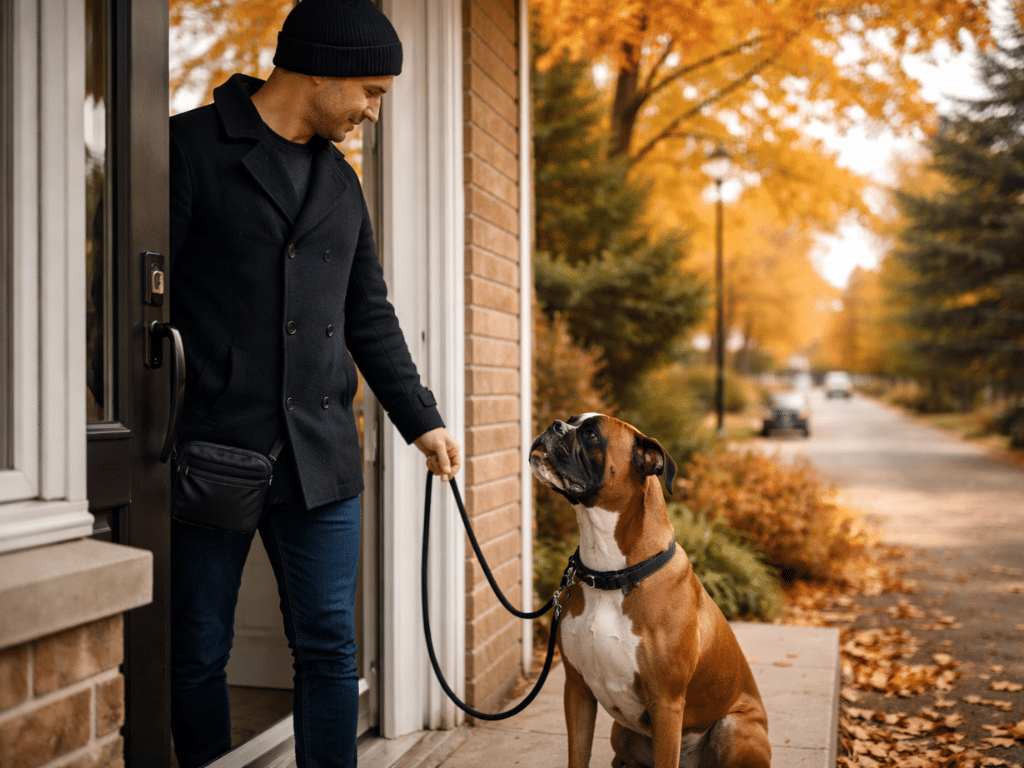


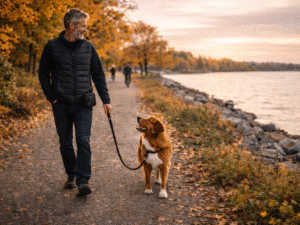
Walks are supposed to be the easy part, right. Clip the lead on, head out, come home happy. But for a lot of first-time owners, the moment the door opens it turns into a completely different experience. Your dog rockets out, the lead goes tight, the nose hits the ground, and suddenly you’re just… attached to them. If that’s you, you’re not behind, and your dog is not “being stubborn”. You’re just missing the skill that makes everything else in dog training easier: engagement.
At K9 Principles, we build engagement first because it’s the foundation that makes loose-lead walking, recall, neutrality, and calm behaviour in public actually stick. Not in your living room. Not in the backyard. On real walks, on real streets, around real distractions, which is what Hamilton dog training has to handle every single day.
Engagement is how you stop feeling like you’re managing chaos and start feeling like you’re leading a walk. It is the difference between “our dog knows it” and “our dog can do it when it matters”.
What Engagement Really Is (And Why It’s Not “Forcing Focus”)
Engagement is your dog choosing to connect with you. It is voluntary. It is a decision your dog makes because you’ve built value in you, not because you’re physically holding them in place or repeating cues until they give up.
A lot of owners think engagement means the dog stares at them the whole walk like a little robot. That is not the goal. The goal is a dog who can enjoy the environment and still keep you in the conversation. Quick check-ins. Easy responsiveness. A brain that can leave a distraction and come back to you without a fight.
When engagement is real, it feels like your dog is “with you” even when they’re sniffing, even when people walk past, even when another dog appears in the distance. That is why engagement is the secret weapon of dog training. It doesn’t replace skills. It makes skills possible in the real world.
Why Dogs “Switch Off” Outdoors (And Why It’s Normal)
Outdoors is a casino for dogs. Smells are everywhere. Movement is constant. Every blade of grass has a story. If your dog could talk, they’d basically say, “This place is amazing, why would we focus on you right now”.
When owners say, “Our dog doesn’t care about treats outside,” what’s really happening is simple: the environment is paying more than you are. It’s not an attitude problem. It’s economics. Your dog is doing what works best for them in that moment.
This is also why a dog can look brilliant indoors and fall apart outside. Indoors is quiet and predictable. Outdoors is loud, exciting, and full of competing rewards. In Hamilton dog training, that difference matters because Hamilton is full of shared paths, cyclists, squirrels, busy streets, and neighbourhood dogs behind fences. Engagement is how your dog keeps a thread of connection through all of that.
The First Minute of the Walk Is Where Most Chaos Gets Created
Most owners think the walk goes wrong when the dog starts pulling halfway down the street. But the pattern usually starts before the dog even steps outside.
If the lead goes on while your dog is already hyped, you’ve taught them that exploding is the correct starting gear. If the door opens while they’re launching forward, you’ve taught them that adrenaline unlocks the outside. If the first thing they get to do is drag you to the first sniffing spot, you’ve taught them that the environment comes first and you come second.
Then the lead gets tight. Then you pull back. Then your dog pulls harder. Then the walk becomes a tug-of-war you did not agree to participate in. That’s not because your dog is bad. It’s because the start routine accidentally rehearses chaos.
At K9 Principles, we fix the start because the start is the steering wheel. If you want dog training in Hamilton to hold up outdoors, you build the walk like a skill, not like a random event.
The Engagement Walk Structure We Use at K9 Principles
This structure is simple enough to repeat daily and powerful enough to change your dog’s whole walking personality. It has four parts, and each one has a job.
You start with a calm door routine that sets the emotional tone. Then you do a short warm-up zone close to home so your dog can transition into “walk brain”. Then you insert small skill moments that build focus without turning the walk into a drill. Then you finish with decompression, where your dog gets to sniff and enjoy the world on purpose, not by dragging you into it.
This is not about controlling your dog for control’s sake. It’s about giving your dog a predictable flow that makes good choices easy. That is what great dog training looks like in real life.
When you run this structure consistently, you’ll feel the shift quickly. The lead gets lighter. Your dog checks in more. Walks feel calmer without you needing to be harsh.
Step One: The Calm Start at the Door (No Drama, Just Clarity)
We do not need your dog to hold a long sit-stay at the door. We just need a moment of calm that says, “We start together”.
Clip the lead on and pause. Wait for any small sign of softness. A quieter body. A pause in the bouncing. A glance toward you. The second you see it, mark it with a happy “yes” and reward it.
If your dog ramps up again, you don’t punish it. You reset. You wait. You pay calm. You open the door when calm shows up. Over time, your dog learns a simple rule: calm makes the walk happen.
This is the first engagement rep of the day, and it matters more than most owners realise. In dog training in Hamilton, this is also a safety habit because calm exits reduce the odds of bolting, dragging, or immediately locking onto distractions.
Step Two: The Warm-Up Zone (The Secret to a Better Walk in Two Minutes)
Expecting a dog to go from couch mode to public behaviour instantly is like expecting a person to sprint the second they wake up. Your dog needs a warm-up.
Your warm-up zone is the first one to three minutes of the walk, close to home, low pressure, and predictable. You can do a small loop. You can walk up and down the same stretch of pavement. You can even stay in the driveway at first.
The point is not distance. The point is readiness. This is where you reward check-ins, practise one or two engagement games, and build a rhythm before you head into busier areas.
Owners who skip the warm-up spend the rest of the walk trying to recover focus. Owners who warm up properly feel like the walk is easier from the first minute because it is. This is one of the fastest wins we see in Hamilton dog training. 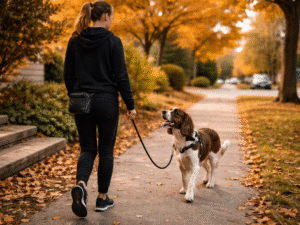
Step Three: Skill Moments (Tiny Deposits That Make Big Behaviour)
A skill moment is a short training moment inside the walk. It is not a long drill. It is not you stopping every ten seconds and turning the walk into a boring obedience session. It is a clean, short rep that keeps your dog practising connection in real life.
A skill moment might be ten steps of loose lead walking. It might be a hand target as a cyclist passes. It might be a quick name response game near a driveway where dogs tend to bark. It might be a simple pattern game as you pass a distraction at a distance.
The reason skill moments work is because your dog stays successful. You practise before your dog is overwhelmed, not after. That is how dog training becomes reliable outside.
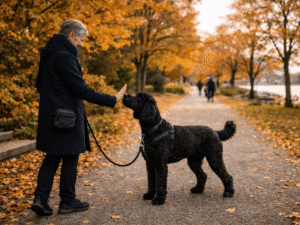
Step Four: Decompression (Let Your Dog Sniff, But Make It a Reward You Control)
Decompression is not the enemy. Sniffing is healthy. Exploring is normal. The problem is when decompression happens by default and the dog learns they can ignore you from the moment the walk starts.
Decompression should be something you deliver on purpose. You choose when it happens. You choose the area. You choose the length of time. You can even release your dog to it with a cue like “go sniff”.
This is how you use the environment as reinforcement without letting it hijack the walk. Your dog learns that engagement unlocks freedom. That is the core trade that makes dog training in Hamilton feel fair and effective.
Game One: Name Response That Actually Works Outside
If your dog’s name does not reliably pull their attention, everything else is harder. Name response is not a party trick. It is the “hello” that starts the conversation.
Start indoors. Say your dog’s name once in a calm, upbeat tone. The instant they look at you, mark “yes” and reward. Then pause and let them look away again. Repeat.
When it’s smooth indoors, move to the doorway. Then the driveway. Then the quiet street. This is where most people accidentally break it by repeating the name over and over until it becomes background noise. Say it once. If your dog doesn’t respond, make it easier. Create more distance from the distraction, increase reward value, or go back a step.
At K9 Principles, we treat name response like a skill you protect. If you keep the reps successful, it becomes automatic. That one change can transform your daily dog training routine because your dog starts offering attention instead of you chasing it.
Game Two: Rapid-Fire Check-Ins (Make Connection a Habit, Not a Request)
A lot of owners wait for a check-in and then reward it. That is good, but it can be slow. Rapid-fire check-ins build a rhythm so your dog starts checking in frequently because it has become the “normal” pace of the walk.
In the warm-up zone, take one or two steps. The moment your dog glances at you, mark and reward. Then move again. Then reward the next glance. Keep it snappy and light.
You are not asking for long eye contact. You are building frequent reconnection. This is what makes walks feel smooth because you’re never fully disconnected in the first place.
For first-time owners doing Hamilton dog training, this is a game that builds confidence fast because it gives you a simple way to create focus without nagging your dog.
Game Three: Hand Target (The Friendliest Way to Redirect Without Pulling)
Hand target is one of the cleanest engagement tools you can teach. It gives you a “come back to us” button that feels like a game, not a correction.
Present your open hand near your dog’s nose. When they touch it, mark and reward. Then move your hand slightly to the side and repeat. Build it until your dog happily snaps to your hand wherever it appears.
Outside, this becomes your steering wheel. When your dog starts drifting toward a distraction, you can present the hand target and guide them back without dragging the lead tight. When you need your dog to re-centre on a busy path, you use the hand target to create a quick win.
This is one of those skills that looks almost too simple, but it’s powerful dog training because it turns redirection into connection.
Magnet Walking (Without Luring Your Dog Like a Fishing Rod)
Magnet walking is often taught badly. Owners wave food in front of the dog’s face, and the dog follows the food, not the person. Then the moment the food disappears, the dog disappears too.
We want the opposite. We want your dog tracking you because being near you pays, not because they can see the reward.
Start in a quiet area. Take a few steps. When your dog is beside you and the lead is slack, mark and reward by delivering the treat from your body line near your thigh. Keep the reward coming from you, not from a hand dangling out in front.
If your dog surges forward, don’t keep walking into tension. Stop, reset, and reward the moment the lead goes slack again. Then move. Then reward position.
This builds a walking rhythm that actually holds up on real streets. With dog training in Hamilton, magnet walking is one of the most practical skills because it teaches your dog what to do, not just what to stop doing.
Moving Rewards (So Your Dog Stops Checking In Only When You Stop)
If every reward happens when you stop, your dog will learn a rule you never intended: stopping is the cue.
Moving rewards fix that. When your dog checks in, mark it and reward while you’re still moving. You can feed from your hand as you walk, or you can drop the treat slightly ahead so your dog catches it and keeps moving with you.
You can also mark the check-in, take a few quick steps, then reward. This turns the reward into part of the movement. Your walk stays fluid, and your dog starts checking in while walking, which is what you actually need in real life.
This is a small change that creates a big improvement in dog training because it prevents the “statue problem” where the dog only connects when the human freezes.
“Find It” Done Right (A Calm Tool, Not a Panic Button)
“Find it” is one of the best tools for lowering arousal, but it needs to be used strategically.
When you scatter a few treats on the ground, your dog’s head goes down, their body softens, and their focus shifts away from what they were staring at. This is brilliant when your dog is starting to load up on something, like another dog, a cyclist, or a squirrel hotspot.
The trick is using it early. If your dog is already exploding, “find it” is late. If your dog is starting to fixate, “find it” can interrupt that build-up and keep your dog successful.
We also do not want “find it” to become the only way you survive walks. It is a strategy, not a lifestyle. The long-term goal is engagement that holds up without needing to scatter treats every time something exists.
Used properly, “find it” is one of the most owner-friendly tools in Hamilton dog training because it helps your dog calm down while you stay in control of the situation.
Pattern Games (Predictability Creates Calm Around Distractions)
Dogs love patterns because patterns make the world predictable. Predictability lowers stress, and lower stress makes engagement easier.
A simple pattern game is a steady rhythm where you say “one, two, three” as you walk and reward on “three”. Your dog starts anticipating that rhythm and stays connected because the pattern itself becomes reinforcing.
Another pattern is an up-and-back walk. You walk ten steps, turn, walk ten steps back, and reward check-ins. The turning breaks fixation and gives your dog a reset.
Pattern games are especially helpful for dogs who stare at other dogs. Staring is often the start of a build-up. Patterns give your dog something else to do that is clear and repeatable.
This is why we use them so often in dog training in Hamilton. They are practical, easy for first-time owners, and they create calm without needing harsh corrections.
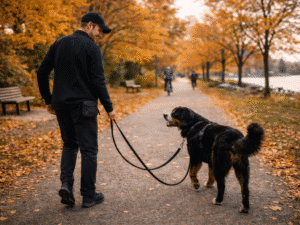
Progressing Engagement From Indoors to Busy Hamilton Paths (The Ladder That Actually Works)
Engagement is built like a ladder. If you skip rungs, you fall.
Start indoors. That is where you teach the games without the world competing. Then move to the doorway and driveway, where smells start to pull your dog’s attention. Then go to quiet streets, where you add mild movement and small distractions. Then graduate to busier routes, like shared paths, parks, and waterfront trails.
The biggest mistake owners make is testing skills in the hardest environment too soon. If your dog struggles on a busy path, that doesn’t mean your dog “can’t do it”. It means you’re asking for university-level focus when your dog is still in primary school.
At K9 Principles, we progress in a way that keeps dogs winning. That is how confidence builds for both you and your dog. That is also how dog training becomes reliable instead of random.
Troubleshooting the Big Four Problems First-Time Owners Hit
If your dog won’t take food outside, the environment is too intense or the reward is too low for that level of distraction. The fix is not forcing food. The fix is lowering difficulty and increasing value. Train closer to home, choose quieter times, add distance from distractions, and upgrade rewards. Most dogs do not find dry kibble exciting when the world is lighting up their brain.
If your dog is too hyped at the start, fix the start. Calm at the door, warm-up zone every time, and no rushing into the walk like you’re late for something. Hype is often reinforced by speed. Slow the first minute down and you’ll feel the rest of the walk improve.
If your dog stares at other dogs, do not stand still and hope it passes. Staring is usually the early stage of a build-up. Create distance first, then run a pattern game, then reward check-ins. Movement plus structure beats frozen tension almost every time.
If your dog only checks in when you stop, switch to moving rewards and reward during motion. Your dog is not trying to be cheeky. Your dog is following a pattern you accidentally taught, and you can absolutely rewrite it with cleaner timing.
This is the part of Hamilton dog training where owners often feel stuck, but the truth is thefse problems are predictable and fixable when you have a clear plan.
How We Turn Engagement Into Real Walk Skills at K9 Principles
Engagement is not the end goal. Engagement is the engine. Once it’s running, we can build everything else on top.
That is why our Level 1 program focuses on the foundations that show up on every walk: check-ins, leash skills, calm starts, real-world reinforcement, and how to handle distractions without turning the walk into a daily battle. It is structured, practical, and designed for normal people with normal lives.
If you want the fastest results, In-Home Private Training is the ultimate choice for excellent outcomes because we can coach you in your real environment. We can watch your door routine, your street, your dog’s triggers, and your timing, then adjust the plan so it fits your exact situation. That is when dog training stops feeling like guesswork and starts feeling like a system you can actually run.
Conclusion:
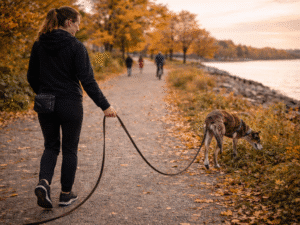 If walks feel chaotic right now, the solution is not more yelling, more tightening the lead, or more hoping your dog grows out of it. The solution is engagement, because engagement is what makes your dog choose you when the world is loud. When you start the walk calmly, warm up before you “test” your dog, add short skill moments, and use decompression as a reward you control, you stop chasing your dog’s attention and you start building it. If you want this done properly and quickly in real neighbourhoods, real parks, and real shared paths, K9 Principles can help through Level 1 or In-Home Private Training, where we build engagement that holds up in real dog training in Hamilton situations and turns your walks into something you actually look forward to.
Contact us for more information:
- Name: K9 Principles
- Address: Haldimand County, Greater Hamilton Area, Burlington, and Most of Norfolk County
- Phone: 289 880-3382
- Email: k9principlesinc@gmail.com
- Website: www.k9principles.ca
FAQs
-
A1. A noticeable change can happen within a week when you fix the start of the walk and reward check-ins consistently, but reliable engagement in busy areas usually takes a few weeks of steady practice through the environment ladder. The fastest progress happens when you practise in easy places first and build up gradually instead of testing your dog in the hardest spots too soon.