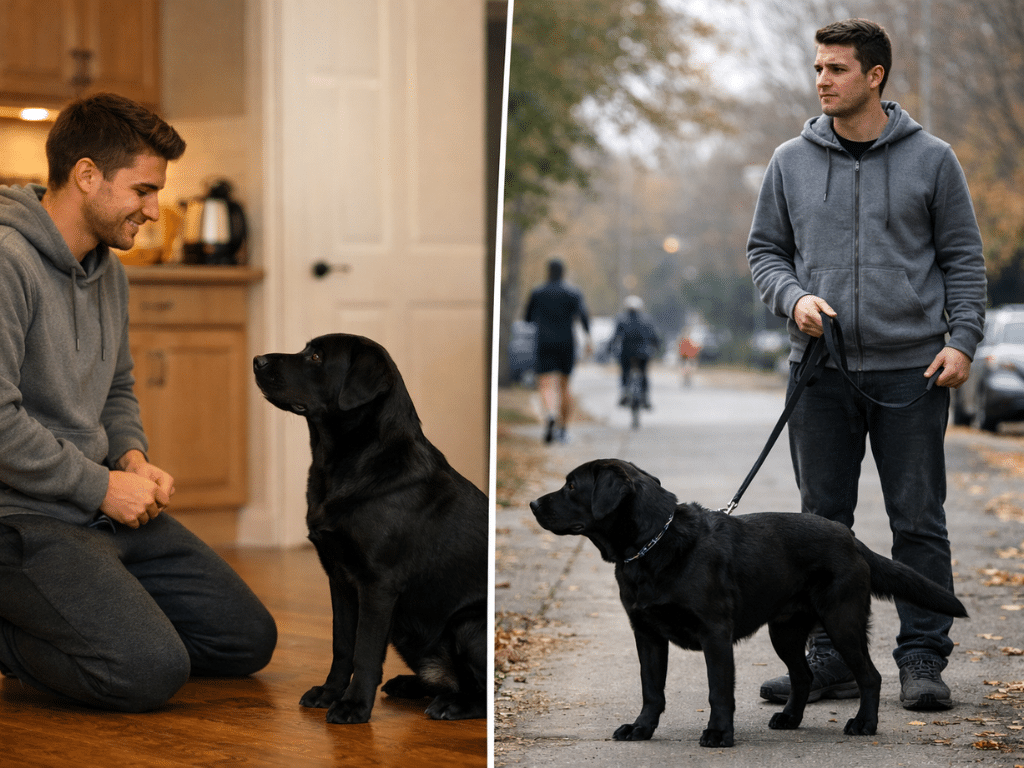



You know that feeling when your dog sits like a superstar in the kitchen, then stares at you outside like you’ve switched languages. Most owners call it stubbornness. We call it normal. This is exactly why proofing and generalisation exist, and why “my dog knows it” is one of the biggest traps in dog training. At K9 Principles, we build reliability the same way you build strength at the gym: you don’t lift your personal best on day one, and you don’t expect perfect form in the middle of chaos without practising it. If you want real-life results from dog training in Hamilton, this is the skill that turns training into freedom.
What Proofing and Generalisation Actually Mean
Proofing means teaching your dog to perform a behaviour accurately even when life changes. Generalisation means teaching your dog that the cue still counts in new places, around new people, with new smells, on new surfaces, at new times of day. Put simply, proofing is making the skill stronger, and generalisation is making the skill travel. This matters because dogs learn in pictures, not paragraphs. If “sit” has only been practised in your living room, your dog may genuinely think “sit” means “put my bum down on this exact rug, in this exact lighting, with this exact vibe.” When you step onto a busy pavement in Hamilton, you’ve changed the entire picture. That is not your dog being cheeky, that is your dog being honest about what they’ve learned so far.
Why Dogs Don’t Automatically Generalise
Humans generalise like breathing. If you learn to open one door, you’ll probably open another door without a lesson. Dogs don’t work like that. Dogs learn through association, and context is a massive part of that association. Smells, sounds, surfaces, distance, your body position, the lead tension, and what happened the last five times in that location all shape what your dog thinks is “the rule.” This is why a dog can have perfect recall in the back yard and forget it at the park edge. The park is a sensory festival. Your dog’s brain is doing maths at speed: squirrels, joggers, other dogs, yesterday’s goose poo, and the memory of that one time they sprinted off and it felt amazing. If you want Hamilton dog training that actually holds up outside, you have to train your dog to understand the cue across contexts, not just perform it in one familiar scene.
The Kitchen Dog vs The Real-World Dog
Inside your home, the environment is predictable. The distractions are low, the consequences are controlled, and your dog has rehearsed behaviours there a hundred times. Outside, you’ve got movement, smells, sound, distance, novelty, and often a lead that changes how your dog feels in their body. This is why owners feel like their dog is “blowing them off” the moment they leave the driveway. The truth is simpler and kinder: your dog is overloaded and under-practised. The solution is not to repeat yourself louder, or to get frustrated, or to label your dog as disobedient. The solution is to shrink the task until your dog can win, then build it back up properly. That’s what professional dog training looks like when it’s done with a plan instead of hope.
The Three Ds: Distance, Duration, Distraction
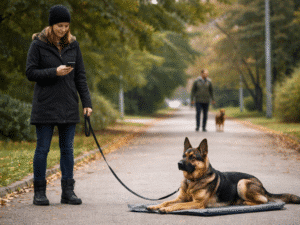 If you take one thing from this entire article make it this: when training falls apart, one of the Three Ds has jumped too far. Distance is how far your dog is from you or from the trigger. Duration is how long the behaviour must be held. Distraction is what else is happening in the environment. Proofing is the art of increasing these in a smart order, not all at once. Owners accidentally crank all three and then feel confused when the dog fails. Think about it. You ask for a down-stay, you stand ten metres away, for one minute, while another dog walks past, and you’re surprised your dog breaks. That’s not a “bad dog.” That’s a normal dog being given an exam they were never prepared for. At K9 Principles, we treat the Three Ds like a dial, not a switch. We turn one dial slightly, keep the others easy, and let the dog build confidence and clarity. This approach is the backbone of dog training in Hamilton that actually transfers to parks, paths, and everyday life.
How to Proof Without Breaking Your Dog
Proofing should feel like a series of wins, not a series of arguments. The moment your dog fails, your job is not to “make them,” your job is to simplify. That might mean moving further away from distractions, shortening the duration, reducing distance, or switching to an easier behaviour that your dog can succeed at in that moment. This is where owners get emotional, because they think stepping back is “going backwards.” It isn’t. It’s how learning works. The fastest way to build reliable behaviour is to keep your dog in the zone where they can succeed, then expand that zone gradually. When proofing is done properly, your dog becomes confident because the rules are consistent, and you become confident because you stop gambling with your cues. This is also where timing matters. If you reward too late, your dog learns the wrong thing. If you correct without clarity, your dog learns stress. If you repeat cues, your dog learns that the first cue doesn’t matter. Good dog training is clean, fair, and planned.
Distraction Layering: Adding the World One Slice at a Time
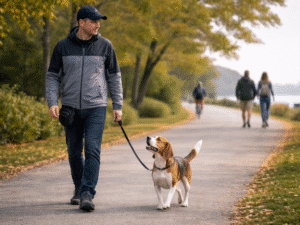 Most people don’t fail because they didn’t train, they fail because they trained in one bubble and then threw the dog into real life. Distraction layering fixes that. Instead of going from “quiet lounge” to “busy trail,” you create stepping stones. You practise in your house, then your back yard, then the driveway, then the quiet side street, then the slightly busier street, then the park edge, then the path at a quiet hour, then the same path at a busier hour. You can do the same with specific distractions. If dogs are your dog’s kryptonite, you don’t start two metres away from an excited dog. You start far enough away that your dog can still think, then you reward engagement, calmness, and appropriate choices. Over time, you close the distance, increase the duration, and add movement. This is where Hamilton dog training becomes real, because Hamilton is full of real distractions: people, bikes, scooters, wildlife, and other dogs living their lives. If you want your dog to behave in that world, you have to train in that world, just in a controlled, progressive way.
Reinforcement in Proofing: How to Pay Without Bribing
Let’s kill a myth quickly: using rewards does not make your dog “treat dependent.” Using rewards badly makes your dog treat dependent. There’s a massive difference. A bribe is waving food to get behaviour. Reinforcement is paying after the behaviour happens to make it more likely next time. In proofing, reinforcement becomes your steering wheel. When you raise difficulty, you should raise pay, not lower it. This is where owners accidentally sabotage themselves by getting stingier exactly when the dog needs more motivation and clarity. Then they say, “He only listens when I have food.” What actually happened is that the behaviour was never reinforced strongly enough in hard environments, so it never became valuable there. At K9 Principles, we use a simple rule: the harder the rep, the better the pay, and the clearer the timing. Over time, as reliability grows, we shift from constant reinforcement to variable reinforcement, and we add real-life rewards like sniffing, greeting, or freedom as part of the training plan. That is how dog training becomes lifestyle, not a performance. 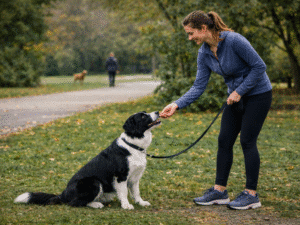
Common Proofing Mistakes That Create ‘Selective Hearing’
The first mistake is repeating cues. When you say “come, come, come,” you teach your dog that the first cue is optional. The second mistake is asking for behaviours when your dog is already over threshold, then getting frustrated when they can’t comply. The third mistake is training only when you feel like it and expecting consistency from a dog who has never seen consistency. The fourth mistake is punishing confusion. If your dog genuinely does not understand that “down” applies on wet grass near a busy road, correcting that confusion doesn’t teach understanding, it teaches avoidance or stress. The fifth mistake is skipping the boring steps. Owners love the idea of off-leash freedom and hate the idea of practising a heel on the driveway. But the driveway is where you build the muscle. The public trail is where you test the muscle, and testing too early is how dogs rehearse ignoring cues. With dog training in Hamilton, one of the biggest reasons dogs “don’t listen” is because they’ve had months of practising that not listening works, especially outdoors. The fix is not more force, it’s better strategy and better reps.
Real-Life Proofing Plans for Hamilton Walks
If you live in Hamilton, you’ve got everything you need to proof properly because the city offers every level of distraction imaginable. Start where you can win. That might be a quiet street in the early morning, or a calm park edge rather than the main path at peak time. Choose one behaviour per session, not five. If your dog is working on loose lead walking, make the goal “loose lead for short stretches” and reward that, rather than dragging your dog through a forty-minute walk hoping it magically improves. If your dog is working on recall, practise recalls on a long line in low distraction areas before you ever trust it in a high distraction place. If your dog is working on neutrality, practise calm observation at a distance from people and dogs, rewarding your dog for choosing to stay engaged with you instead of scanning for trouble or excitement. Build your training routes like a ladder. The route itself becomes part of the plan. Over time, you can proof the same skills on busier pavements, around schools at pick-up time, near trails with cyclists, and around parks with wildlife smells. This is how Hamilton dog training stops being a class you attended and becomes a skill you own. If you want a structured roadmap, K9 Principles lays this out step by step in training so you’re never guessing what “next” looks like. You can start here: https://k9principles.ca/ and if you want the foundations that make proofing easier, look at Level 1 and Level 2: https://k9principles.ca/programs-level-1/ and https://k9principles.ca/programs-level-2/
When You Need Help: How K9 Principles Proofs Dogs Faster
Most owners don’t need more willpower, they need a clearer plan and better feedback. Proofing is where tiny details matter: your timing, your lead handling, your distance from distractions, the order you increase difficulty, and how you recover from mistakes. At K9 Principles, we don’t just teach the behaviour, we teach you how to keep it alive in the real world. That means we help you spot the moment your dog is about to tip over threshold, adjust your Three Ds before failure happens, and create clean reinforcement patterns that make your dog want to choose you even when the environment is loud. This is also where your dog’s motivation matters. Some dogs are social, some are sniff-driven, some are toy-driven, and some are environmentally obsessed. We use what your dog genuinely cares about to build reliable responses, and then we teach you how to fade food correctly so your dog isn’t looking at your pocket, they’re listening to your cue. If you’re serious about dog training in Hamilton and you want results that hold up on trails, pavements, parks, and doorways, proofing is the line between “my dog can do it” and “my dog does do it.” If you want the most hands-on path where we do the training for you, Home School Academy is built for this.
Conclusion: Reliability Is Built, Not Hoped For
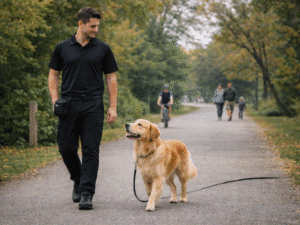 Proofing and generalisation are the reason great dogs look great everywhere, not just at home. Your dog is not broken, not stubborn, and not trying to embarrass you. They are responding to the environment they’re in and the training history they’ve lived. When you understand the Three Ds, layer distractions properly, reinforce with purpose, and train in progressive locations, your cues start to mean the same thing everywhere. That is what reliable dog training looks like. It’s also what creates real freedom, because you stop negotiating with your dog and start trusting what you’ve built together. If you’re ready to turn “sometimes” into “every time,” K9 Principles can help you do it in a way that feels fair, practical, and built for real life in Hamilton.
Contact us for more information:
- Name: K9 Principles
- Address: Haldimand County, Greater Hamilton Area, Burlington, and Most of Norfolk County
- Phone: 289 880-3382
- Email: k9principlesinc@gmail.com
- Website: www.k9principles.ca
FAQs
-
A1. The honest answer is that the timeline depends on how many quality reps you build and how cleanly you increase difficulty, but most owners see a noticeable jump in reliability within weeks when they stop stacking the Three Ds and start training progressively in real environments. If your dog has years of practising ignoring cues outside, it takes longer, but it still improves fast when the plan is correct.