




If you’ve ever been on a walk and felt your dog transform the second they spot another dog, a jogger, or a cyclist, you already understand why “basic obedience” isn’t the full answer. The lead goes tight, your dog locks on, and suddenly it’s like your voice disappears. Most owners think the fix is more socialisation, more exercise, or more commands. Those can help, but they often don’t solve the real issue underneath. The missing skill is dog neutrality, and once you understand it, it changes how you see everything from leash reactivity to greetings to off-leash freedom. At K9 Principles, neutrality is one of the biggest reasons our dog training in Hamilton works in public, not just in your living room. It’s also one of the biggest reasons people finally feel like they’ve “got their dog back”.
What Dog Neutrality Actually Means (And What It Isn’t)
Dog neutrality means your dog can notice life without being emotionally hijacked by it. They can see another dog, a stranger, wildlife, a skateboard, traffic noise, kids playing, and they stay steady. They might look, they might be curious, but they don’t spiral into staring, whining, pulling, barking, lunging, or freezing. Their brain stays online.
Neutrality does not mean your dog becomes dull or shut down. It does not mean your dog is forbidden from greeting anyone or enjoying the world. Neutrality means your dog can pass things calmly and only interact when it’s invited and appropriate. It’s the difference between a dog that reacts to the world and a dog that can live in it.
If you’ve been searching for Hamilton dog training, you’ve probably seen a lot of content focused on obedience positions like sit, down, heel, and stay. Those are useful, but neutrality is what makes those behaviours reliable when life is loud. Neutrality is the glue.
Why Your Dog “Loses It” On Walks Even If They’re Friendly
One of the most common things we hear is, “He’s not aggressive, he just loves dogs,” or “She’s friendly, she’s just excited.” Friendly dogs can still be chaotic. Excited dogs can still be unsafe. Your dog can have good intentions and still behave in a way that’s socially inappropriate, stressful, or difficult to manage.
A lot of public meltdowns come from frustration and expectation. If your dog has learned that seeing a dog usually leads to greeting, then not greeting feels unbearable. If your dog has practised pulling to get access, pulling becomes the default. If your dog has practised barking and it creates space, barking becomes a tool. Dogs repeat what works.
This is why dog training isn’t just about stopping behaviour. It’s about changing the loop underneath the behaviour so your dog’s default response to the world becomes steadier and more thoughtful.
Neutrality vs Socialisation: Exposure Isn’t The Same As Skill
Socialisation is one of the most misunderstood concepts in dog training. Many owners think it means their dog should meet everything, touch everything, greet everyone. The problem is that this can accidentally teach your dog a dangerous expectation: that every dog and every person is for them.
Real socialisation is teaching your dog to feel safe and stable around life. That is neutrality. A well-socialised dog can exist around dogs, people, movement, and noise without needing to interact.
This matters massively with dog training in Hamilton because the world here is busy. Trails, parks, sidewalks, patios, community spaces, and neighbourhood streets are full of unpredictable variables. Neutrality is what makes those spaces doable without constant tension.
The Reinforcement Trap: How Dogs Learn To Drag You
Dogs are brutally honest learners. They repeat what pays. If your dog pulls and gets to greet, pulling worked. If your dog screams and you finally let them say hi, screaming worked. If your dog barks and the other dog leaves, barking worked. If your dog lunges and you tighten the lead while panicking, the whole moment becomes more intense and more memorable.
Neutrality is built by changing what gets rewarded. Calm behaviour is what moves you forward. Calm behaviour is what earns access. Calm behaviour is what unlocks interaction when it’s safe and appropriate. Chaos stops working.
That’s dog training. Not vibes. Not hoping. Not gear-shopping. It’s building a pattern your dog can trust.
Neutrality Starts At Home (Because Public Is Just Home With The Volume Turned Up)

Most owners chase neutrality outside first because that’s where the embarrassment happens. But your dog’s default emotional state is built at home. If your dog practises door rushing, window barking, pacing, demand behaviour, and “I must control what’s happening,” then public life becomes an amplified version of that.
Neutrality starts with the dog learning to settle, wait, and cope with normal household movement without needing to get involved. It starts with calm routines. It starts with boundaries that create clarity. It starts with teaching your dog that doing nothing can be successful.
At K9 Principles, we treat neutrality as a lifestyle skill because dog training in Hamilton has to work in real homes and real neighbourhoods, not just training sessions.
Neutrality On Walks Is Mostly About Distance (Not Bravery)
Distance is the most underrated tool in dog training. Training happens when your dog can still think. If your dog is already over threshold, you’re not teaching, you’re surviving.
A useful way to think about it is this: you need to work at the distance where your dog can notice the trigger and remain functional. They can still take food. They can still move. They can still respond. That is the learning zone. 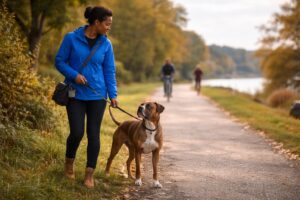
Too close too soon and your dog practices exploding. Every rehearsal makes the reaction faster next time. So the goal is not to avoid triggers forever. The goal is to build skill at a manageable distance, then gradually reduce the distance as your dog becomes steadier.
This is where Hamilton dog training gets real. You use driveways, hills, parked cars, benches, and smart U-turns to create space. That’s not “giving in.” That’s leadership. You’re protecting the training moment so your dog can learn.
Disengagement: The Skill That Makes Walks Feel Normal Again
One of the clearest signs neutrality is building is disengagement. Your dog sees something, then chooses to look away and come back to you or continue calmly. That choice is huge. It means your dog is learning, “I noticed, but I don’t need to lock on.”
Disengagement isn’t a panic command. It’s a habit built through reinforcement and repetition. You reward the dog for checking in. You reinforce the dog for choosing calm. You build a pattern where your dog learns that looking back to you is the profitable choice.
In dog training in Hamilton, disengagement is one of the most practical skills you can build because it helps with surprises. A dog that can disengage is a dog that can stay safe.
How To Train Dog Neutrality: A Simple System That Actually Works
Neutrality isn’t something your dog either “has” or “doesn’t have”. It’s a skill, and like any skill, it gets built through repetition in the right conditions. Most owners struggle because they try to train neutrality when the dog is already over the edge. In that moment your dog isn’t learning, they’re coping. The goal is to train in the zone where your dog can notice the world and still keep their brain online.
Start by choosing one daily walk that becomes your neutrality walk. Not your exercise walk, not your “let’s see what happens” walk, but your training walk where you’re willing to create space and slow things down. When your dog notices a trigger, you immediately focus on distance. If your dog can look at the trigger and still take food, still move with you, and still break eye contact even briefly, you are in the learning zone. If your dog locks on, stiffens, pulls hard, starts whining, or can’t take food, you are too close, and the smartest move is to increase distance until your dog can function again. This is not avoidance. This is you controlling the difficulty so your dog can succeed.
Once you’re at a workable distance, you begin reinforcing neutrality in tiny moments. The first win isn’t “ignoring the trigger forever”. The first win is any sign your dog can make a better choice. If they glance at the trigger and then look back at you, that is gold. If they soften their body, loosen the lead, or take a breath and keep walking, that is gold. You reward those moments like they matter because they do. Over time, your dog learns that calm behaviour around distractions is profitable and safe.
Next you build a consistent rule for access. If your dog is the type that melts down because they want to greet, the rule becomes simple. Calm is what unlocks life. Pulling and screaming do not unlock life. Your dog does not need to lose greetings forever, but they do need to learn that greetings are earned, not demanded. That one change in the reinforcement loop is often the difference between a dog that improves and a dog that stays stuck.
Then you gradually close the distance over days and weeks, not minutes. Neutrality grows when the dog stacks wins. Every time your dog rehearses a meltdown, the behaviour gets easier for them next time. Every time your dog rehearses calm choices, calm gets easier next time. The mistake most owners make is trying to prove progress by getting closer too soon. Real progress is when your dog stays calm at a distance that used to cause a reaction, and then you slowly make the environment harder only when the dog is ready.
Finally, you proof neutrality in real life, not just in one location. A dog can look neutral on one quiet street and still fall apart on a busy trail, and that doesn’t mean your dog failed. It means the skill needs generalising. You build neutrality in a handful of environments across Hamilton, and you keep the same rules everywhere. Distance when needed, reinforcement for calm choices, and calm-only access to anything exciting. That’s how neutrality becomes who your dog is, not just something they do occasionally.
Greetings: How “Friendly” Turns Into Rude (And How Neutrality Fixes It)
Most rude greetings are created by accident. Owners allow greetings while the dog is pulling, squealing, jumping, or spinning. The dog learns that chaos equals access. Then the owner wonders why the dog can’t greet calmly. The dog has never been taught that calm is the entry fee.
Neutrality changes the rules. Greetings become optional and structured. Your dog learns that they can say hello when invited and when calm, and they can also walk past without feeling like they’re missing out. That is real maturity.
This is huge for Hamilton dog training because public spaces are full of strangers who invite interaction. Without structure, your dog will build their own rules, and those rules usually involve pulling first and thinking later. 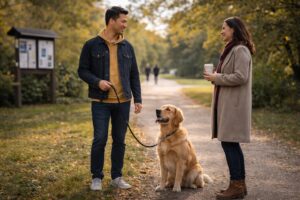
The Friendly-Frustrated Dog: The Most Common Public Meltdown
A large chunk of reactivity isn’t aggression. It’s frustration. The dog wants access, can’t get it, and explodes. Owners often feel confused because the dog looks “angry” but is actually desperate.
Neutrality solves this by removing the expectation that every dog equals interaction. Your dog practises being near dogs without greeting them. They learn to pass, breathe, and move on. Over time, other dogs stop feeling like magnets.
This is one of the biggest transformations we see through dog training in Hamilton with K9 Principles. Owners stop feeling like they’re managing chaos and start feeling like they’re building steadiness.
Neutrality Isn’t Just Walks: Doorbells, Cars, Kids, and Real Life
Neutrality shows up everywhere. If your dog loses it at the doorbell, in the car, at the window, around kids playing, or when you stop to talk to someone, it’s the same skill. It’s your dog’s ability to remain emotionally steady while life happens.
Dog training should not just create obedience. It should create coping. Neutrality is coping. It’s what turns a dog into a calm household member, not just a dog that can perform commands.
Structured Freedom: The Middle Ground That Makes Dogs Better, Not Bitter
Owners often swing between two extremes: too much restriction or too much freedom. Too much restriction creates frustration. Too much freedom creates chaos. Neutrality sits in the middle. Neutrality is structured freedom.
Structured freedom means your dog still gets to sniff, explore, and enjoy walks, but not by dragging you, screaming for access, or rehearsing explosive habits. Calm becomes the way your dog earns more of what they want.
This is where dog training in Hamilton stops being exhausting and starts feeling like a system that actually works.
How Neutrality Makes Off-Leash Control Real (Not Hopeful)
Off-leash freedom is not built on recall alone. If your dog is emotionally hijacked by the environment, your recall is competing with their nervous system. That’s not a fair contest.
Neutrality makes recall believable because it reduces the emotional spike and keeps your dog mentally available. It makes the environment less of a magnet. It makes your dog more capable of choosing you.
At K9 Principles, we treat neutrality as part of the off-leash foundation because Hamilton dog training has to hold up around real distractions, not perfect training scenarios. 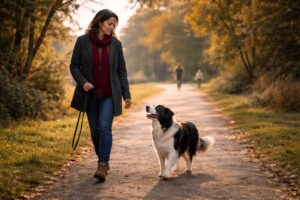
When You Should Get Help (Because Some Dogs Need A Real Plan)
If your dog’s reactions are intense, escalating, or unsafe, the answer is not to “push through.” You need a structured plan with proper set-ups and progression. Professional dog training exists for a reason. If you’re searching dog training in Hamilton because you feel stuck, overwhelmed, or embarrassed, it’s not because you’re failing. It’s because the problem needs a real strategy, not random exposure and hope.
Conclusion: Neutrality Is The Skill That Makes Everything Else Work
If you want calm walks, polite greetings, and genuine off-leash potential, neutrality is the foundation. It’s your dog’s ability to notice life and remain steady. It’s what turns training into real-world reliability. It’s what makes Hamilton walks feel normal instead of stressful.
Dog training in Hamilton should not leave you constantly bracing, apologising, avoiding, or bargaining with your dog. Hamilton dog training should give you freedom, confidence, and a dog that can handle the world without needing to control it. If your dog is brilliant at home but falls apart in public, that’s not stubbornness. That’s a neutrality gap. And neutrality is trainable. With the right progression, the right structure, and the right support, you can build a dog who can move through life calmly, safely, and reliably, and that’s exactly what we build at K9 Principles through dog training that actually holds up in the real world.
Contact us for more information:
- Name: K9 Principles
- Address: Haldimand County, Greater Hamilton Area, Burlington, and Most of Norfolk County
- Phone: 289 880-3382
- Email: k9principlesinc@gmail.com
- Website: www.k9principles.ca
FAQs
-
A1. The earlier the better, but any dog can learn neutrality. Puppies learn it faster because habits haven’t been rehearsed, but adult dogs absolutely improve with consistent dog training. We see major progress in dog training in Hamilton once calm becomes the dog’s default.
