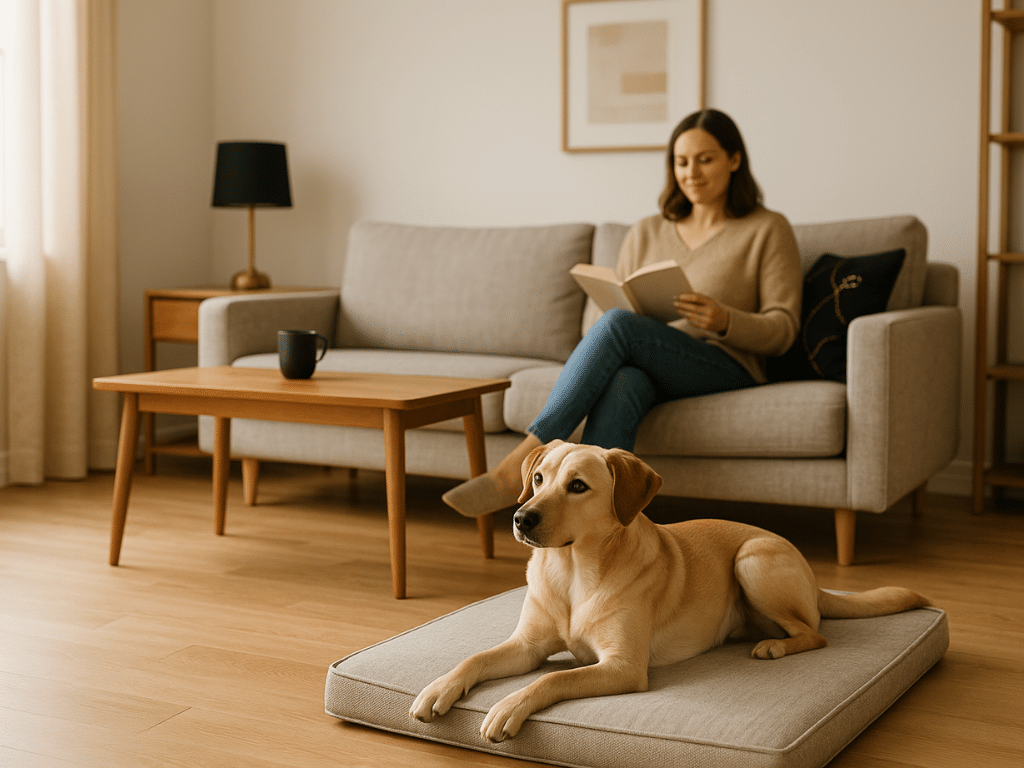



You bring a dog into your home because you want a happy, easy, relaxed life together. You picture peaceful walks, cosy evenings, a dog who listens, and a house that still looks like adults live there.
But here’s the part nobody tells you: most behaviour problems don’t start on the walk or in a training class. They start quietly inside the home, long before anyone realises something is going wrong. One of the most common and most preventable mistakes dog owners make is giving their dog too much freedom too early.
Freedom sounds kind. Freedom sounds fair. Freedom feels loving. Until it isn’t.
If you put structure and guidance in place when your dog is young, you will only need to maintain their behaviour later. If you hand over freedom before they are ready, you will spend years managing problems that could have been avoided.
Let’s unpack why early structure is the foundation of a calm, confident, well-behaved dog for life.
Why Early Structure Creates Calm, Confident, Well-Behaved Dogs
Puppies and adolescent dogs are not born knowing how to be “good”. They arrive with instincts, energy, curiosity, and a very limited understanding of how to live in a human world. They do not come pre-installed with impulse control, boundaries, emotional regulation, or safety awareness.
When a young dog is given full access to the house and yard with little guidance, they will absolutely practise behaviours you do not want. They explore with their mouth, they experiment with their paws, and they test what happens when they bark, jump, chase, grab, and ignore you.
They are not being “bad”. They are learning. The question is: what are they practising all day?
Because dogs don’t grow out of what they practise. They grow into it.
What Too Much Freedom Looks Like In Real Life
In real homes, “too much freedom too soon” often looks harmless at first. A puppy racing from room to room. A young dog staring out the front window. A dog following you from the kitchen to the sofa to the hallway, never quite switching off. 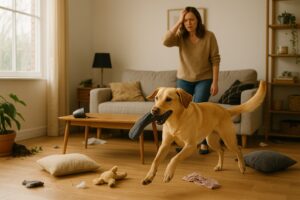
Over time, those little habits turn into bigger problems. A dog with too much freedom early on often spends the day:
- Barking at every person or dog that passes the window.
- Chewing furniture, rugs, skirting boards, or whatever they can sink their teeth into.
- Digging up the garden and turning your lawn into a crater field.
- Jumping on guests the second they walk in the door.
- Grabbing food off counters and tables the moment someone looks away.
- Practising reactivity by charging fences or doors whenever they hear a sound.
- Guarding spaces like sofas, beds, or doorways.
- Ignoring your voice because they have learned you are background noise.
- Running off with stolen items and turning recall into a chase game.
None of this appears overnight. It is built, repetition after repetition, in a life with too much freedom and not enough structure.
Why Freedom Must Be Earned, Not Given
For a dog, freedom is responsibility. When you allow a young or untrained dog to make all the decisions in the home and out on walks, you are effectively saying, “You’re in charge. You figure it out.”
Most dogs are not ready for that.
Without clear guidance, they feel confused. Confusion turns into anxiety. Anxiety turns into overexcitement, reactivity, and pushy behaviour. A dog that seems “stubborn” or “naughty” is often a dog who has been handed freedom without the skills to handle it.
Freedom must be earned the same way you would earn trust at a job. You don’t walk into a new role and immediately get the keys to the entire building, the company credit card, and the authority to make every decision. You start with training, supervision, and clear expectations. Only when you show you can handle those things do you get more responsibility.
Dogs are no different.
Structure While Young = Stability For Life
The most successful, stable, and confident dogs we see in our work at K9 Principles all have one thing in common: their freedom was earned slowly.
When your dog is young or lacking skills, structure becomes the foundation that teaches them how to live in your home and in the wider world. Early structure teaches your dog how to be calm when nothing exciting is happening instead of pacing or pestering you. It teaches them how to settle and rest, rather than always needing to be entertained. It shows them how to follow rules around food, furniture, doors, guests, and other dogs. It makes it clear how to behave in a human household, which is very different from a litter of puppies or a pack of dogs. It helps them learn how to handle stimulation and excitement without tipping over into chaos. It builds a habit of responding to your guidance instead of relying on their own impulses.
Once these skills are installed, maintaining them later becomes simple. Maintaining good habits is always easier than trying to fix deeply rehearsed bad ones.
What Happens When Freedom Comes Too Soon
When dogs are given freedom without guidance, they are left to guess. They make up their own rules. Sometimes those rules work for you, but often they don’t.
Dogs who had too much freedom too early often grow into adults who do not listen unless there is something in it for them, struggle to settle and are always “on”, pace and follow you from room to room, react to every noise, movement, or visitor, push boundaries to see what they can get away with, appear “naughty” or “spiteful” but are actually overwhelmed and confused, and feel responsible for controlling the environment, which is an exhausting job for a dog.
Freedom without leadership turns dogs into their own decision-makers. That may sound empowering, but in reality it is unfair. Most dogs are not emotionally equipped to run the household. They need you to be the calm, consistent leader so they can relax into being a dog.
Management Tools Are Not “Mean” – They Are Essential
Many dog owners in Hamilton and the surrounding areas come to K9 Principles feeling guilty about using crates, baby gates, or leashes in the house. They have been told that “a dog should be free” or that management is somehow unkind.
The truth is the exact opposite.
Management tools prevent your dog from rehearsing unwanted behaviour and give them the structure they desperately need. Used properly, they create calm, safety, and clarity. There is nothing cruel about that.
Let’s look at some of the most important tools and how they help.
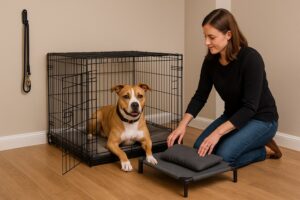
Crates: A Safe Den, Not a Dog Jail
A well-introduced crate is one of the most powerful tools you can use for dog training in Hamilton or anywhere else. It supports calmness, safety, impulse control, and protects both your dog and your home.
Crate training teaches dogs how to self-regulate. Instead of constantly seeking stimulation, they learn how to settle, rest, and switch off. Instead of rehearsing destructive behaviour while you are in the shower, on a work call, or out running errands, they are safe and relaxed in a controlled space.
Dogs who are comfortable in their crate cope better with travel, vet stays, grooming appointments, and changes in routine. Far from being a punishment, a crate becomes a familiar, secure den they can retreat to when life feels loud or overwhelming.
X-Pens and Baby Gates: Creating Controlled Freedom
Exercise pens and baby gates are ideal for limiting roaming and creating layers of freedom. Instead of giving a young dog the whole house and hoping for the best, you start with one safe area where you can supervise and reinforce good choices.
This is how you teach your dog to make good decisions in small spaces before expecting them to behave in big ones. A dog who cannot stay calm in the kitchen will not magically become calm in the whole house. By controlling how much space they have, you make it easier for them to succeed.
Leashes On In The House: Instant Clarity
A drag line or leash inside the home is a game-changer for puppies, adolescents, and dogs with impulse issues. It gives you an immediate, gentle way to guide them without grabbing at collars or repeating yourself.
With a leash on, you can prevent door rushing by calmly guiding your dog back and asking for a sit before you open the door. You can interrupt jumping on guests by stepping on the leash and redirecting them to a calm behaviour. You can stop pacing and constant wandering by guiding them back to their bed or crate to rest. You can intervene quickly if they head for the garbage bin, counters, or that one chair they love to chew.
Rather than shouting, chasing, or arguing, you simply and quietly show them what you want.
Tethers: Teaching True Relaxation
Tethers – a leash attached to a secure point in the room – can be incredibly helpful for dogs who struggle to switch off or who shadow you from room to room.
By calmly tethering your dog near you with a comfortable bed, you give them the chance to learn how to settle in your presence without constantly having to follow you. This reduces anxiety-driven following and teaches them that it is safe to relax even when life is happening around them.
Used correctly, tethers are not about restraining a panicking dog. They are about preventing rehearsals of frantic behaviour and creating opportunities for calm.
Place Bed or Mat Training: Calm on Cue
Teaching a “place” command – where your dog goes to a specific bed or mat and stays there until released – is one of the most valuable skills you can teach.
Place work builds impulse control and helps your dog learn how to be calm around guests, food, children, and general household activity. Instead of hovering under the table, begging at the counter, or charging the door, your dog learns to relax on their mat and watch the world go by.
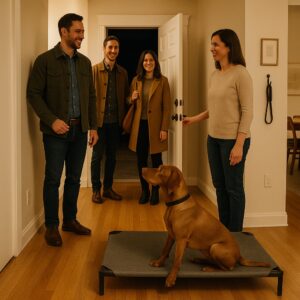
For owners looking for Hamilton dog training that fits real family life, place training is often the moment where things start to feel manageable again. Mealtimes become easier. Visitors become less stressful. Evenings become calmer.
Structured Confinement Rotations: The Rhythm Of A Balanced Day
One of the most effective ways to prevent overstimulation is to rotate your dog through different structured activities and rest periods throughout the day.
A simple rotation might look like this:
- Time in the crate for deep rest and decompression.
- Time on place for calm engagement while life happens around them.
- Short periods of supervised freedom where they can move, explore, and practise making good choices.
- Then back to the crate before they become tired and silly, instead of waiting until they tip over into chaos.
This rhythm prevents your dog from spending all day in a state of constant arousal. It teaches them that life is a balance of activity and rest, not one long, unstructured sprint.
How To Know When Your Dog Is Ready For More Freedom
Freedom is not given all at once. It is earned layer by layer as your dog proves they can handle more responsibility.
Your dog is ready for more freedom when they can stay calm indoors instead of pacing, whining, or constantly seeking attention, hold a place cue for a meaningful amount of time, settle without needing you to entertain them, ignore common distractions such as household noises, people walking past the window, or family members moving around, walk politely on-leash without dragging you to every smell or sound, come when called even when something interesting is happening, respect boundaries around doors, furniture, food, and guests, and consistently make good choices in one room before you expect the same behaviour throughout the house.
If your dog cannot do these things in a small, controlled space, they will not magically do them in the whole house or out in the real world. Earning freedom is not about age. It is about skill and reliability.
The Goal: A Dog You Truly Enjoy
Most people do not dream about spending years managing barking, reactivity, destruction, or constant chaos. They dream about enjoying their dog.
Freedom is not a right. For a dog, freedom is a skill. And like any skill, it must be taught.
Give too much freedom too soon and you will spend a long time trying to fix problems that were completely preventable. Put structure and management in place early and you will enjoy a calm, confident, well-behaved dog for life.
Manage and teach now. Then relax and enjoy later. Your future self – and your dog – will thank you.
Conclusion: How K9 Principles Can Help You Get There Faster
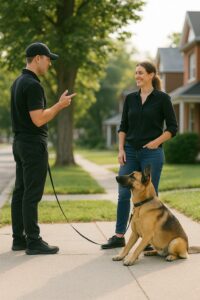
If you are in Hamilton or the surrounding areas and you are realising your dog may have had a bit too much freedom too soon, you are not alone. At K9 Principles, we work with owners every day who feel overwhelmed, guilty, or frustrated, and together we rebuild the structure their dog has been missing.
Through our In-home Private Training and our carefully designed programs, we teach you exactly how to use crates, gates, leashes, place training, and structured freedom so your dog can finally relax, and you can stop firefighting behaviour. This is not about harsh methods or “breaking” your dog. It is about giving them the leadership and clarity they have been craving from you.
If you want real dog training in Hamilton that focuses on calm, confidence, and long-term results, reach out to K9 Principles. Let’s build the structure now so you can enjoy the freedom later.
Contact us for more information:
- Name: K9 Principles
- Address: Haldimand County, Greater Hamilton Area, Burlington, and Most of Norfolk County
- Phone: 289 880-3382
- Email: k9principlesinc@gmail.com
- Website: www.k9principles.ca
FAQs
-
A1. No. When crates and gates are introduced properly, they actually improve your relationship. Instead of constantly telling your dog off, you give them clear boundaries and a safe place to relax. Dogs feel more secure when they understand the rules and have somewhere cosy to switch off. Most of the problems that damage the bond – frustration, shouting, chasing them around the house – come from too much freedom, not from structure.